
Why Surface Prep Determines Whether Your Coating Holds or Fails
A coating bonds to what it touches. On CNC machined parts, that surface carries residue from every operation it passed through—cutting fluids, metal fines, oxide layers, the oils from whoever handled it last. Each contaminant sits between the coating and the substrate, weakening the bond at that point. When enough weak points accumulate, the coating lifts, blisters, or chips under service conditions that a clean surface would have handled without issue.
The relationship between surface cleanliness and coating performance is not proportional—it is binary at the microscopic level. A surface either meets the energy threshold required for molecular bonding, or it does not. Partial cleaning produces partial bonds, and partial bonds fail under stress. The financial consequences show up as rework cycles, warranty returns, and production delays that cost more than the cleaning process ever would have.
| Contaminant Type | Impact on Coatings | Removal Difficulty |
|---|---|---|
| Oils/Greases | Poor adhesion, blistering | Medium |
| Metal Fines | Pinholes, weak spots | Medium |
| Oxides | Reduced adhesion, corrosion | High |
| Fingerprints | Localized defects, poor wetting | Low |
| Coolants | Residue formation, adhesion loss | Medium |
What Contaminants Actually Accumulate on Machined Parts
CNC parts collect contamination in layers. The deepest layer comes from machining fluids—cutting oils and coolants that penetrate surface porosity and remain even after parts appear dry. Above that sits particulate matter: metal chips, grinding dust, and burrs that create physical barriers to coating contact. Oxide films form within hours of machining on reactive metals, creating a chemically inert layer that resists bonding. Human handling adds fingerprint oils and salts in patterns that match exactly where coating defects later appear.
Each contaminant type requires a different removal mechanism. Oils dissolve in appropriate solvents or emulsify in aqueous solutions. Particulates dislodge through mechanical action—ultrasonic cavitation, spray impingement, or agitation. Oxides need chemical attack or mechanical abrasion. A cleaning process that addresses only one category leaves the others intact.
The sequence matters as much as the method. Removing particulates before degreasing can drive metal fines deeper into oil films. Rinsing before complete contaminant dissolution spreads residue rather than eliminating it. Drying parts that still carry dissolved contaminants deposits those contaminants back onto the surface as the carrier evaporates.
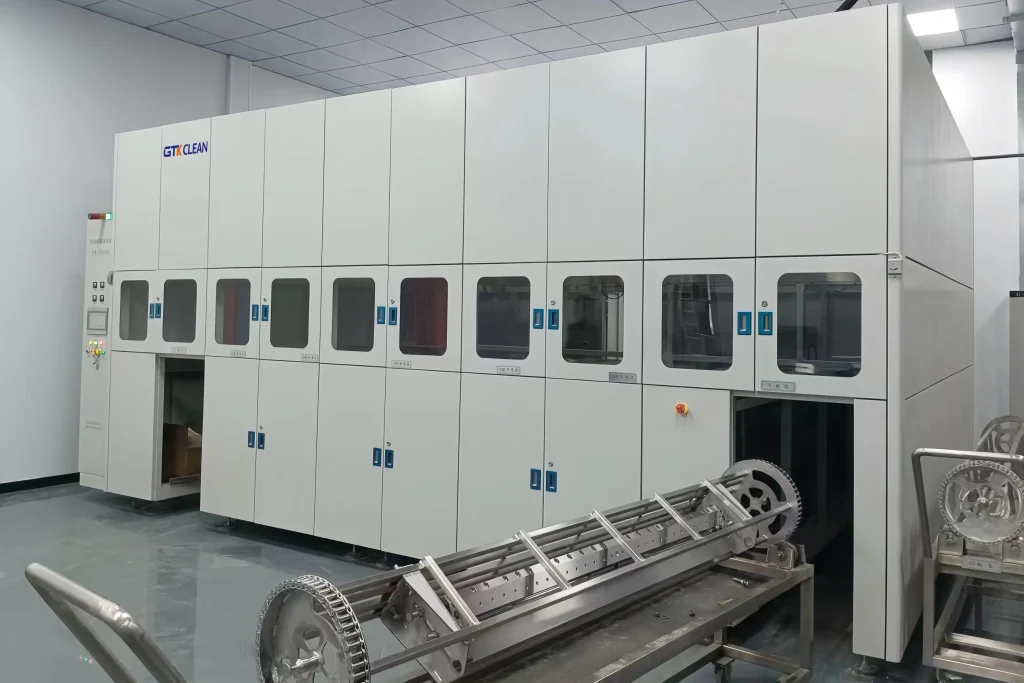
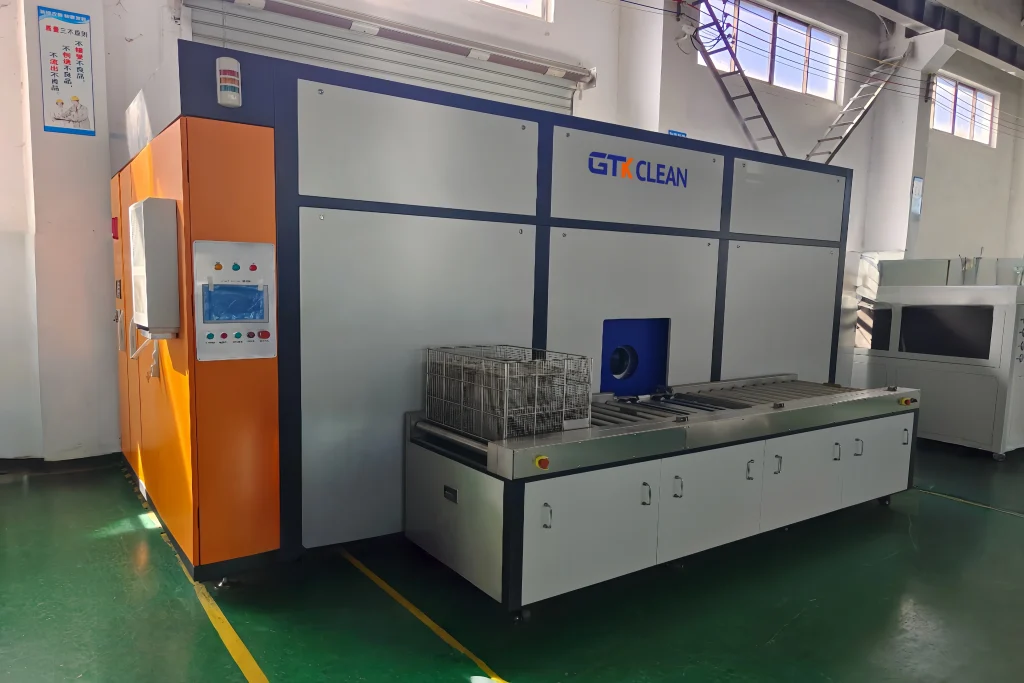
Effective cleaning follows a consistent order: bulk degreasing first to remove the heaviest oil loads, then precision cleaning to address what remains in surface features, followed by rinsing that actually displaces rather than dilutes, and finally drying methods that prevent recontamination or oxidation before coating.
Which Cleaning Technology Matches Your Part Geometry
The geometry of a CNC part determines which cleaning technology can actually reach its surfaces. A flat plate with open features cleans effectively under spray impingement. A housing with blind holes, internal passages, or undercuts defeats spray cleaning entirely—the fluid never contacts the contaminated surfaces.
Ultrasonic cleaning addresses complex geometries through cavitation. High-frequency transducers generate pressure waves in the cleaning fluid, creating microscopic vacuum bubbles that collapse with enough force to dislodge contaminants from surfaces the fluid contacts. The fluid penetrates wherever it can flow, carrying the cavitation effect with it. Blind holes, threaded features, and internal channels clean effectively if the fluid can enter them.
Solvent-based systems, particularly vapor degreasing, offer different advantages. Low surface tension allows solvents to wet surfaces that aqueous solutions bead up on. Vapor condensation provides continuous fresh solvent contact without redepositing dissolved contaminants. Parts emerge dry and residue-free without a separate drying step.
| Technology Type | Pros | Cons | Ideal Application |
|---|---|---|---|
| Ultrasonic Cleaning | Deep penetration, effective for complex geometries | Can damage delicate parts if not controlled | Precision parts, blind holes, intricate structures |
| Solvent Cleaning | Excellent degreasing, fast drying | Environmental concerns, flammability | Parts requiring high cleanliness, oil removal |
| Aqueous Cleaning | Environmentally friendly, versatile | Longer drying times, potential for flash rust | General industrial parts, various contaminants |
| Vapor Degreasing | Residue-free drying, good for complex shapes | Requires specific solvents, ventilation | High-precision components, electronics |
Aqueous systems handle the broadest range of contaminants when properly formulated. Heated solutions with appropriate surfactants emulsify oils, suspend particulates, and—with the right chemistry—attack oxide films. The tradeoff is drying time and the risk of flash rust on ferrous parts if moisture remains in features.
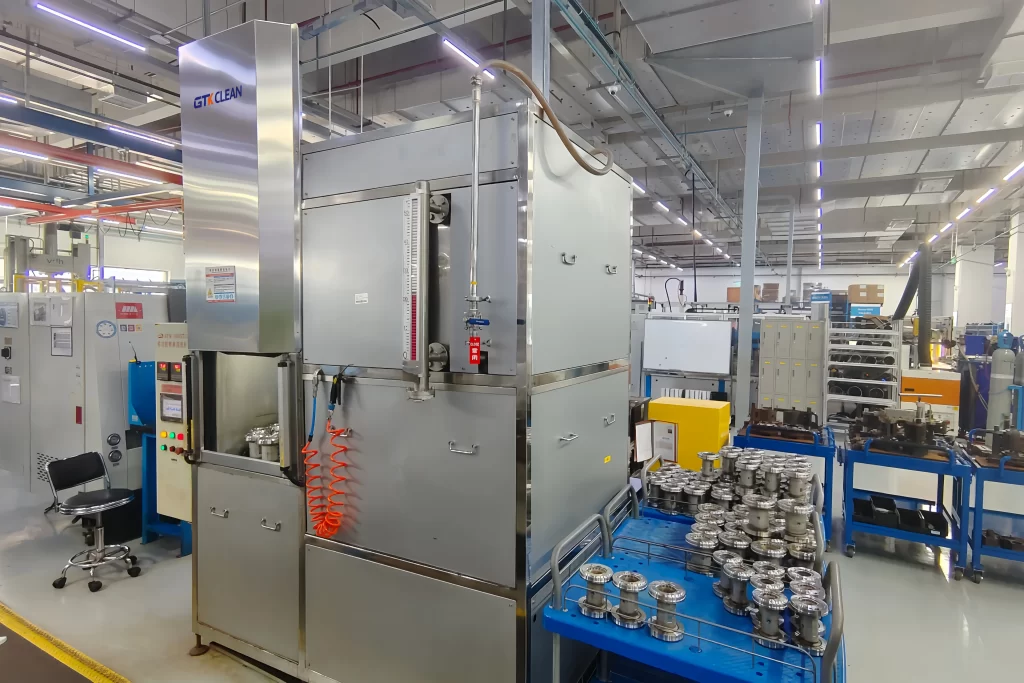
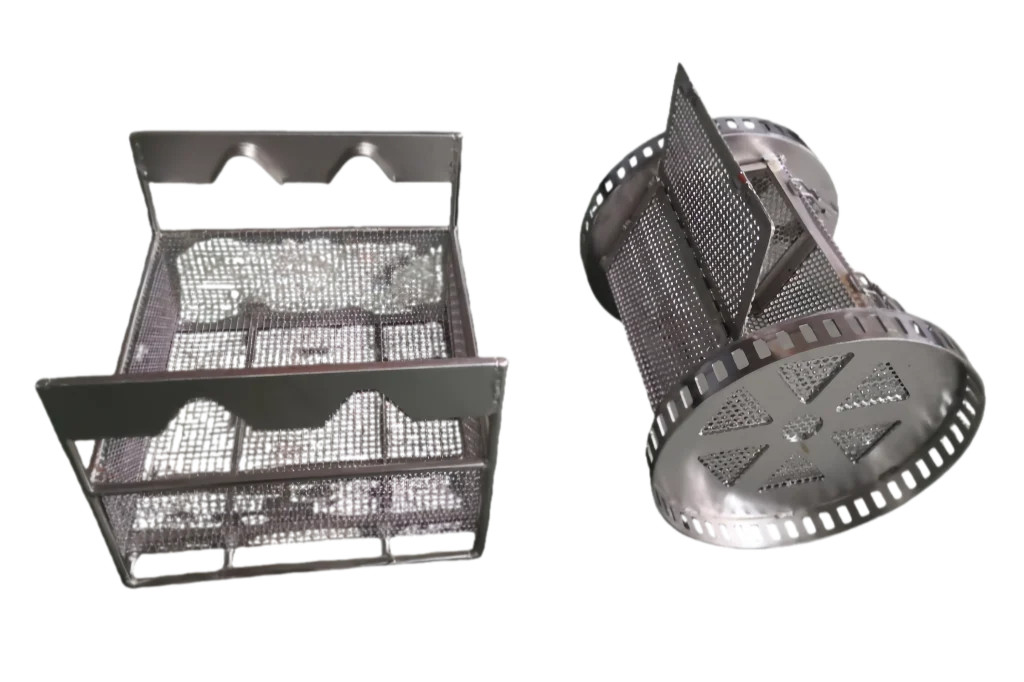
For parts with both complex geometry and tight cleanliness requirements, rotary basket ultrasonic systems provide 360-degree exposure during the cleaning cycle. The rotation ensures all surfaces face the transducers at some point, and the basket prevents parts from shadowing each other.
How to Verify Your Parts Are Actually Clean
A surface that looks clean may not be clean enough for coating. Visual inspection catches gross contamination but misses the residue films that cause adhesion failures. Verification requires measurement.
Surface energy testing provides the most direct indicator of coating readiness. Dyne pen tests apply fluids of known surface tension to the part surface. If the fluid wets and spreads, the surface energy exceeds that value. If it beads up, the surface energy falls below it. Most coatings require surface energies above 38-40 dynes/cm for adequate wetting; many specifications call for higher values.
Water break testing offers a quick pass/fail check for hydrophobic contamination. A clean surface holds a continuous water film; oil residue causes the film to break into droplets. The test detects contamination but does not quantify cleanliness levels.
For critical applications, gravimetric analysis measures actual contaminant mass. Parts are weighed, cleaned with a solvent that dissolves the target contaminants, and the solvent is evaporated to recover the residue. The residue mass indicates contamination level. This method is too slow for production use but validates cleaning processes during development.
Particle counting addresses particulate contamination specifically. Parts are rinsed with filtered solvent, and the rinse fluid passes through a particle counter. Results report particle counts by size range, allowing comparison against cleanliness specifications like ISO 16232 for automotive components.
Process validation ties these measurements to cleaning parameters. Once a process consistently produces parts that pass verification, the parameters become the specification. Monitoring those parameters during production provides confidence without testing every part.
If your coating application requires cleanliness verification beyond what standard testing provides, discussing specific measurement methods with your cleaning equipment supplier can identify solutions matched to your specification requirements.
Where Cleaning Process Efficiency Creates Real Cost Savings
Cleaning costs extend beyond the obvious expenses of equipment, chemicals, and labor. Cycle time affects throughput. Chemical consumption and disposal create ongoing operating costs. Energy use for heating and drying adds up across production volumes. Water consumption matters where supply is limited or discharge is regulated.
Automated multi-tank systems reduce cycle time by processing cleaning, rinsing, and drying stages in parallel. While one batch cleans, another rinses, and a third dries. Single-tank systems process these stages sequentially, extending total cycle time.
Filtration and fluid management extend chemical life significantly. Removing particulates and separated oils from cleaning solutions maintains their effectiveness longer. Continuous filtration during operation prevents redeposition of removed contaminants. Periodic oil separation recovers the cleaning chemistry while disposing only of the removed contamination.
Closed-loop solvent systems recover and recycle cleaning solvents rather than consuming them. Vapor degreasing inherently recycles solvent—the condensed vapor returns to the sump, and only the small amount lost to dragout requires replacement. This reduces both chemical cost and disposal burden.
Drying method selection affects both energy consumption and part quality. Vacuum drying removes moisture at lower temperatures, reducing energy use and preventing heat-related oxidation. Hot air drying is faster but consumes more energy and may not reach moisture trapped in features.
Frequently Asked Questions About CNC Part Cleaning for Coatings
How do different cleaning solutions impact coating adhesion and longevity?
Water-based solutions effectively remove polar contaminants—salts, water-soluble coolants, and some surfactant-based cutting fluids. They require thorough rinsing to remove detergent residues and complete drying to prevent flash rust on steel parts. Solvent-based solutions dissolve non-polar oils and greases more effectively, and many evaporate without residue, eliminating the rinsing and drying concerns. The wrong solution for the contamination type leaves residue that the coating bonds to instead of the substrate. That bond fails when the residue eventually migrates or degrades.
What are the common pitfalls in CNC part cleaning that lead to coating failure?
The most frequent cause is incomplete removal of machining fluids from features where they pool—blind holes, internal corners, and the roots of threads. These areas retain contamination through cleaning processes that effectively clean exposed surfaces. Inadequate rinsing ranks second; cleaning chemicals left on parts interfere with coating adhesion as much as the original contamination did. Handling cleaned parts without gloves reintroduces fingerprint oils exactly where they cause visible defects. Storing cleaned parts in contaminated environments or for extended periods allows recontamination and oxidation before coating.
Can automated cleaning systems guarantee optimal surface cleanliness for all coating types?
Automated systems provide consistency that manual cleaning cannot match—the same parameters, the same sequence, the same timing on every cycle. Whether that consistency produces adequate cleanliness depends on whether the process was developed correctly for the specific parts, contaminants, and coating requirements. A system configured for one application may not suit another. Process development, validation testing, and ongoing monitoring determine whether the automation delivers the required results. To discuss whether your current process parameters match your coating specifications, contact Suzhou Grintek Environmental Technology Co.,Ltd. at +86 17768507147 or [email protected].
If you're interested, you may want to read the following articles:
Die-Cast Cleaning Solutions for Industrial Parts - GTK
Ultrasonic Cleaning Energy Costs Minimizing Strategies
What Is Ultrasonic Cavitation Effect?
Choosing the Right Ultrasonic Cleaning System for Your Factory
What Is Ultrasonic Wave?
 English
  German
  Spanish
  French
  Russian
  Portuguese