

Ultrasonic cleaning systems for CNC machined parts deliver reliable chip and coolant removal only when designed around part geometry and production volume, because standard configurations often fail on deep holes, blind holes, and fine threads. The right system eliminates manual rework and ensures every component meets cleanliness specifications without downstream contamination. I have spent two decades designing and commissioning these systems for manufacturers across more than twenty countries, and the single most common mistake I see is treating cleaning as an afterthought rather than an engineered step in the production process. This article outlines what to look for in a system, what trade-offs matter, and how to avoid the standard-equipment trap that leads to persistent residue issues.
Why Do Standard Ultrasonic Cleaning Systems Fail on CNC Machined Parts
A generic immersion tank with a blanket power rating cleans flat surfaces adequately but leaves coolant, chips, and metal fines trapped in internal features. In one program we supported, a precision hydraulics manufacturer found that off-the-shelf ultrasonic equipment left detectable residue inside 0.8 mm cross-drilled passages nearly half the time, even after extended cycles. The problem was not the ultrasonic power itself but the static orientation of the parts. Cavitation does not reliably propagate into recesses unless the cleaning basket rotates or the parts are fixtured to present blind holes to the transducer field.
CNC parts introduce three specific challenges that generic systems are not designed to solve. The first is geometry complexity: cross-drilled holes, threads, and internal cavities trap air, preventing cavitation from reaching the surface. The second is contaminant mix: parts carry cutting fluids, chips, and light oils that each require different cleaning chemistry and mechanical action to remove. The third is batch variability: a pallet of machined parts may include different geometries, making uniform exposure difficult in a static tank. Without addressing these factors, any system will produce inconsistent results no matter how many kilowatts of ultrasonic power it advertises.
How Should You Evaluate System Configuration for CNC Part Contaminant Removal
The configuration that works is one where the cleaning stages map directly to the contaminants on the part. For CNC machined components, I consider a minimum three-stage sequence essential: ultrasonic degreasing, rinse, and drying. For parts destined for coating or assembly, we often add a second rinse stage and, where surface oxides are a concern, a passivation step.
A fully automatic system with a rotary basket changes the cleaning outcome significantly. The 360-degree rotation during ultrasonic immersion continuously reorients the part, exposing every blind hole and recess. We use this configuration in the GTKCLEAN Ultrasonic Cleaners for CNC Machined Parts line, pairing rotation with high-pressure spray as a pre-step to knock off loose chips before the ultrasonic stage. The spray removes the bulk of chips and coolant, allowing the ultrasonic cavitation in the degreasing tank to focus on microscopic films and embedded particles rather than getting saturated with swarf.
Drying choice comes down to part complexity. Hot air drying works for simple geometries, but parts with deep holes retain moisture that causes water spots or flash rust. I have seen machined steel housings emerge dry on the outside but bleed water from internal passages hours later, contaminating assembly stations. For those components, vacuum drying pulls residual moisture out of cavities and leaves the part production-ready in a predictable cycle time.
What Components Affect Ultrasonic Cleaning Performance on Machined Parts
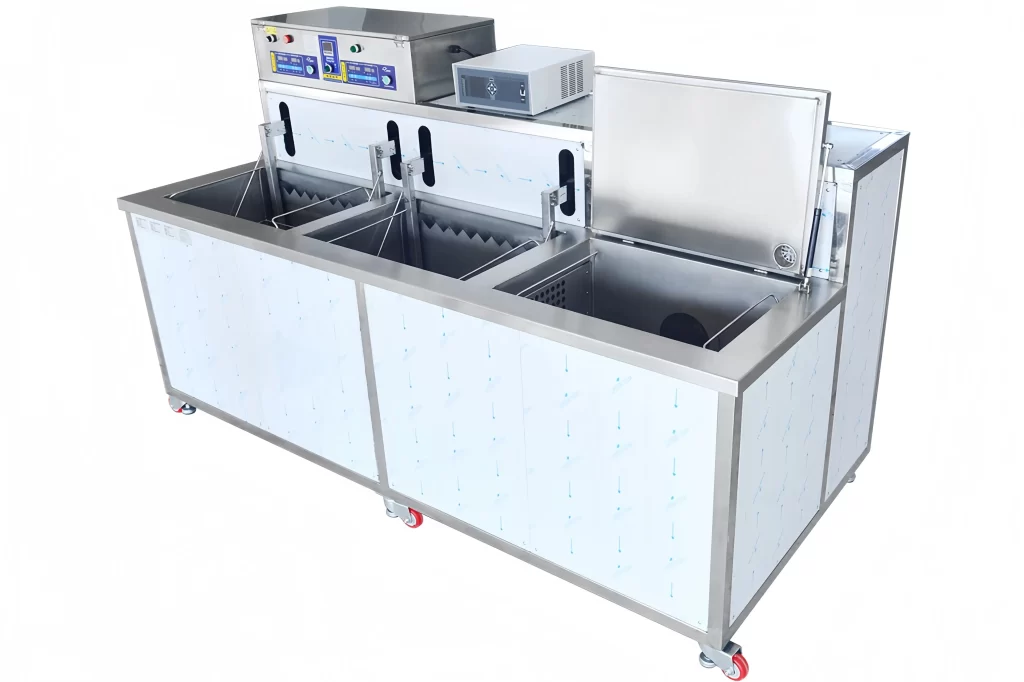
Three components determine whether an ultrasonic system cleans consistently or produces unpredictable results: the transducer arrangement, the filtration circuit, and the basket design.
Transducers mounted on the tank base do the heavy lifting, but the frequency selection determines what kind of contaminant gets removed. Lower frequencies around 20 kHz produce aggressive cavitation bubbles that dislodge chips and heavy oils effectively. Higher frequencies above 40 kHz create smaller, gentler bubbles that clean fine threads and polished surfaces without pitting. For CNC parts with both tapped holes and lapped sealing surfaces, a system that supports dual-frequency operation or switchable frequencies lets you dial in the right energy level. Running the entire batch at one frequency is a compromise that either under-cleans the coarse features or over-cleans the delicate ones.
Filtration is the difference between a system that recirculates clean solution for months and one that needs fluid changes every week. A multi-stage filtration loop with magnetic separation, bag filters, and a coalescer removes chips, fines, and tramp oil continuously. Without it, abrasive particles suspended in the cleaning bath act like a lapping slurry, slowly eroding precision surfaces with every cycle.
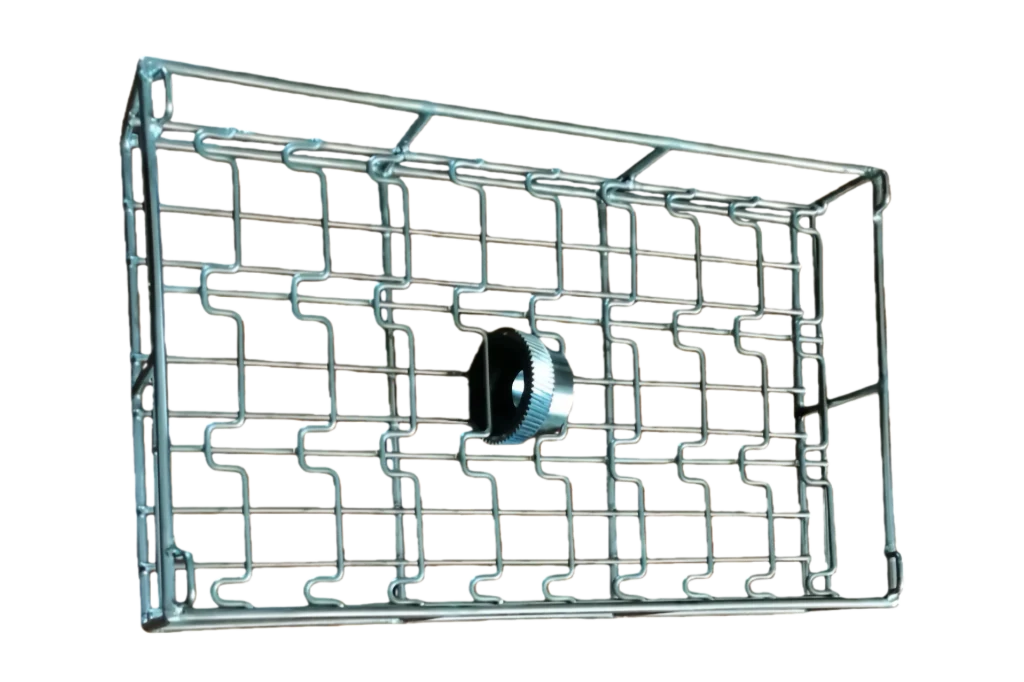
Basket design is where many buyers overlook the costliest mistake. A basket that holds parts securely but obstructs cavitation negates the entire ultrasonic process. For parts with blind holes, the basket must fixture the part so that the opening faces the transducer or is freely flooded without air pockets. In our heavy-component programs, we design baskets that manage the load without scratching, while allowing drain paths so that rinse water and drying air reach every cavity. An incorrect basket adds hours of manual blow-off time downstream and reintroduces contamination during transfer.
| System Feature | Standard Equipment Limitation | Recommended Capability for CNC Parts |
|---|---|---|
| Basket movement | Static immersion | Rotary or indexing motion for 360° exposure |
| Transducer frequency | Single 28 kHz or 40 kHz fixed | Dual or switchable 20/40 kHz to match contaminant type |
| Filtration | Single pass bag filter | Multi-stage: magnetic, bag, coalescer with continuous recirculation |
| Drying | Hot air only | Hot air plus vacuum for blind-hole parts |
| Automation level | Manual load/unload | Full auto with programmable cycle selection per part number |
How to Integrate Ultrasonic Cleaning into CNC Production Workflows
Integrating cleaning directly into a production line rather than running it as a batch operation offline reduces part handling, eliminates work-in-progress accumulation, and catches contamination issues before parts move to assembly or coating. The right level of automation depends on daily throughput and part mix.
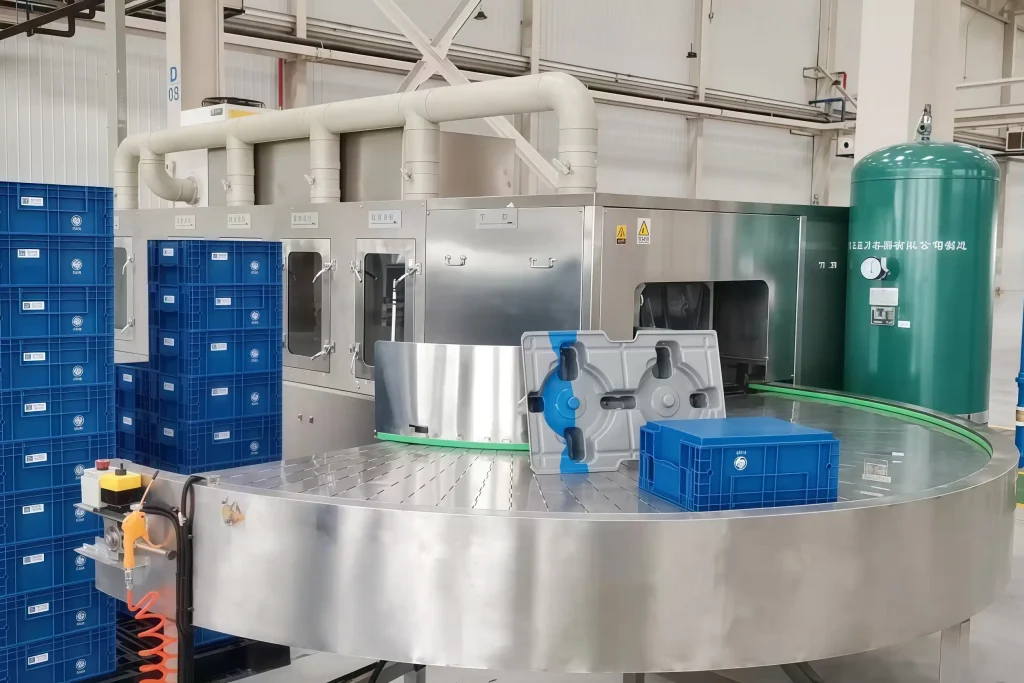
For high-volume production of a single part family, an inline conveyor system with automated loading from the machining center feed-out can achieve continuous flow. The parts pass through spray, ultrasonic, rinse, and drying stations sequentially without operator intervention. I recommend this configuration when daily throughput exceeds several hundred parts and the part family shares a narrow dimensional range, so one set of fixtures works for the entire run.
For medium-volume shops running diverse part numbers, a semi-automated multi-tank system with manual basket transfer offers flexibility without requiring a full conveyor integration. Operators load baskets, and the system sequences the cleaning stages based on the program selected on the PLC. This layout works well when parts change frequently and each job requires different cycle parameters. The capital cost is a fraction of a fully inline system, and throughput can still reach several baskets per hour with the right staging.
Where contamination carries a direct cost, I have seen this integration logic pay back the equipment investment in under a year. In one application preparing CNC parts for PVD coating, the automated line eliminated the rework rate that had been running at nearly eight percent, almost entirely due to residual finger-handling contamination and inconsistent manual wiping.
How to Specify a Custom Ultrasonic Cleaning System for Your CNC Parts
A custom system specification should start with the most difficult part in your portfolio, not the easiest. If the system cleans the worst-case geometry reliably, it will handle the rest. Provide the equipment supplier with three things: part drawings showing internal features and dimensional tolerances, the specific contaminant list with the state they are in when they arrive at the cleaning station, and the cleanliness specification the part must meet after processing.
From my experience working with procurement teams, the specification that most directly affects long-term cost is the drying requirement. If you under-specify drying, you push the problem to downstream operations where operators blow off parts with compressed air, adding variable labor and contamination risk. If you over-specify it, you pay for capacity you do not need. For parts with blind holes narrower than about 3 mm, vacuum drying becomes the practical choice because air knives cannot push water out of capillaries.
The second spec that matters is the cleaning solution management system. An integrated water treatment or solvent recovery setup reduces fluid consumption and waste disposal cost and stabilizes bath chemistry across shifts. I have seen shops that skip this to save upfront cost end up spending more on detergent and labor for fluid changes within the first eighteen months than the treatment system would have cost. If your production runs multiple shifts, the economics strongly favor including it from the start.
Achieving Consistent Cleanliness with Engineered Ultrasonic Systems for CNC Machined Parts
I have walked into too many factories where the cleaning station is the bottleneck because the system was chosen from a catalog instead of engineered to the parts. When the system matches the part geometry, contaminant type, and production flow, it stops being a bottleneck and becomes an invisible step that just works. Sending a part number, a contaminant list, and your expected daily throughput to an applications engineer is the fastest way to narrow the options to a configuration that will actually perform. If your parts include deep holes, cross-drilled passages, or fine threads, specify that upfront because it changes the basket, the dryer, and the transducer layout. Reach out to our team at [email protected] or +86 17768507147 with your part drawings and production targets, and we will recommend a system configuration matched to your specific cleaning requirements.
Common Questions About Ultrasonic Cleaning for CNC Machined Components
What is the most common cause of residual contamination after ultrasonic cleaning?
The most common cause is not insufficient ultrasonic power but trapped air in blind holes and internal passages. When a part is immersed statically, air pockets prevent cavitation bubbles from forming on the contaminated surface. Rotating the part during the ultrasonic cycle or fixturing it to present the opening toward the transducer eliminates this problem. I check for this failure mode first when troubleshooting because increasing power or cycle time without addressing air pockets only wastes energy.
How do I choose between aqueous and solvent cleaning for CNC machined parts?
It depends on the contaminant and the part material. Aqueous systems using water-based detergents work well for removing water-soluble coolants and general machining oils, and they avoid VOC emissions. Solvent systems like hydrocarbon or modified alcohol units clean heavier greases and wax-based compounds faster and dry more easily because the solvent evaporates completely. For parts with deep, narrow features, solvent-based vacuum ultrasonic systems deliver more consistent dryness because the solvent exits the cavity without leaving residue. I lean toward aqueous for high-volume production where the contaminant is primarily water-mix coolant, and toward solvent for complex parts with heavy oil or pre-coating requirements.
Can ultrasonic cleaning damage the surface finish of precision machined parts?
Yes, if the frequency is too low for the material or the cycle time is too long. Lower ultrasonic frequencies generate more aggressive cavitation that can pit softer metals or erode sharp edges. I have seen aluminium parts lose thread sharpness after extended cycles at 20 kHz. This is preventable by selecting a higher frequency, limiting exposure time, and using a cleaning basket that keeps parts from vibrating against each other. Modern systems with programmable cycle parameters let you limit the energy dose precisely.
How much does an automated ultrasonic cleaning system for CNC parts cost?
The system cost scales with the number of stages, the basket capacity, and the level of automation. A basic manual multi-tank setup is significantly less than a fully automatic inline conveyor system. The more important figure is the total cost of ownership, which includes fluid consumption, labor, rework rates, and maintenance. I have seen applications where a higher upfront investment in automation paid back through labor reduction alone in under twelve months. To get a meaningful price range, you need to share part dimensions, throughput, and cleanliness requirements with the equipment supplier.
What cleaning standard should I specify for machined parts before coating or assembly?
The cleanliness specification should match the downstream process requirement, not a generic number. For parts going to PVD or DLC coating, you typically need no visible residue, no fingerprints, and ionic contamination below a defined threshold. For assembly operations that use adhesives or press fits, the spec may focus on particulate size and count. Ask your coating or assembly supplier what contamination is unacceptable, then specify the cleaning process to meet that criteria. I have seen manufacturers over-clean parts to an aerospace standard that added cost without adding value when the real requirement was far simpler. If you share your coating specifications with us, we can recommend a cleaning configuration that hits the right cleanliness level without over-engineering.
If you're interested, check out these related articles:
How to Choose Multi-Tank Ultrasonic Systems for High Volume
Industrial Ultrasonic Cleaners Versus Traditional Cleaning Methods
 English
  German
  Spanish
  French
  Russian
  Portuguese