

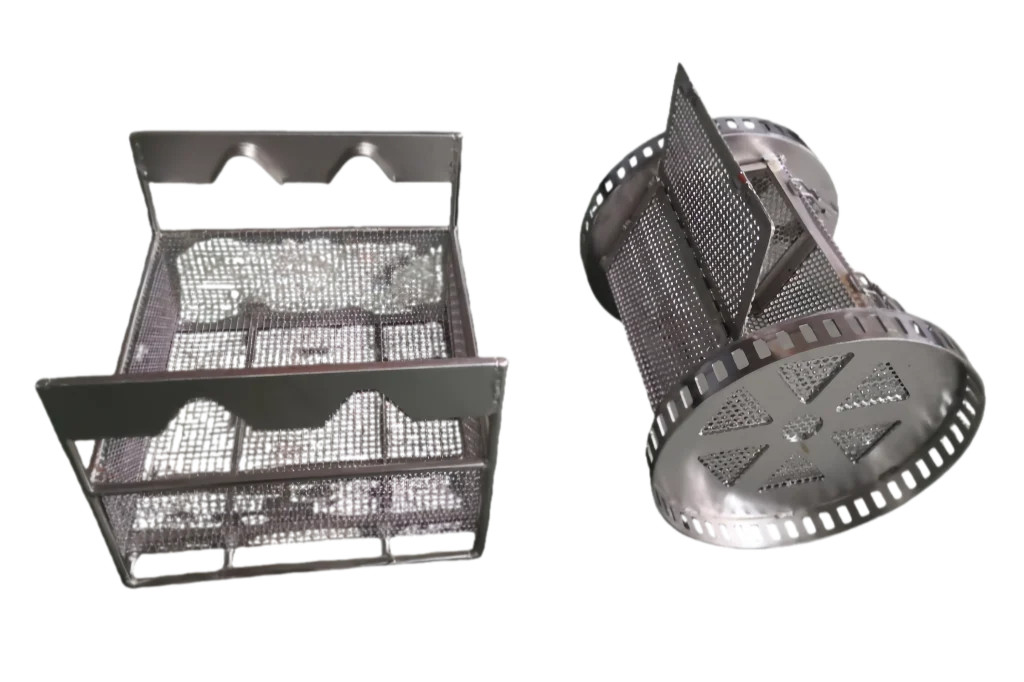
Preparing optical lenses for coating requires removing all surface contaminants to single-digit micrometer levels because even microscopic residues cause coating defects and adhesion failures. Whether for anti-reflective, mirror, or filter coatings on glass, plastic, or crystal substrates, the cleaning process directly determines yield and optical performance. In two decades of designing industrial cleaning systems, I have seen how inadequate pre-coating preparation leads to peeling, haze, and expensive rework. This article explains the contamination risks, multi-stage ultrasonic cleaning, ultrapure water requirements, and drying methods that coating facilities rely on to achieve zero-defect production.
Common Contaminants on Optical Lens Surfaces
Optical lenses accumulate organic films, particulate residues, and environmental debris during manufacturing, handling, and storage. These contaminants interfere with coating adhesion and introduce optical defects that degrade transmission and reflectivity.
The most damaging residues are polishing compounds, cutting oils, and fingerprints. Polishing compound residues contain sub-micron abrasive particles that embed into the lens surface. If not removed, they create nucleation points where the coating layer separates from the substrate, leading to pinhole defects visible under magnification. Cutting oils and coolant residues leave thin hydrocarbon films that prevent coating materials from bonding to the glass. Even a monolayer of oil reduces surface energy enough to cause delamination weeks after coating, often detected only during final quality testing.
Environmental dust and airborne particles further complicate pre-coating preparation. A single 10-micron particle trapped under a multi-layer optical coating creates a visible defect that renders the component unusable for imaging or laser applications. For high-precision optics, cleanliness requirements extend to the sub-micron range, which manual wiping cannot achieve reliably.
Multi-Stage Ultrasonic Cleaning for Optical Lenses
Manual cleaning with solvents and lens tissue introduces variability. Each operator applies different pressure, uses different wipe counts, and leaves inconsistent residue levels. For production volumes exceeding a few hundred pieces per day, automated multi-stage ultrasonic cleaning eliminates this variability and delivers repeatable, verifiable cleanliness.
Ultrasonic cleaning operates through cavitation. High-frequency sound waves create microscopic vacuum bubbles in the cleaning solution that implode on contact with lens surfaces, dislodging particles and emulsifying oils without abrasive contact. The process reaches blind holes, edge bevels, and recessed features that wipes miss entirely.
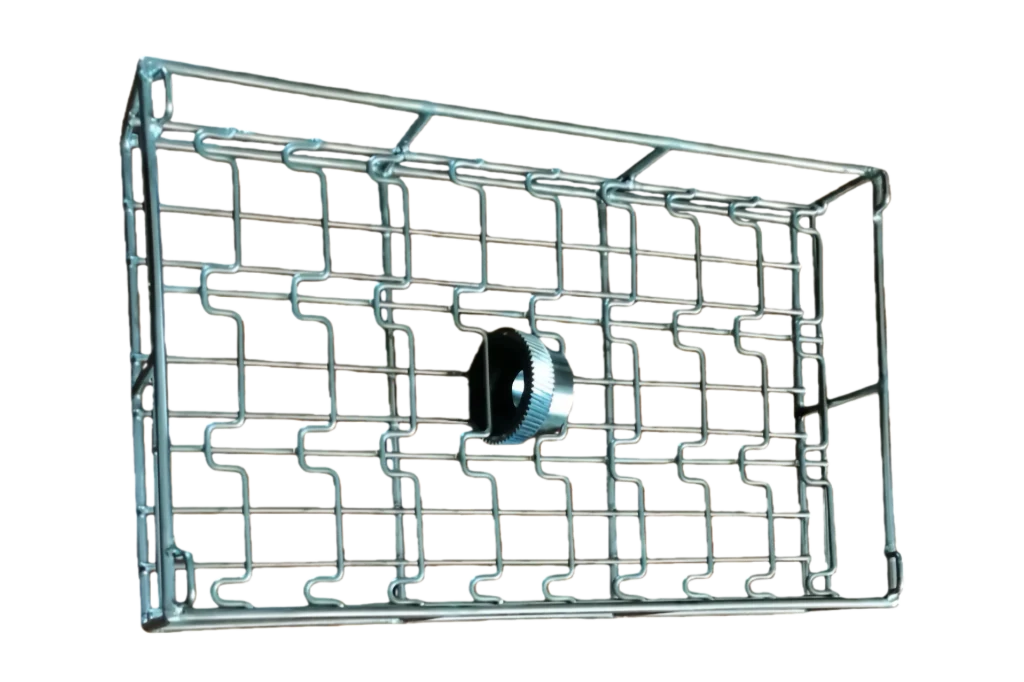
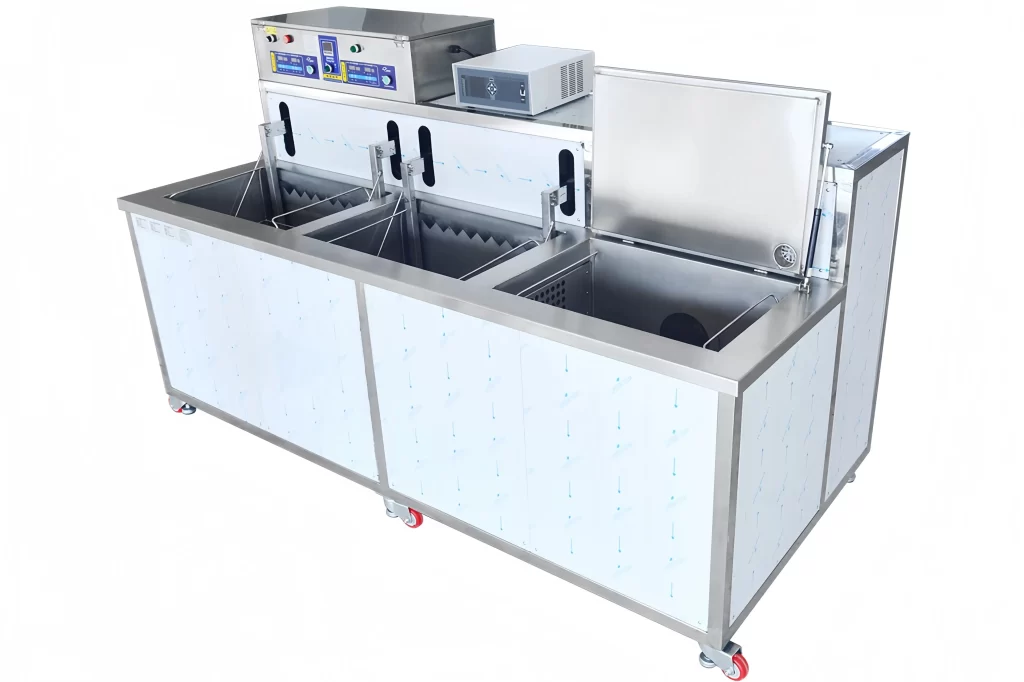
A complete automated cycle moves lenses through five or more stations. A typical sequence starts with a hydro-jet spray to remove gross debris, followed by heated ultrasonic degreasing at 45–65 °C with a mild alkaline detergent or neutral cleaning agent. The third stage, a pure-water immersion rinse, flushes away loosened contaminants. The fourth stage, a multi-pass ultrapure water rinse with conductivity controlled to ≤0.06 μS/cm, removes ionic residues that cause coating adhesion failures. Finally, drying combines high-velocity air knives with hot air circulation, or vacuum drying for lenses with complex internal geometries that trap moisture.
In our pre-PVD optical component cleaning systems, we integrate Siemens or Mitsubishi PLCs with color touchscreen HMIs to enforce recipe consistency across every batch. Process deviations trigger automatic alarms, preventing inadequately cleaned lenses from reaching the coating chamber. This level of control is not achievable with manual benches.
If your program involves high-mix optical lens production with demanding cleanliness targets, a multi-stage ultrasonic system configured for your specific part geometry may resolve persistent coating defects. Contact us at [email protected] to discuss your current reject rate and see whether a process upgrade can eliminate the contamination source.
Water Quality and Drying Requirements for Pre-Coating Cleaning
Water quality is the most overlooked variable in optical lens preparation. Tap water contains dissolved minerals, silica, and chlorides that leave residue films on lens surfaces as droplets evaporate. These invisible films change surface energy and create nucleation centers for coating failure. Even deionized water, if stored in open tanks, absorbs atmospheric carbon dioxide and degrades to unacceptable resistivity levels within hours.
An inline ultrapure water system maintains conductivity below 0.06 μS/cm by recirculating through mixed-bed deionization cartridges and UV sterilization. For lenses destined for laser optics or precision imaging coatings, we specify conductivity limits of 0.055 μS/cm and total organic carbon below 10 ppb. This water quality ensures the final rinse leaves no ionic or organic footprint.
Drying must be equally controlled. Air knife systems using HEPA-filtered compressed air blow bulk moisture off the lens surface without physical contact. Follow-on hot air drying at 80–100 °C removes residual moisture from bevels and mounting edges. For lenses with deep concave surfaces where air knives cannot reach effectively, vacuum drying evaporates trapped moisture and eliminates water spot formation entirely. The selection between these methods depends on lens geometry and throughput.
Validating Optical Lens Cleanliness Before Coating
No single test fully verifies that a lens is clean enough for coating. We combine visual inspection under oblique lighting with quantitative surface energy measurements to catch residues that inspection alone misses.
The water break test provides a rapid pass-fail check. A stream of ultrapure water flows across the lens surface. If the water sheet breaks into droplets, organic contamination is present. A continuous sheet indicates adequate cleanliness for most coating processes. For quantitative verification, contact angle measurement with a goniometer yields surface energy values. A water contact angle below 10 degrees typically indicates a contamination-free surface suitable for PVD, CVD, or sputtered coatings.
For critical applications, such as aerospace optics or medical laser components, we add particle counting. A liquid particle counter measures particulate levels in the final rinse water exiting the lens cleaning station. Consistent particle counts below 10 particles per milliliter at 0.5 microns confirm that the cleaning process removes, rather than redistributes, contamination.
These validation steps should be documented as part of the coating facility's quality management system, with process records linked to each coating batch for traceability.
Selecting Automated Cleaning Systems for Optical Coating Lines
The right cleaning system integrates into the coating line without becoming a bottleneck. Key selection criteria include throughput, part handling, cleanroom compatibility, and ongoing operating cost.
Throughput requirements define tank sizing and cycle time. For high-volume production of consumer optics such as smartphone camera lenses, a conveyor-based or rotary basket system with 5-6 minute cycle times per tank and automated loading/unloading keeps pace with coating chamber throughput. For lower-volume production of large telescope mirrors or custom optics, a multi-tank manual transfer system offers flexibility at lower capital cost. Part size and weight dictate load-bearing requirements: our heavy-duty systems handle workpieces up to 2000 kg with reinforced baskets and robotic transfer.
Cleanroom integration introduces additional constraints. The cleaning system's exhaust management, particle generation, and material compatibility must meet the coating chamber's cleanliness classification. Stainless steel construction, sealed electrical enclosures, and HEPA-filtered drying air prevent the cleaning system from becoming a contamination source itself.
Operating cost depends on water consumption, detergent usage, and energy. Recirculating filtration and overflow systems extend cleaning solution life and cut water and detergent consumption by 30–50 % compared to single-pass systems. Energy-efficient hot air dryers with heat recovery further reduce utility costs over the equipment lifetime.
Evaluating a system's total cost of ownership, not just the purchase price, reveals the long-term production economics. A system that uses 40 % less DI water and operates with fewer rejects will recover its incremental cost within the first year of production.
If your coating line requires consistent optical cleanliness with documented process validation, share your lens specifications and current defect data with us. We can recommend a pre-coating cleaning configuration that fits your throughput and substrate material. Reach us at [email protected] or call +86 17768507147.
Common Questions About Optical Lens Coating Preparation
What is the single most common cause of coating adhesion failure on optical lenses?
In our experience, hydrocarbon residue from insufficient cleaning is the primary cause. A thin film of polishing oil or cutting fluid remains on the lens surface after manual solvent wiping, reducing surface energy enough that the coating material bonds weakly and delaminates within weeks. Automated ultrasonic degreasing with heated detergent followed by ultrapure water rinsing removes these films consistently.
Can ultrasonic cleaning damage delicate optical lenses?
It depends on the lens material, geometry, and ultrasonic frequency. For standard optical glasses and crystals, frequencies between 40–80 kHz produce gentle cavitation that safely removes contaminants without surface erosion. For very thin or fragile elements, such as pellicle mirrors or mounted assemblies, we reduce power density or use a combination of spray and immersion without ultrasonics. A process validation run with sample lenses is the safest way to confirm compatibility.
How often should cleaning solution be replaced in a production optical coating line?
Replacement frequency depends on contamination load, but recirculating filtration can extend solution life to one or two production shifts. We design systems with oil skimmers and particulate filters that continuously clean the cleaning solution. When the solution's detergent concentration drops below a set threshold, automated dosing replenishes it, so the bath remains effective without full dumping.
Are there specific cleanliness standards that optical coating facilities should meet?
No universal standard exists for optical pre-coating cleanliness, but coating facilities frequently adopt MIL-PRF-13830B for surface quality and ISO 10110 for optical element specifications as reference points. In practice, facilities define their cleanliness criteria based on coating type and end-use. We recommend establishing internal acceptance limits for water contact angle, particle count, and visual inspection pass-fail thresholds and validating them against coating yield data over multiple production runs.
What drying method prevents water spots on optical lenses with concave surfaces?
Vacuum drying is the most reliable method for concave lenses because it pulls residual moisture out of recessed areas that air knives cannot reach. The vacuum chamber reduces the boiling point of water, so any trapped moisture evaporates rapidly without leaving mineral residue. For high-throughput lines where vacuum drying adds cycle time, angled air knife positioning combined with hot air recirculation can achieve spot-free results if the lens geometry does not trap deep pockets of rinse water. Share your lens drawings with us and we will confirm which drying configuration will eliminate water spots for your specific parts: [email protected] or +86 17768507147.
If you're interested, check out these related articles:
How to Choose the Best Ultrasonic Power for an Ultrasonic Cleaning Machine ?
Reduce Energy Costs in Industrial Ultrasonic Cleaning
Precision Mold Cleaning Solutions
How to Integrate Automated Cleaning into Production Lines
Precision CNC Part Cleaning Solutions - GTK
 English
  German
  Spanish
  French
  Russian
  Portuguese