

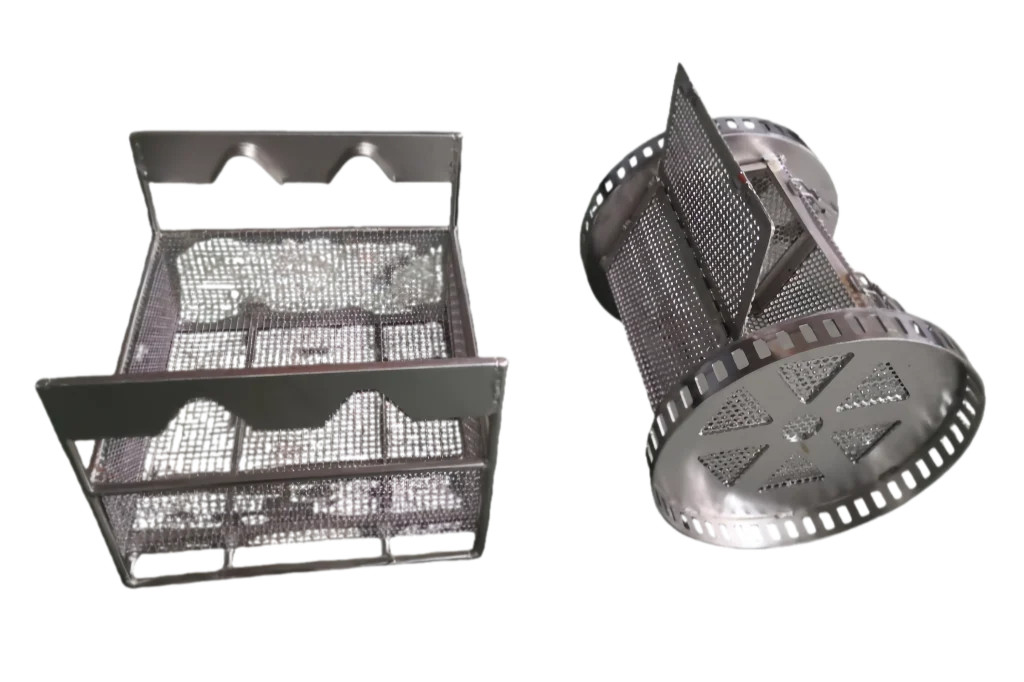
Industrial cleaning baskets do more than hold parts. Material choice and load limits determine cleaning quality, drying time, basket life, and operator safety. In more than twenty years designing automated ultrasonic, solvent, and conveyor cleaning systems, I have seen more reject causes tied to basket design than to cleaning chemistry. This article focuses on the material selection logic and the load verification steps buyers often skip until a basket deforms, blocks ultrasonic energy, or damages parts. You can expect supplier questions to become more precise after you read it.
Material Selection for Industrial Cleaning Baskets
Industrial cleaning baskets succeed or fail on material choice. The material sets the basket's service life and its reaction to the cleaning chemistry. Stainless steel 304 and 316 remain the default for water-based ultrasonic systems because they tolerate heat, alkaline detergents, and repeated drying cycles without losing rigidity. Polypropylene and PVDF offer chemical resistance at lower weight, but their temperature limits and lower stiffness make them unsuitable for heavy or hot loads. PTFE offers strong chemical resistance but rarely justifies its cost for a full basket.
| Material | Best for | Watch for |
|---|---|---|
| 304 stainless steel | General water-based cleaning, moderate corrosion exposure | Chloride stress cracking in acidic or saline media |
| 316 stainless steel | Solvent and acidic processes, ultrapure water rinses | Higher cost; still vulnerable to concentrated chloride attack |
| Polypropylene | Light loads, aggressive aqueous chemicals, room-temperature cycles | Softens above roughly 80°C; deforms under heavy loads |
| PVDF | High chemical resistance, higher temperature than PP | Expensive; difficult to weld and repair |
| PTFE | Very aggressive chemicals, non-stick requirements | High cost; low mechanical strength |
Basket material also affects ultrasonic transmission. A basket made from fine stainless mesh has low mass and less acoustic shadowing than sheet or thick bar stock, but it offers less protection to sharp or heavy workpieces. When we design a basket for a customer running 40 kHz cleaning in ultrapure water, we start with a 316 stainless frame and replace only the contact points if part marking appears. A plastic basket in the same tank would absorb less ultrasonic energy, but it can protect delicate part surfaces. The choice comes down to which risk you can accept: scratching or energy loss.
Load Capacity in Industrial Cleaning Baskets
Load capacity in industrial cleaning baskets is not simply the lifting limit of the basket. It sets how well the cleaning medium reaches every part. A basket rated for 500 kg may still clean poorly if it is filled so tightly that ultrasonic cavitation cannot penetrate the center of the load. We treat load capacity as a cleaning parameter: the load must leave enough open area for solution circulation and drainage while keeping parts from shifting. In automated lines, the moving load is often higher than the static weight because transfer arms and conveyors apply acceleration forces when they start and stop. We ask buyers for part weight, basket weight, liquid drag, and transfer method before selecting mesh size, frame thickness, and lifting points.
A basket for a rotary ultrasonic cleaner that turns 360 degrees sees different forces from a static multi-tank basket. In rotary systems we have supplied up to 2000 kg per batch, but the basket needs a reinforced frame, motor, and tank structure to match. The same 2000 kg in a poorly balanced basket will cause uneven rotation, wear the drive, and leave one side of the batch wet. Load distribution matters more than total load.
Load and cycle design are only part of the system decision. <Semi-Automated Ultrasonic Cleaning for Medium-Volume Production> covers how manual basket transfer and semi-automated movement affect the throughput and load consistency a basket must tolerate.
Basket Design Factors That Affect Cleaning and Drying
The design of an industrial cleaning basket determines whether the cleaning media reaches every face and whether the parts can dry. The main factors are open area, drainage angle, part separation, and contact point design. Fine mesh with high open area lets cavitation reach the parts, but it offers less protection for heavy components. A solid sheet basket shields parts from collisions, but it can trap water in blind holes and internal cavities, leaving residue after rinsing. For stamped parts with blind holes, we often use a round basket that rotates during cleaning so cavities drain and cavitation enters from different angles. For plate-type parts, a sheet-type basket with low contact area prevents contact marks but may need air knife drying from both sides.
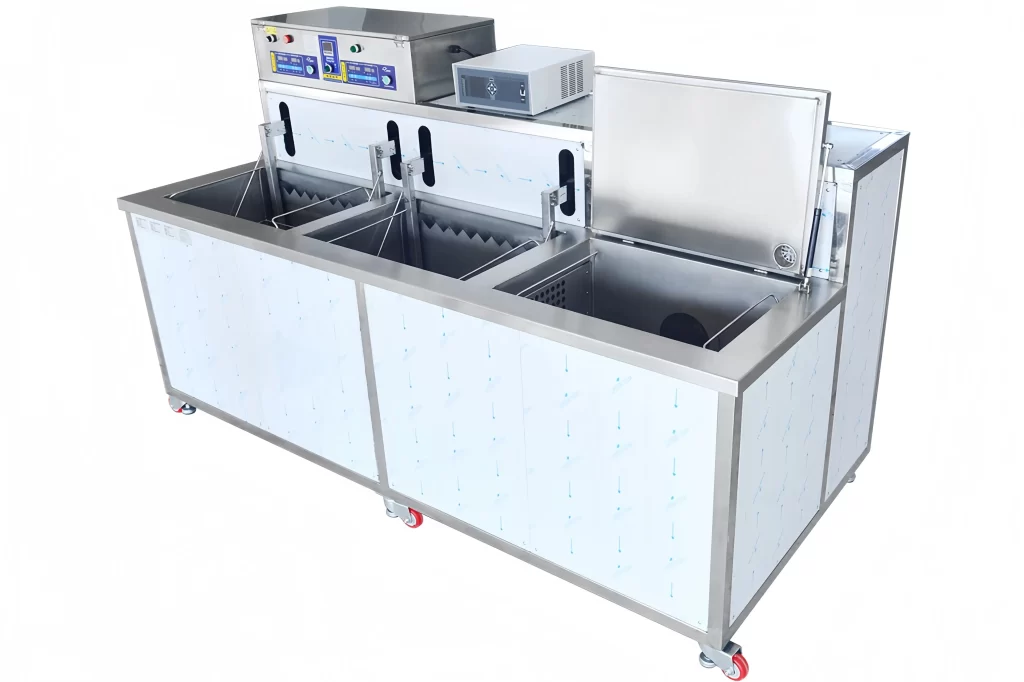
Drainage is the point most buyers overlook until parts come out wet. A basket that cleans well can hold several liters of water in its corners. That water drips into the drying station and creates water spots or recontamination. We specify drain holes, sloped rails, and open frame corners for processes where parts move directly into a vacuum or hot air dryer.
If your program involves parts with blind holes or a mix of plate and shaped components, it is worth confirming the basket's drainage path and open area before you finalize the bill of materials. Send a part drawing and target load to [email protected] and we can check whether the proposed design will dry cleanly in your line.
Matching Industrial Cleaning Baskets to Automated Cleaning Systems
The basket is an automation component, not just a container. It must locate correctly in every station: the lift, the spray zone, the ultrasonic tank, the rinse, and the dryer. We have seen production lines stop because a basket fit into one tank but caught on the next station's guide rail by a few millimeters. A well-designed basket includes datum features, consistent outer dimensions, and clearance for thermal expansion, especially with stainless steel in heated tanks. In conveyor or tunnel systems, the basket must match conveyor pitch, width, and stop positions so the line does not index early or jam.
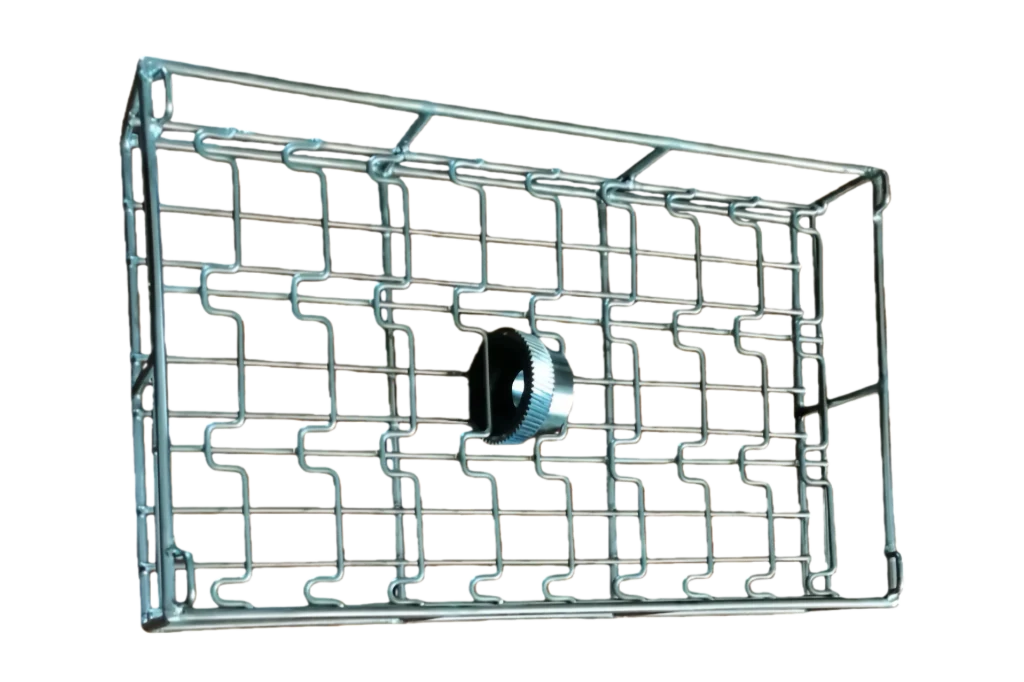
Rotary baskets need a drive interface and a locking mechanism that holds parts during rotation. A square basket in a rotary system should not be used for complex parts that need tumbling or full 360 degree exposure. In multi-tank systems with manual or semi-automatic transfer, the basket's handles, lifting eyes, and center of gravity must suit the operator or transfer arm. We design baskets with the same attention as the machine fixture, because a misaligned basket causes more downtime than a failed pump.
Basket fit and station design are part of the same automation problem. <Choosing the Right Ultrasonic Cleaning System for Industrial Success> covers how tank size, transfer type, and part handling interact when you select a cleaning line.
Specifying a Cleaning Basket Without Overlooking Load Limits
Basket failures usually surface as production problems: parts scratched, wet loads, line jams, or a cracked frame after a few months. If you are replacing a basket or specifying a new one, send us the part drawing, cleaning chemistry, target load, and transfer method. We will review the material, frame, mesh, and drainage path against your cleaning system and confirm the load capacity and delivery schedule. Email [email protected] or call +86 17768507147. Tell us the part number, quantity per basket, and whether the load rotates or moves through a conveyor. We will return a basket specification and quotation without charging a design fee for the initial review.
Common Questions About Industrial Cleaning Baskets
Which basket material lasts longest in ultrasonic cleaning?
For most heated water-based ultrasonic processes, 316 stainless steel gives the longest service life because it combines corrosion resistance with rigidity and damage tolerance. Polypropylene and PVDF can outlast stainless steel in strong acid or halide environments, but they lose strength at high temperature. PTFE handles the most aggressive chemicals but deforms under load, so it is used for liners and small fixtures rather than full heavy baskets.
How do I calculate the right load capacity for a cleaning basket?
The common mistake is to specify only the static part weight. The real load includes the basket, retained cleaning liquid during transfer, and the acceleration force from conveyor starts or rotary motion. Take the total static mass and add at least 15 to 20 percent for automated movement, then confirm the frame, mesh, and lifting points carry that distributed load without permanent deformation. For rotary baskets, also keep the load balanced around the rotation axis so the drive does not stall or wear unevenly.
Does basket material affect ultrasonic cleaning effectiveness?
Basket material changes two separate outcomes: acoustic transmission and part contact damage. Thin stainless mesh lets cavitation pass through with little loss, but hard contact points can mark delicate parts. Polypropylene absorbs little ultrasonic energy and cushions parts, but it softens in hot tanks. The best material therefore depends on cleaning temperature and part fragility, not just chemical compatibility. For precision machined components in hot alkaline tanks, we use 316 stainless mesh with polymer inserts only at contact points.
What should I send to get an accurate basket quotation?
In our quotation reviews, the requests that move fastest include the part drawing, part weight, quantity per basket, cleaning chemistry, process temperature, and transfer method. These details let us choose the material, frame, mesh, and drainage path without multiple rounds of questions. If you are not sure about transfer forces or load distribution, send what you have and we will work from the machine drawings. Share your part information at [email protected] and we will confirm the basket specification and delivery schedule.
If you're interested, check out these related articles:
Die-Cast Cleaning Solutions for Industrial Parts - GTK
Industrial Ultrasonic Cleaning Systems: Diverse Applications Guide
 English
  German
  Spanish
  French
  Russian
  Portuguese