
Selecting the optimal ultrasonic cleaning system starts with a clear grasp of what your operation demands and what the technology can genuinely deliver. We often see industrial clients weighing semi-automated against fully automated solutions, each with distinct strengths. Drawing on our two decades of experience and 28 technical patents in industrial cleaning, we compare both paths so your decision rests on solid ground.
Defining Semi Automated Ultrasonic Cleaning
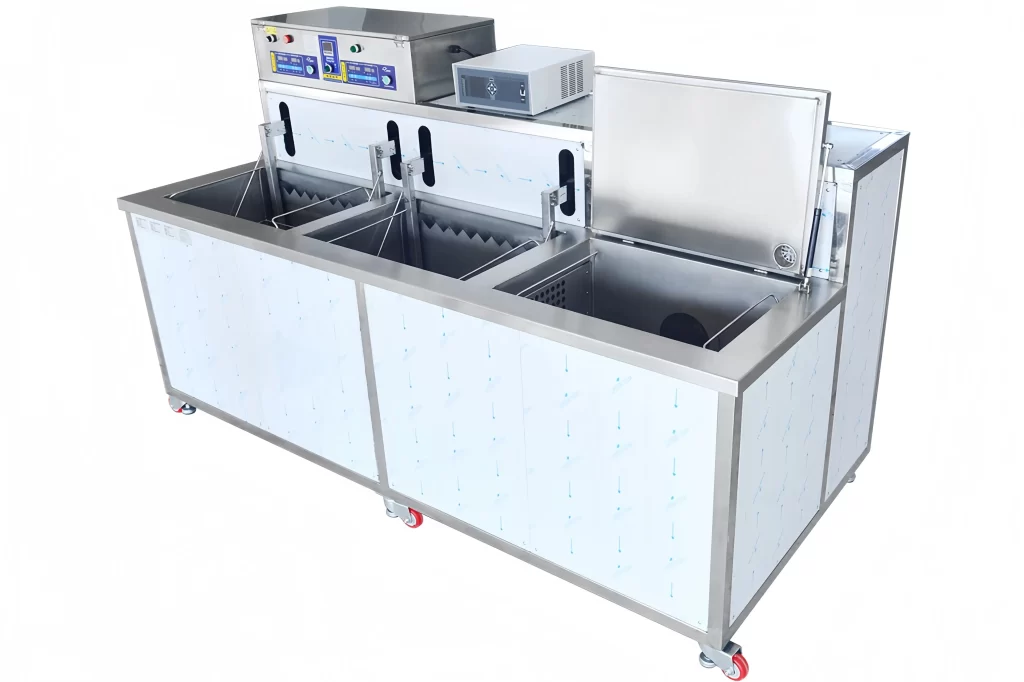
Semi-automated ultrasonic cleaning systems blend operator input with automated process control. These systems typically feature multiple tanks, where parts are manually transferred between cleaning, rinsing, and drying stages. For instance, our Multi-Tank Ultrasonic Cleaners operate with manual basket transfer, allowing operators to control the pace and sequence of cleaning steps. This approach offers significant flexibility for varied batch cleaning processes and diverse part geometries. Operators can adjust parameters like temperature and time per tank, providing precise control over the cleaning cycle. This manual integration provides semi automated cleaning benefits, particularly for applications requiring frequent changes in part types or cleaning specifications.
Exploring Fully Automated Ultrasonic Cleaning Solutions
Fully automated ultrasonic cleaning solutions operate with minimal human intervention, offering a continuous and highly consistent cleaning process. These systems often incorporate robotic handling or conveyor systems to move parts through various stages. Our CNC Aluminum Shell Inline Cleaners, for example, demonstrate this with a continuous conveyor system transporting parts through spray degreasing, rinsing, and drying. The fully automated cleaning advantages include consistent quality, reduced labor costs, and suitability for high-volume production. Systems like our Heavy-Duty Automated Ultrasonic Cleaners can handle workpieces up to 2000 kg, utilizing robotic lifting and handling for smooth operation. This level of automation is ideal for lights out manufacturing cleaning environments where repeatability and scalability are paramount.
For those seeking to understand the fundamental principles behind these advanced cleaning methods, exploring the underlying science is beneficial. You might find our article on 《What Is the Principle of an Ultrasonic Cleaning Machine?》 particularly insightful.
Operational Cost and Efficiency Comparison
Comparing the operational costs and efficiency of semi-automated versus fully automated systems involves evaluating several financial aspects. Initial investment for semi-automated systems is generally lower, as they require less complex automation infrastructure. However, semi-automated systems incur higher ongoing labor costs due to the need for continuous operator involvement. Fully automated systems, while demanding a higher initial capital outlay, significantly reduce labor expenses over time. Our fully automated solutions, such as the Fastener Tunnel Cleaners, feature automatic loading/unloading and filtration systems that extend fluid life, thereby reducing material consumption and waste. This leads to a favorable ultrasonic cleaning ROI in high-volume settings.
Key Differences in Operational Costs
The long-term financial impact varies considerably. Semi-automated systems offer flexibility, but their total cost of ownership cleaning can increase with labor and consumables. Fully automated systems, like our Hydrocarbon Solvent Ultrasonic Vacuum Cleaners, include solvent recycling systems that conserve hydrocarbon, remove impurities, and reduce overall costs. Energy efficiency industrial cleaning is also a factor, with automated systems often optimized for lower utility consumption ultrasonic through integrated heat recovery and precise process control. Maintenance costs automated systems can be higher due to complex components, but predictive maintenance can mitigate these.
Throughput and Labor Requirements Analysis
The impact on throughput and labor requirements is a primary differentiator between these two system types. Semi-automated systems, while flexible, are limited by manual transfer speeds and operator availability. This makes them suitable for batch cleaning processes and lower production volumes. Operators are directly involved in loading, unloading, and transferring parts between tanks, influencing overall industrial cleaning throughput.
Impact on Throughput and Labor Requirements
Fully automated systems excel in high-volume environments, offering continuous flow cleaning and significantly higher throughput. Our Rotary Basket Ultrasonic Cleaners, for instance, feature 360° rotary cleaning and fully automatic operation from loading to drying, minimizing manual labor. This enables production line efficiency and consistent processing of large quantities of parts. The reduction in labor impact automated cleaning allows for workforce planning cleaning systems to reallocate personnel to other critical tasks, boosting overall productivity. Systems like our CNC Aluminum Shell Inline Cleaners are designed for high efficiency & low labor, ideal for mass production.
To gain a deeper understanding of how ultrasonic technology works, consider reading our detailed explanation on 《What Is Ultrasonic Cavitation Effect?》.
Application Suitability and Cleanliness Standards
The choice between semi-automated and fully automated systems heavily depends on the specific application and the required cleanliness standards. Semi-automated systems, such as our Multi-Tank Ultrasonic Cleaners, are versatile for various applications, including electronics, optics, precision hardware, automotive, medical, and R&D labs. They offer adjustable parameters for diverse parts and contaminants.
System Suitability for Complex Geometries and Cleanliness
Fully automated systems are indispensable for stringent cleanliness standards and complex part geometries cleaning. For example, our Pre PVD (Coating) Parts Ultrasonic Cleaners are designed with multi-stage processes and ultrapure water systems to prevent water spots and secondary contamination, crucial for pre-PVD applications. Similarly, the Hydrocarbon Ultrasonic Cleaning machine is engineered for precision 360° cleaning for recessed and blind-hole stamped parts, meeting the highest demands in medical device cleaning and aerospace component cleaning. Our Rotary Basket Ultrasonic Cleaners are specifically designed for complex parts with blind holes, cracks, and recesses, ensuring thorough cleaning.
| Feature | Semi-Automated Ultrasonic Cleaning | Fully Automated Ultrasonic Cleaning |
|---|---|---|
| Initial Investment | Lower | Higher |
| Labor Costs | Higher (ongoing) | Lower (reduced intervention) |
| Throughput | Moderate (batch processing) | High (continuous flow) |
| Consistency | Operator-dependent | High (process controlled) |
| Flexibility | High (for varied batches) | Moderate (for specific tasks) |
| Cleanliness Standard | Good | Excellent (precision cleaning technology) |
For further technical details on the core components that enable such advanced cleaning, our article on 《What Is The Piezoelectric Effect?》 provides valuable context.
Frequently Asked Questions About Ultrasonic Cleaning Systems
What factors determine the optimal choice between semi automated and fully automated ultrasonic cleaning systems?
The optimal choice between semi-automated and fully automated ultrasonic cleaning systems depends on several critical factors, including production volume, part complexity, required cleanliness standards, available labor, and budget. Semi-automated systems offer flexibility for varied batches and lower initial investment, while fully automated systems excel in high-volume, repetitive tasks, ensuring consistent precision cleaning technology and reducing long-term labor costs. GTKCLEAN helps clients analyze these variables to select the most efficient industrial parts cleaning solution.
How do automated ultrasonic cleaning systems contribute to improved industrial cleaning quality and consistency?
Automated ultrasonic cleaning systems significantly enhance industrial cleaning quality and consistency by eliminating human variability from the process. They ensure precise control over cleaning parameters such as temperature, ultrasonic frequency, cycle time, and solution concentration. This level of control, inherent in automated manufacturing processes, guarantees repeatable results, crucial for meeting stringent cleanliness standards in industries like aerospace and medical devices, and ultimately leads to superior precision cleaning technology.
Can GTKCLEAN's automated ultrasonic systems be integrated into existing production lines?
Yes, GTKCLEAN specializes in designing comprehensive automated cleaning equipment, including ultrasonic cleaning systems, that can be integrated into existing production lines. Our 20+ years of R&D experience allow us to provide tailored system integration solutions, addressing challenges such as space constraints, material handling, and data communication protocols. We work closely with clients to ensure a smooth transition and optimized workflow for their industrial parts cleaning processes.
Optimize Your Industrial Cleaning with GTKCLEAN
Take your industrial cleaning further with GTKCLEAN's 20+ years of R&D expertise and 28 technical patents. Whether your needs lean towards the flexibility of semi-automated or the consistency of fully automated ultrasonic systems, our global team is ready to design a custom solution that optimizes your operations and meets the most stringent cleanliness requirements. Contact Suzhou Grintek Environmental Technology Co.,Ltd. today for a personalized consultation and discover the GTKCLEAN advantage. Reach us at [email protected] or +86 17768507147.
 English
  German
  Spanish
  French
  Russian
  Portuguese