
Selecting the right industrial cleaning method determines whether parts with intricate designs meet cleanliness standards or fail downstream processes. This choice affects manufacturing quality, cycle time, and operating cost. The distinction between spray and immersion cleaning—particularly how each handles complex part geometries—matters most when blind holes, internal passages, or tight crevices are involved.
How Spray Cleaning Works in Industrial Settings
Spray cleaning uses directed liquid streams to knock contaminants off part surfaces. High-pressure nozzles project cleaning solution onto the workpiece, creating mechanical scrubbing action through fluid impact. This approach removes loose debris, machining chips, and surface oils efficiently from external surfaces that face the spray path. Cleaning cycles run fast because the solution recirculates through filters continuously, and chemical consumption stays predictable.
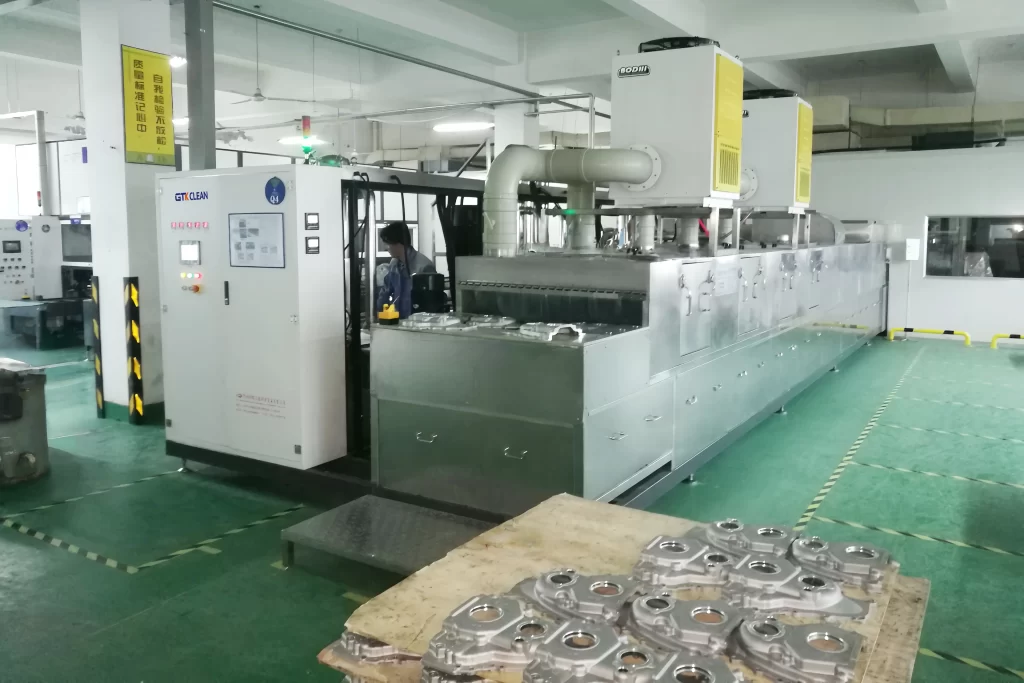
Conveyor belt systems like the CNC Aluminum Shell Inline Cleaners demonstrate this method well. Multi-directional spray nozzles rotate around complex-shaped aluminum housings, hitting surfaces from multiple angles as parts travel through the wash zone. Coverage improves when nozzle arrays are positioned to address part orientation, but a fundamental limitation remains: spray cannot reach what it cannot see. Blind holes, narrow slots, threaded bores, and internal channels stay contaminated because the fluid stream never penetrates these features. The spray hits the opening and deflects, leaving residue inside.
Why Immersion Cleaning Reaches Where Spray Cannot
Immersion cleaning submerges parts completely, allowing cleaning solution to fill every cavity, passage, and recess regardless of geometry. The liquid surrounds the workpiece and penetrates features that would block a spray stream. Agitation—whether mechanical oscillation, basket rotation, or air bubbling—enhances the cleaning action by moving fresh solution into contact with contaminated surfaces.
Ultrasonic technology transforms immersion cleaning performance for intricate designs. Transducers mounted on the tank walls or bottom generate high-frequency sound waves (typically 25–40 kHz for industrial parts) that propagate through the liquid. These waves create microscopic cavitation bubbles that form during the low-pressure phase and collapse violently during the high-pressure phase. Each collapse releases localized energy that scrubs surfaces at a microscopic scale. The cavitation effect reaches into blind holes, threaded holes, and gaps measured in fractions of a millimeter.
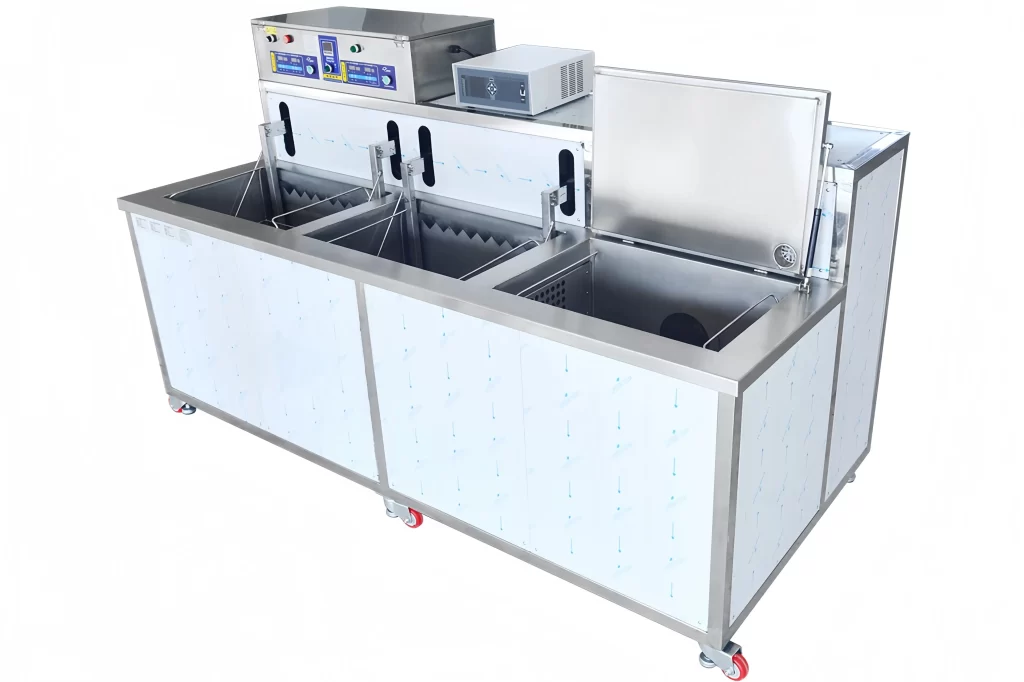
The Ultrasonic Cleaners For Stamping Parts use this principle to clean features that would defeat manual scrubbing or spray washing. Stamped parts often have burrs, oil residue in corners, and compound curves that trap contaminants. Cavitation reaches these areas because the sound waves travel through the liquid uniformly—the part geometry does not block the cleaning mechanism the way it blocks a spray stream.
Comparing Spray and Immersion Performance by Application
The decision between spray and immersion depends on what the part looks like, what contamination it carries, and how clean it needs to be for the next process step.
| Feature | Spray Cleaning | Immersion Cleaning |
|---|---|---|
| Penetration | Limited to surfaces facing nozzles | Complete coverage including blind holes and internal passages |
| Contaminant Type | Loose chips, surface oils, dust on exposed areas | Embedded oils, fine particles, burrs, residues in recesses |
| Part Geometry | Simple shapes, open access, flat or convex surfaces | Complex castings, machined housings, parts with internal features |
| Cycle Time | Faster when parts suit the method | Longer soak times, but fewer rejects and rework cycles |
| Fluid Consumption | Lower tank volume, but efficiency drops for complex parts | Higher initial volume, effective filtration extends bath life |
Spray cleaning handles high throughput when parts have accessible surfaces. Large panels, simple brackets, and machined blocks with no internal features move through spray systems quickly. The method struggles when the part design includes features that hide from the spray path.
Immersion cleaning becomes necessary when blind holes, internal threads, or small orifices must be free of contamination. Coating adhesion, assembly fit, and functional performance often depend on cleanliness in these hidden areas. A part that looks clean externally can still fail if residue inside a threaded hole interferes with a fastener or if oil in an internal passage contaminates a fluid system.
Multi-Stage Systems for Challenging Part Geometries
Parts with both external contamination and internal complexity often need a combined approach. A system might start with high-pressure spray to remove gross contamination—chips, heavy oil films, and loose debris—before transferring parts to an ultrasonic immersion stage for precision cleaning of internal features. Rinse stages follow, and drying completes the cycle.
The Pre PVD (Coating) Parts Ultrasonic Cleaners follow this architecture. The sequence includes hydrojet spray for initial cleaning, ultrasonic immersion for penetration into blind holes and complex surfaces, multiple ultrapure water rinse stages, and controlled drying. Ultrapure water conductivity at ≤ 0.06 μS/cm prevents water spots and ionic contamination that would interfere with coating adhesion. This level of cleanliness matters for components entering PVD, anodizing, or other surface treatment processes where contamination causes visible defects or adhesion failures.
Custom configurations address specific part challenges. Deep holes require extended soak times or oscillating basket movement to refresh the solution inside the bore. Blind holes benefit from part orientation that allows trapped air to escape as the cleaning solution enters. Production capacity requirements determine tank sizing, conveyor speed, and the number of parallel cleaning stations.
Calculating True Cleaning Cost Beyond Equipment Price
Equipment purchase price represents only part of the cost picture. Operating costs include energy, chemicals, water, waste treatment, labor, and the cost of quality failures when cleaning falls short.
Spray systems use less fluid volume initially, but their inability to clean complex parts thoroughly creates hidden costs. Rework cycles consume time and labor. Parts that pass visual inspection but carry internal contamination cause field failures or assembly problems. These costs often exceed the savings from lower fluid consumption.
Immersion systems with solvent recycling reduce chemical consumption significantly. The Hydrocarbon Solvent Ultrasonic Vacuum Cleaners include a distillation system that recovers and purifies the cleaning solvent continuously. Impurities concentrate in the still bottoms while clean solvent returns to the wash tank. This approach cuts solvent purchase costs and reduces hazardous waste disposal volume. A batch of up to 200 kg cleans in 8–9 minutes for a single-stage process, which supports high throughput without proportional increases in chemical consumption.
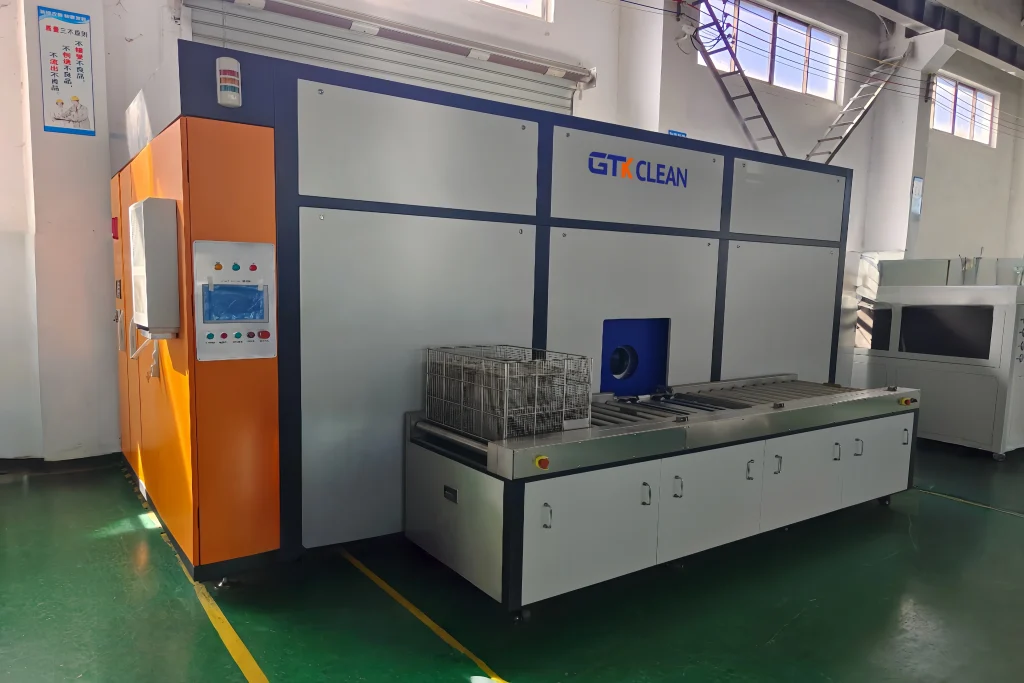
Automation reduces labor cost and improves consistency. Manual cleaning varies with operator technique and attention. Automated systems deliver the same cleaning parameters every cycle, which reduces variation in downstream processes and makes quality problems easier to trace.
Matching system capacity to production volume avoids both bottlenecks and underutilization. An oversized system wastes energy heating and circulating fluid that cleans fewer parts than designed. An undersized system creates queues that delay production or forces operators to shorten cycles, compromising cleanliness. If your production mix includes parts with varying complexity, a system with adjustable parameters or multiple cleaning zones accommodates the range without requiring separate equipment lines.
Frequently Asked Questions
Is one cleaning method universally better for all complex geometries?
No single method handles every geometry optimally. Immersion cleaning with ultrasonic assistance reaches internal passages and blind holes that spray cannot access. Spray cleaning processes accessible surfaces faster and uses less fluid. The part design determines which method delivers adequate cleanliness. Many production environments use both methods in sequence, applying spray for gross contamination removal and immersion for precision cleaning of internal features.
How do environmental regulations influence the choice between spray and immersion cleaning?
Regulations restrict solvent emissions, wastewater discharge, and hazardous waste generation. Water-based cleaning solutions have become standard for both spray and immersion systems in most applications. When solvents are necessary for oil removal or material compatibility, closed-loop systems with distillation recovery minimize emissions and waste. Both methods require proper treatment of spent cleaning solution before discharge. The choice between methods depends more on cleaning effectiveness for the part geometry than on regulatory compliance, since compliant configurations exist for both approaches.
Can both spray and immersion cleaning be integrated into a single system?
Combined systems are common for parts that need both high-volume debris removal and precision cleaning of internal features. A typical configuration moves parts through a spray pre-wash zone, then into one or more ultrasonic immersion tanks, followed by rinse stages and drying. This approach uses spray efficiency for the initial cleaning pass and immersion thoroughness for final cleanliness. The integration works well when part handling automation can transfer workpieces between cleaning stages without manual intervention.
Choosing a Reliable Ultrasonic Equipment Manufacturer: A Strategic Guide
Ultrasonic Cleaning systems for Pre PVD (Coating) Parts
What Is the Principle of an Ultrasonic Cleaning Machine?
Discuss Your Cleaning Requirements
Achieving consistent cleanliness for complex industrial parts requires matching the cleaning method to the part geometry and contamination type. GTKCLEAN designs and manufactures automated cleaning equipment with patented technology for manufacturers worldwide. Contact us at [email protected] or +86 17768507147 to discuss your specific cleaning challenges and production requirements.
 English
  German
  Spanish
  French
  Russian
  Portuguese