
Industries that run production lines around the clock cannot afford cleaning processes that work only on lightly soiled parts. When machined components arrive caked in cutting oil, stamping lubricants, carbon deposits, or heat-treatment scale, the cleaning system has to remove every bit of contamination before the part moves to coating, welding, or assembly. I have spent more than twenty years designing ultrasonic cleaning lines for exactly these conditions, and the gap between a generic off-the-shelf cleaner and a purpose-built heavy-contamination system is the difference between a reliable production flow and a daily bottleneck.
What Makes Heavy Contamination Different from Routine Soiling
Heavy contamination is not just a thicker layer of the same dirt. It usually consists of polymerized oils baked onto surfaces during machining, heavy greases packed into threads and blind holes, corrosion inhibitors that leave waxy residues, and metal fines embedded in carrier fluids. These contaminants bond chemically or mechanically to the substrate, so a simple spray wash or single-tank immersion will not break the bond, especially inside recessed features.
The first problem is adhesion. Stampings from high-pressure forming lines often carry chlorinated or sulfurized extreme-pressure additives that cure into a varnish under heat. I have pulled parts from a customer’s existing spray line where the outer surfaces looked clean but the threaded holes still held a dark film, which caused adhesion failures in subsequent PVD coating. The second problem is load variability. A basket might contain parts with widely different amounts of contamination, and the cleaning process has to deliver consistent results across every piece, not just the average.
How Ultrasonic Cavitation Attacks Bonded Contamination
Ultrasonic cleaning works through cavitation: microscopic bubbles form and collapse in the cleaning liquid, generating jet streams that mechanically strip contamination from surfaces. The key for heavily contaminated parts is ensuring that cavitation reaches every critical surface, including deep bores, cross-drilled passages, and the underside of threads.
Frequency selection is the first control that matters. Lower frequencies around 20–28 kHz produce larger, more energetic cavitation bubbles that deliver higher impact force on the part surface. That is where you start for heavy grease, carbon deposits, or baked-on cutting oil. For most of the heavy-contamination lines I have specified, we start the first ultrasonic stage at 25 kHz or 28 kHz and reserve higher frequencies for secondary cleaning or rinsing, where the goal shifts from breaking contamination to removing loosened particles without damaging the part surface.
Power density is the second driver. A benchtop unit with 0.3–0.5 W/cm² will not touch hardened stamping oil in undercuts, regardless of cycle time. For heavy contamination, I typically design with power densities of 0.8–1.5 W/cm² in the degreasing tank, depending on part geometry and contamination type. Higher power increases cavitation intensity, but it must be matched to the transducer layout so that hot spots do not cause erosion on thin sections. That balance is one of the main reasons off-the-shelf machines underperform on production floors; they are built to a generic specification that cannot account for the specific part.
Designing the Cleaning System Around Heavy Loads and Complex Geometries
When parts weigh 500 kg or more per basket and have internal cavities that trap liquid, the system engineering matters as much as the ultrasonic parameters. I have worked on heavy-duty automated cleaners built for workpieces up to 2000 kg, where the tank structure, lifting mechanism, and basket design all need to handle the load without distorting and without creating safety risks during transfers.
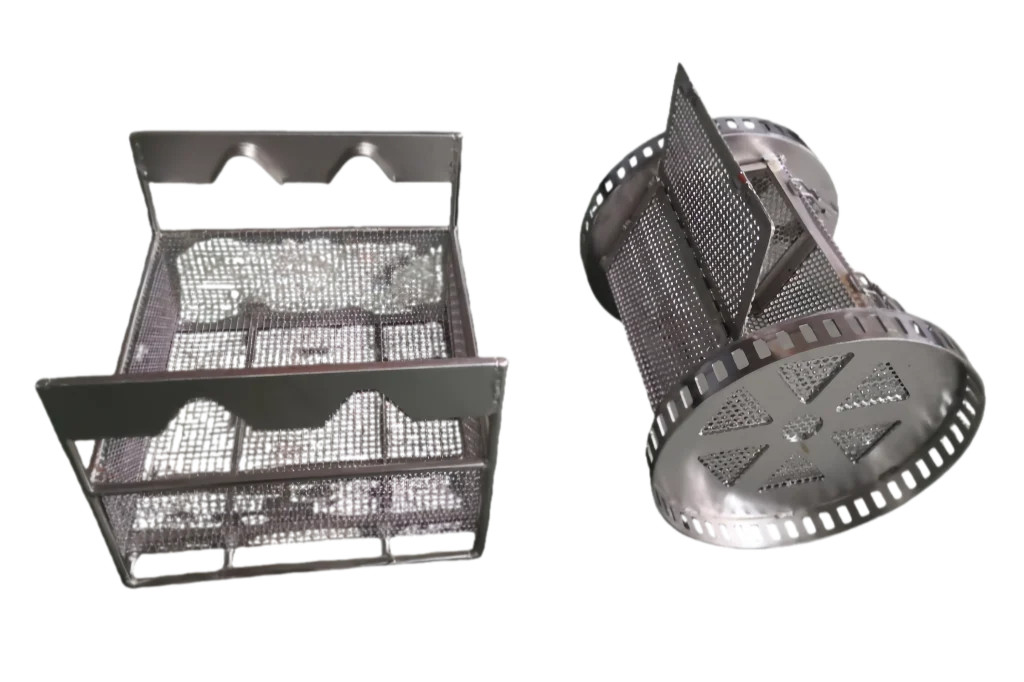
Basket orientation and rotation often decide whether the part comes out clean. For components with blind holes, a rotary basket that turns 360° during the ultrasonic cycle ensures that trapped air bubbles escape and that cavitation reaches every internal surface. Without rotation, the same blind holes act as pockets that shield contamination from the cleaning action. On one line we commissioned for large gearbox housings, adding slow basket rotation in the ultrasonic tank reduced the defect rate from about 7% to under 0.5%, simply because cavitation could access the bearing bores from every angle.
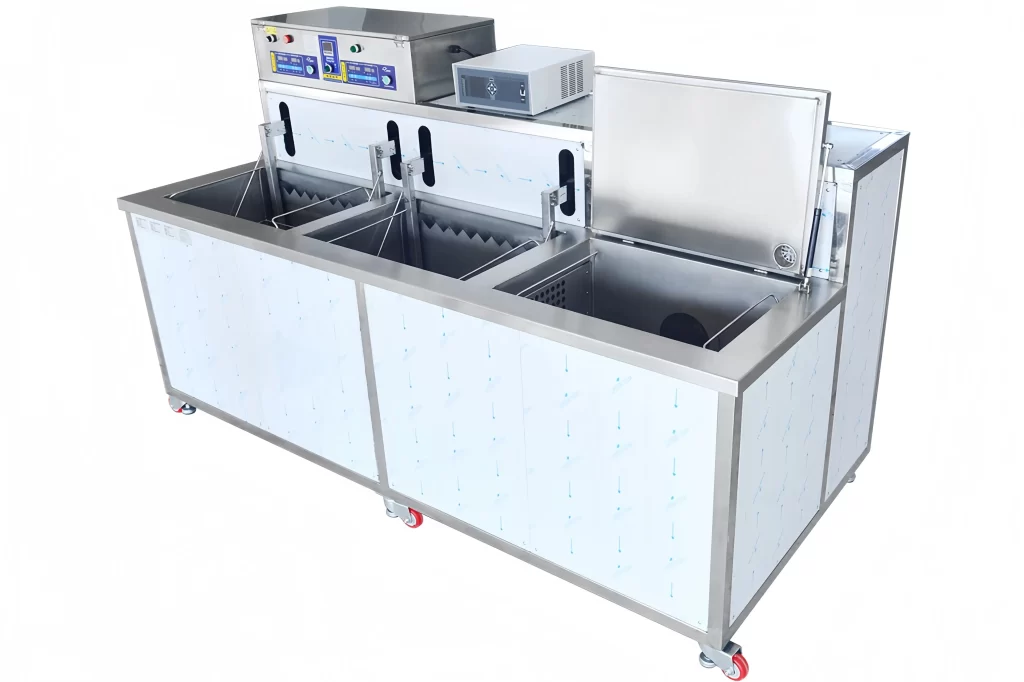
Tank configuration follows the contamination profile. A known profile, where every part carries a similar type and amount of soil, allows a simpler single- or two-tank degreasing stage. Unknown or mixed contamination, such as in a contract cleaning shop that processes parts from multiple machining lines, usually demands multi-tank ultrasonic cascades: a rough ultrasonic tank with high power and short cycle, then a precision ultrasonic tank with finer filtration and controlled temperature, followed by dedicated rinsing. This staging prevents cross-contamination and extends the life of the cleaning solution.
Multi-Stage Processes That Deliver Repeatable Cleanliness
Heavy contamination cleaning is never a single-step process. The minimum viable process for production-level results typically involves ultrasonic degreasing, at least one rinse stage with water of appropriate quality, and a drying stage that leaves no water marks. When the downstream process is coating, painting, or plating, those rinse stages become just as critical as the ultrasonic step.
I have found that a three-stage arrangement covers the majority of heavy-contamination applications in our projects: a dedicated degreasing ultrasonic tank running at 25–28 kHz with heated alkaline or neutral detergent, a first rinse with reverse-osmosis water to remove the bulk of the cleaning chemistry, and a final rinse with deionized water whose conductivity stays below 0.06 μS/cm. Skipping the final DI rinse or letting its conductivity drift above a few microsiemens inevitably leads to water spots that cause coating defects, even if the part looks visually clean.
The table below shows a typical four-tank configuration we use for stamped automotive parts with heavy oil and stamping compound residues.
| Stage | Tank | Process | Medium | Temp. | Time |
|---|---|---|---|---|---|
| 1 | Ultrasonic degrease | 28 kHz, 1.0 W/cm² | Alkaline detergent, 5% | 55 °C | 5–6 min |
| 2 | RO water rinse | Immersion + overflow | RO water (<10 µS/cm) | 30–40 °C | 3–4 min |
| 3 | DI water rinse | Immersion + circulation | DI water (<0.06 µS/cm) | 25–35 °C | 3–4 min |
| 4 | Hot air / vacuum | Air knife + hot air | — | 90 °C | 5–8 min |
If the stamped parts have deep recesses where water tends to pool, we substitute vacuum drying in the last stage, which flashes off residual moisture from hidden cavities far more reliably than hot air alone.
When to Step Up to Fully Automated Ultrasonic Systems
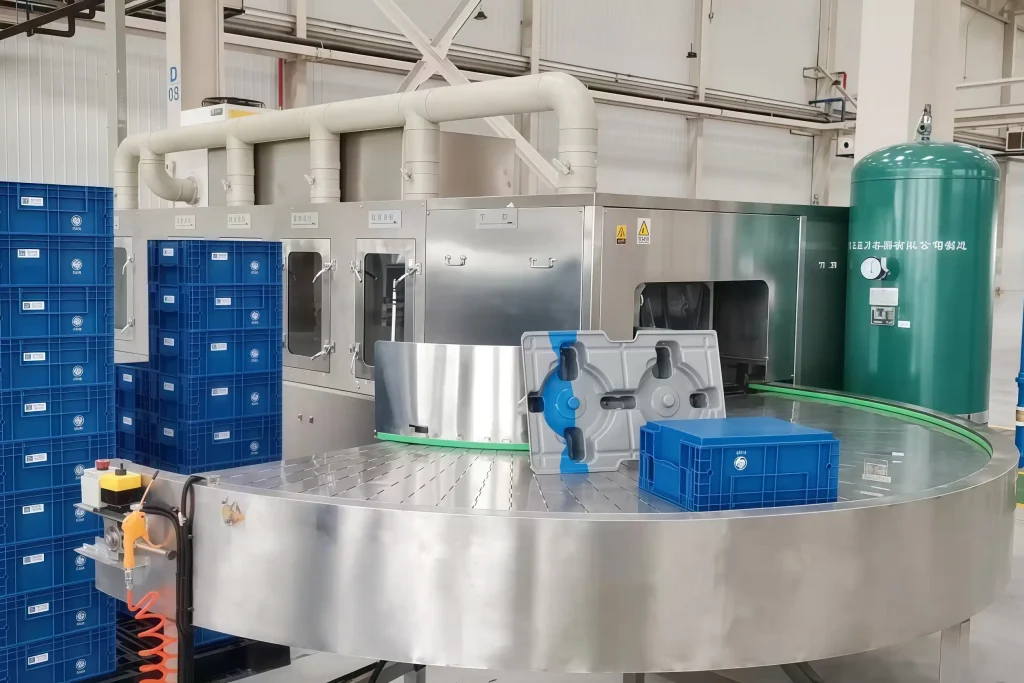
Manual and semi-automated systems can handle heavy contamination in low-volume or R&D settings, but once production exceeds roughly 100–150 baskets per shift, the process consistency and labor cost equations change. A fully automated multi-tank system with robotic basket transfer removes the operator-to-operator variability in cycle timing, tank dwell, and basket orientation, which are the biggest sources of rejected parts in manual lines.
From a procurement perspective, the decision usually comes down to labor reduction, cleaning quality repeatability, and integration with the upstream and downstream processes. In a typical line I specified for a transmission component manufacturer, the automated system paid back its capital premium in under eighteen months by eliminating two full-time operators per shift and cutting the scrap rate from manual handling by nearly 4 percentage points. The cleaning quality also became stable enough that the customer could reduce post-cleaning inspection sampling by half.
Fully automated systems also enable remote process monitoring and recipe switching, which matters when a single cleaning line serves multiple part families with different contamination profiles. The PLC stores the program for each part number, so the operator loads the basket and selects the recipe on the HMI; the machine handles all the transfers, temperatures, and cycle times. In our global deployments, this has proven essential for sites running three shifts with minimal on-site engineering support.
If your program involves parts weighing more than 300 kg or requires cleaning before a coating operation with strict adhesion requirements, it is worth confirming the ultrasonic power density, basket rotation, and final rinse conductivity with the equipment supplier before finalizing your specification. A small mismatch in any of those parameters can create a bottleneck that multiplies through the entire production schedule. For critical programs, share your part drawings, contamination type, and target throughput with our team at [email protected] or call +86 17768507147, and we can run a feasibility review specific to your production environment.
Common Questions About Heavy-Contamination Ultrasonic Cleaning
Can one ultrasonic tank handle both heavy grease and fine particulate?
In most cases, no, not without compromising the quality of both cleaning steps. The detergent and filtration system optimized for heavy grease removal will struggle with fine particulates, because the same high surfactant load that emulsifies oil can suspend particles but cannot remove them from the bath. Multi-tank systems solve this by dedicating the first tank to degreasing with coarse filtration and later tanks to precision rinsing with fine filtration down to 10–20 µm. We have seen single-tank attempts where the cleaning solution turned into a sludge within a week, forcing frequent bath changes and downtime.
What ultrasonic frequency works best for baked-on carbon deposits?
For carbonized residues on engine components or heat-treatment scale, 20–25 kHz usually provides the impact needed to fracture the deposit. If the carbon layer is thick but brittle, the lower frequency cracks it; then a secondary 40 kHz stage removes the loosened fragments without surface erosion. The exact frequency depends on the substrate hardness. I have used 20 kHz on cast-iron exhaust manifolds without issue but would not run that frequency on a thin aluminum intake housing without first testing for cavitation erosion.
How do I prevent parts from corroding after heavy-contamination cleaning?
The rinse and drying stages are where corrosion prevention is achieved. After ultrasonic degreasing, the part surface is chemically active and will flash-rust in minutes if left wet. We specify a final rinse with deionized water that contains a volatile rust inhibitor at a low concentration, followed by vacuum or hot-air drying that removes moisture before oxidation can begin. For parts stored before coating, the rust inhibitor provides 3–6 months of indoor protection without affecting subsequent coating adhesion.
Does heavy contamination shorten the life of the cleaning solution?
It does, and faster than many operators expect. The cleaning solution in the degreasing tank carries a high soil load from the start. Without continuous oil skimming and multi-stage filtration, the bath can degrade within a single shift. The systems we build incorporate overflow weirs that skim floating oil into a separation tank, and cartridge or bag filters that trap suspended solids before the solution recirculates. This filtration loop can extend bath life by a factor of three to five compared to a stagnant tank, which directly reduces chemical consumption and waste handling costs.
Is it worth investing in automation for heavy contamination cleaning if volumes vary widely?
Yes, if the volume variability is predictable and the system supports quick recipe switching. The automation investment protects you against the quality swings and labor costs that become uncontrollable when volume spikes hit a manual line. For operations that run 50 baskets one week and 300 the next, an automated system with stored part programs prevents the line from becoming the bottleneck during high-demand periods. If your volume swings are tied to specific part families, share your production forecast with us at [email protected] and we can confirm whether a flexible automated configuration will recover its cost within your planning horizon.
If you're interested, check out these related articles:
Budgeting for Industrial Cleaning Equipment Upgrades A Strategic Guide
Semi-Automated Ultrasonic Washers: Cost vs Performance Analysis
Stamped Parts Cleaning Solutions - GTK
 English
  German
  Spanish
  French
  Russian
  Portuguese