

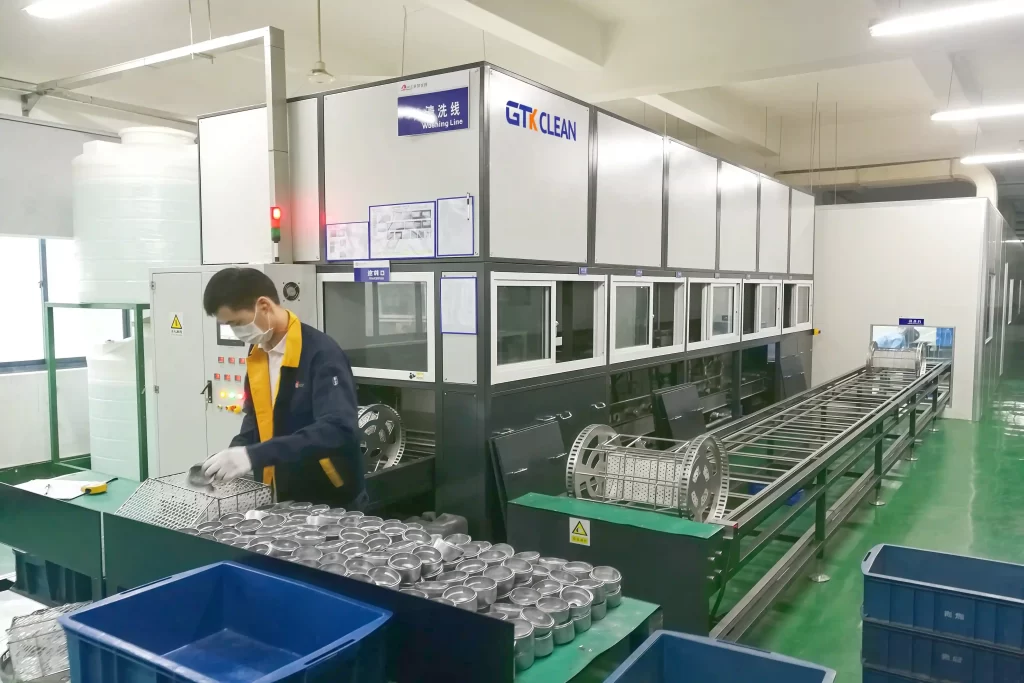
The first time I watched an ultrasonic cleaner strip years of carbon buildup from a precision machined part in under three minutes, I understood why this technology dominates industrial cleaning. The part came out looking factory-fresh, with every blind hole and internal channel spotless. That cleaning power traces back to one component: the ultrasonic transducer. These devices sit at the heart of every ultrasonic cleaning system, converting electrical signals into the mechanical energy that makes cavitation possible. Understanding how ultrasonic transducers work, and how to select the right one, determines whether a cleaning system delivers consistent results or becomes an expensive disappointment.
The Piezoelectric Effect Powers Industrial Ultrasonic Cleaning
Ultrasonic transducers function through the piezoelectric effect, a physical phenomenon where certain crystalline materials generate electrical charge under mechanical stress. The reverse also holds true: apply an electrical field to these materials, and they physically deform. In ultrasonic cleaning applications, this bidirectional property becomes the engine that drives the entire process.
When alternating current flows through a piezoelectric ceramic element, the material expands and contracts at the frequency of the electrical signal. These rapid mechanical oscillations transfer into the cleaning liquid as ultrasonic waves. The waves propagate through the solution, creating alternating zones of compression and rarefaction. During the low-pressure phase, dissolved gases and vapor form microscopic bubbles throughout the liquid. These bubbles grow rapidly until they reach an unstable size. When the next high-pressure wave arrives, the bubbles collapse violently in a process called cavitation.
The implosion of cavitation bubbles releases tremendous localized energy. Temperatures at the collapse point can briefly exceed several thousand degrees, and the resulting shockwaves and micro-jets strike nearby surfaces with enough force to dislodge stubborn contaminants. This happens millions of times per second across the entire cleaning bath. The acoustic energy reaches into blind holes, threads, and internal passages that spray washing or manual scrubbing cannot access.
Piezoelectric transducers dominate industrial applications because they offer high conversion efficiency and operate across a broad frequency range. Magnetostrictive transducers exist as an alternative, using magnetic fields to induce mechanical vibration in ferromagnetic materials, but piezoelectric designs handle most cleaning tasks more economically. The choice between transducer types depends on power requirements, operating frequency, and expected service life. GTKCLEAN's transducer designs reflect over two decades of refinement, with 28 technical patents supporting performance claims that hold up under production conditions.
Cavitation Mechanics Determine Cleaning Quality
Superior cleaning results from controlled cavitation, not just powerful cavitation. The distinction matters because raw acoustic energy without proper distribution creates uneven cleaning and potential part damage. Effective ultrasonic transducer technology balances bubble formation, collapse intensity, and spatial uniformity across the cleaning zone.
When electrical energy reaches the transducer, the piezoelectric element converts it into mechanical vibrations at the target frequency. These vibrations radiate into the cleaning solution as pressure waves. The wave amplitude determines how aggressively bubbles form and collapse. Higher amplitude means more energetic cavitation, but pushing too hard causes vapor lock conditions where the liquid cannot recover between pressure cycles.
The micro-jets produced during bubble collapse penetrate surface irregularities with remarkable precision. Oils, machining chips, polishing compounds, and oxide layers all yield to this microscopic scrubbing action. The cleaning happens simultaneously across every exposed surface, including areas completely inaccessible to mechanical brushes or directed spray. A blind hole ten diameters deep cleans as thoroughly as an exposed flat surface, provided the ultrasonic energy distribution remains uniform.
Degassing plays an underappreciated role in cleaning performance. Dissolved air in the cleaning solution cushions cavitation bubble collapse, reducing cleaning intensity. Ultrasonic energy drives dissolved gases out of solution during the first few minutes of operation. Systems that account for this degassing period deliver more consistent results than those that assume full cleaning power from the moment of startup.
GTKCLEAN designs ultrasonic cleaning systems for specific industrial applications, including Ultrasonic Cleaners for CNC Machined Parts and Ultrasonic Cleaners For Stamping Parts. Multi-stage configurations combine ultrasonic cleaning with high-pressure spray, ultrapure water rinsing, and controlled drying. Pre-PVD coating applications demand this level of process control because any residual contamination compromises coating adhesion.
For a deeper understanding of how these waves clean so effectively, explore 《What Is the Principle of an Ultrasonic Cleaning Machine?》.
Frequency Selection Shapes Cleaning Outcomes
The operating frequency of an ultrasonic transducer determines the size and behavior of cavitation bubbles, which directly affects what contaminants the system can remove and what parts it can safely clean. Getting this choice wrong means either inadequate cleaning or damaged workpieces.
Low Frequency Systems Handle Heavy Contamination
Transducers operating at 20-40 kHz produce relatively large cavitation bubbles. When these bubbles collapse, they release substantial energy over a broader area. This aggressive action strips heavy contamination from robust parts quickly. Engine blocks caked with carbon deposits, large molds coated with release agents, and heavily soiled industrial components respond well to low-frequency cleaning.
The trade-off involves surface impact. Larger bubble collapse events can erode soft materials or damage delicate surface finishes over extended exposure. Parts with thin walls, polished surfaces, or soft metal compositions may show cavitation damage after low-frequency cleaning. The cleaning bath itself experiences more wear at lower frequencies, requiring more durable tank construction.
High Frequency Systems Protect Delicate Parts
Transducers in the 68-200 kHz range generate much smaller cavitation bubbles. The collapse events release less energy individually, but the higher bubble density provides thorough coverage. Fine particles, light oils, and surface films lift away without the mechanical stress that accompanies low-frequency cleaning.
Precision components with tight tolerances benefit from high-frequency cleaning. Optical parts, electronic assemblies, medical devices, and aerospace components often require frequencies above 80 kHz to prevent surface degradation. The smaller bubbles also penetrate finer geometries more effectively, cleaning micro-channels and delicate features that larger bubbles cannot reach.
| Factor | Low Frequency (20-40 kHz) | High Frequency (68-200 kHz) |
|---|---|---|
| Cavitation | Large, aggressive bubbles | Small, gentle bubbles |
| Contaminants | Heavy, stubborn soils | Fine particles, light oils |
| Parts | Robust, large components | Delicate, intricate parts |
| Penetration | Deep into blind holes | Excellent for complex geometries |
| Surface Impact | Higher potential for erosion | Minimal risk of damage |
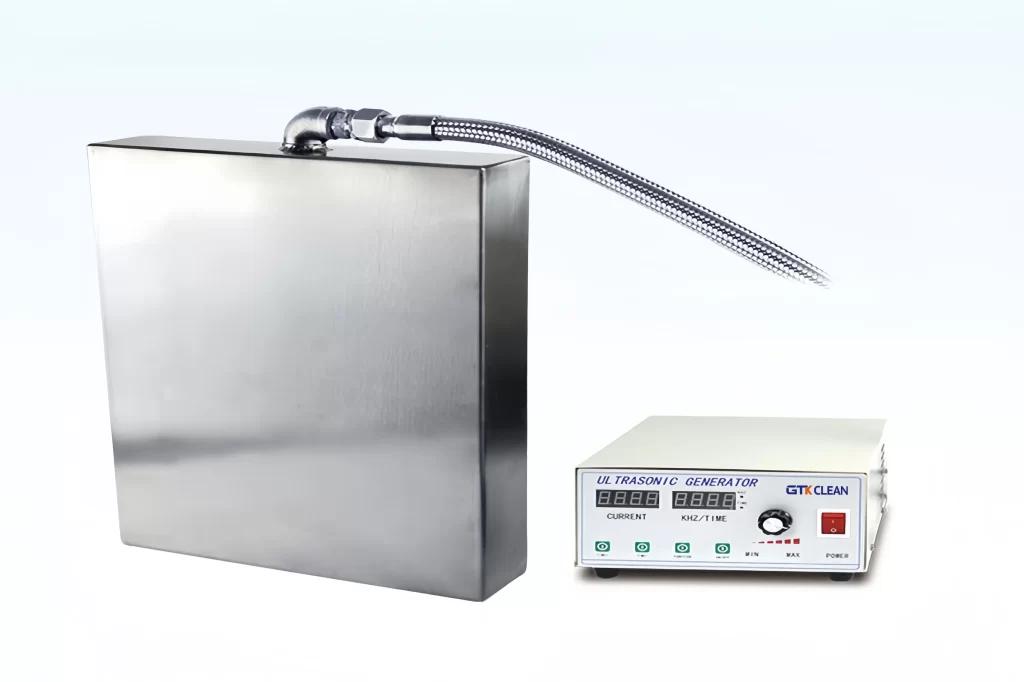
GTKCLEAN offers Ultrasonic Vibration Plate configurations at 20kHz, 28kHz, 40kHz, and 80kHz to address this range of requirements. Matching frequency to application prevents both cleaning failures and part damage.
To understand the underlying scientific principle that powers these transducers, read 《What Is The Piezoelectric Effect?》.
Transducer Configuration Affects System Design
Beyond frequency, the physical arrangement of ultrasonic transducers within a cleaning system influences performance, flexibility, and maintenance requirements. Three main configurations serve different operational needs.
Immersible Transducers Convert Existing Tanks
Immersible transducers are self-contained, sealed units that lower directly into a cleaning tank. They include the piezoelectric elements, housing, and electrical connections in a waterproof package. Facilities with existing tanks can add ultrasonic capability without replacing infrastructure. The transducers sit on the tank bottom or suspend from brackets, directing acoustic energy upward through the cleaning solution.
This configuration offers flexibility but requires attention to placement. Transducer positioning affects the uniformity of the acoustic field. Poorly placed immersible units create dead zones where cavitation intensity drops below effective levels. The sealed construction also limits heat dissipation, so duty cycle restrictions may apply in demanding applications.
Bolt-On Transducers Integrate with Custom Tanks
Bolt-on transducers mount permanently to the exterior of a tank, typically bonded to the bottom or sides with specialized adhesives or mechanical fasteners. The tank wall becomes part of the acoustic transmission path, conducting vibrations from the transducer into the cleaning solution. This arrangement allows custom tank geometries and materials while maintaining efficient energy transfer.
The bond between transducer and tank must remain intact throughout the system's service life. Thermal cycling, chemical exposure, and mechanical stress can degrade adhesive bonds over time. Quality bonding procedures and appropriate adhesive selection prevent the performance degradation that accompanies partial delamination.
Plate Transducers Suit High-Volume Operations
Plate transducers integrate multiple piezoelectric elements into a single structural panel. These panels form part of the tank itself, providing uniform acoustic energy across large cleaning areas. Continuous flow systems and high-throughput production lines benefit from this configuration because it maintains consistent cleaning intensity regardless of part position within the tank.
The integrated construction simplifies maintenance by reducing the number of individual components. However, replacing a failed element typically requires removing the entire plate assembly. System designers balance this consideration against the performance advantages of integrated construction.
Maintenance Practices Protect Long-Term Performance
Ultrasonic transducers operate under demanding conditions. Continuous vibration, chemical exposure, and thermal cycling stress both the piezoelectric elements and their mounting systems. Preventive maintenance extends service life and prevents the gradual performance degradation that leads to cleaning failures.
Recognizing Common Failure Modes
Cavitation erosion affects transducer faces and tank surfaces over time. The same bubble collapse events that clean parts also attack exposed metal. Transducer housings and tank bottoms near high-intensity zones show pitting and material loss after extended service. Regular inspection catches erosion before it compromises structural integrity.
Overheating damages piezoelectric ceramics and degrades bonding adhesives. Transducers generate heat during operation, and inadequate cooling allows temperatures to climb into damaging ranges. Maintaining proper liquid levels ensures the cleaning solution absorbs and dissipates this heat. Operating with insufficient liquid or excessively high power settings accelerates thermal damage.
Electrical failures often begin with moisture ingress. Seals and cable glands degrade over time, allowing cleaning solution or atmospheric moisture to reach electrical connections. Corrosion and short circuits follow. Periodic inspection of seals and prompt replacement of damaged components prevents electrical failures.
Bonding separation reduces acoustic energy transfer from bolt-on transducers. When the adhesive bond between transducer and tank degrades, vibrations no longer couple efficiently into the cleaning solution. Cleaning performance drops even though the transducer itself continues operating normally. Acoustic measurements or cleaning performance tests reveal bonding problems before complete failure.
Implementing Preventive Measures
Maintaining optimal operating parameters prevents most transducer problems. Liquid levels should remain within specified ranges to ensure proper cooling and acoustic coupling. Cleaning solution chemistry must stay within compatibility limits for transducer materials and tank construction. Power settings should match the actual cleaning requirements rather than defaulting to maximum output.
Regular inspection schedules catch developing problems early. Visual examination reveals erosion, corrosion, and seal degradation. Acoustic measurements confirm that transducers deliver expected energy levels. Cleaning performance tests verify that the system still meets cleanliness specifications.
GTKCLEAN builds Ultrasonic Generator and Ultrasonic Cleaning Systems for durability under production conditions. Robust construction and quality components reduce maintenance frequency, but no system operates indefinitely without attention.
Emerging Technologies Expand Cleaning Capabilities
Ultrasonic transducer technology continues advancing as manufacturers pursue higher efficiency, broader application ranges, and reduced environmental impact. Several development directions show particular promise for industrial cleaning applications.
Multi-Frequency Systems Offer Operational Flexibility
Traditional ultrasonic cleaners operate at a single fixed frequency. Multi-frequency transducers can switch between operating frequencies, allowing one system to handle both aggressive cleaning of robust parts and gentle cleaning of delicate components. This flexibility reduces equipment requirements for facilities that process diverse part types.
The frequency switching happens through electronic control of the driving signal. The transducer itself must accommodate the mechanical stresses of multiple resonant frequencies, which requires careful design of the piezoelectric stack and mounting system. GTKCLEAN's 28 technical patents include innovations in this area.
Advanced Materials Improve Efficiency and Durability
New piezoelectric ceramic formulations offer higher conversion efficiency, converting more electrical energy into acoustic energy. This reduces power consumption for equivalent cleaning performance. Improved materials also withstand higher operating temperatures and resist degradation from chemical exposure.
Transducer housing materials have evolved alongside the piezoelectric elements. Corrosion-resistant alloys and engineered polymers extend service life in aggressive cleaning chemistries. These material advances reduce maintenance requirements and improve long-term reliability.
Intelligent Control Systems Optimize Performance
Modern ultrasonic cleaning systems incorporate sensors and feedback control to maintain optimal operating conditions automatically. Acoustic sensors measure actual cavitation intensity and adjust power output to compensate for changes in liquid level, temperature, or part loading. This real-time optimization ensures consistent cleaning results across varying production conditions.
Integration with facility automation systems allows ultrasonic cleaners to participate in larger production workflows. Parts tracking, quality data logging, and predictive maintenance alerts become possible when cleaning systems communicate with plant-wide control networks.
Automated Systems Multiply Transducer Effectiveness
Integrating ultrasonic transducers into automated cleaning systems transforms cleaning from a manual operation into a controlled, repeatable process. Automation ensures every part receives identical treatment, eliminating the variability that accompanies manual handling.
Multi-stage automated systems combine ultrasonic cleaning with complementary processes. A typical sequence might include high-pressure spray to remove loose debris, ultrasonic degreasing to strip oils and cutting fluids, multiple rinse stages with progressively purer water, and controlled drying. Each stage addresses specific contamination types, and the ultrasonic transducers handle the most challenging cleaning tasks.
GTKCLEAN's Automated Ultrasonic Cleaners for CNC machined parts exemplify this integrated approach. Parts move through the cleaning sequence on automated handling systems, spending precisely controlled time at each station. PLC control systems from Siemens or Mitsubishi manage the entire process, monitoring parameters and alerting operators to any deviation from specifications.
Rotary Basket Ultrasonic Cleaning Systems add mechanical motion to ultrasonic action. Parts tumble gently within rotating baskets as ultrasonic waves clean all surfaces. This combination proves particularly effective for complex parts with blind holes and internal passages, where static positioning might leave some surfaces in acoustic shadows.
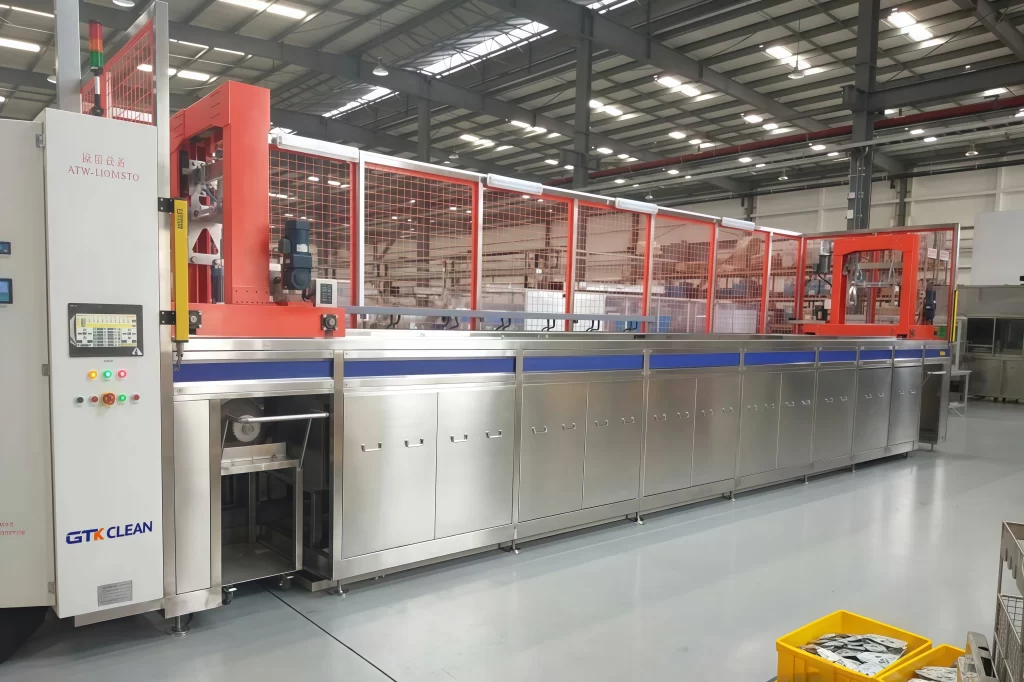
Tunnel Cleaning Systems handle high-volume production of smaller parts like fasteners. Continuous conveyors carry parts through ultrasonic cleaning zones, maintaining throughput rates that batch systems cannot match. The transducer arrays in these systems must deliver uniform acoustic energy across the entire conveyor width to ensure consistent cleaning.
Partner with GTKCLEAN for Production-Ready Solutions
Industrial cleaning challenges vary enormously across applications, and ultrasonic transducer technology offers the flexibility to address most of them effectively. The key lies in matching transducer characteristics to specific cleaning requirements. Frequency, power, configuration, and integration all influence the final result.
GTKCLEAN brings over two decades of focused experience to these matching decisions. Our engineering team has solved cleaning problems across industries, from precision aerospace components to high-volume automotive parts. That accumulated knowledge informs every system we design.
Contact our specialists to discuss your specific cleaning challenges. We can evaluate your parts, contamination types, and production requirements to recommend appropriate ultrasonic transducer technology. Reach us at +86 17768507147 or [email protected].
Frequently Asked Questions About Ultrasonic Transducer Technology
What distinguishes immersible, bolt-on, and plate transducers in practical applications?
Immersible transducers drop directly into existing tanks, making them the fastest path to adding ultrasonic capability without replacing infrastructure. They work well for facilities testing ultrasonic cleaning or processing smaller volumes. Bolt-on transducers attach permanently to tank exteriors, offering better thermal management and longer service life for dedicated production systems. Plate transducers integrate multiple elements into structural panels, providing the most uniform acoustic field for high-volume continuous operations. Selection depends on whether you need flexibility, durability, or throughput.
Why does operating frequency matter so much for cleaning results?
Frequency controls cavitation bubble size, which determines both cleaning intensity and surface impact. A 25 kHz transducer produces bubbles roughly four times larger than an 80 kHz transducer. Those larger bubbles collapse with more force, stripping heavy contamination quickly but potentially damaging soft materials. Smaller high-frequency bubbles clean gently enough for polished surfaces and delicate geometries while still removing fine particles and light oils. Choosing the wrong frequency means either inadequate cleaning or damaged parts.
How can facilities prevent premature transducer failure?
Most transducer failures trace back to operating conditions rather than component defects. Maintaining proper liquid levels prevents overheating. Using compatible cleaning chemistries avoids corrosion of transducer housings and tank materials. Operating at appropriate power levels for the actual cleaning task reduces mechanical stress on piezoelectric elements. Regular inspection catches seal degradation before moisture reaches electrical connections. Facilities that follow these practices typically see transducer service life measured in years rather than months.
 English
  German
  Spanish
  French
  Russian
  Portuguese