
Why Cleaning System Selection Drives Production Output
Cleaning system selection determines whether a high-volume line runs continuously or stalls waiting for parts. The wrong choice creates bottlenecks that compound across shifts—parts queue up, operators idle, and downstream stations starve. The right choice keeps pace with machining output while meeting cleanliness specs that final assembly or coating operations demand.
Two system architectures dominate high-volume environments: conveyor systems that process parts in continuous flow, and batch systems that clean discrete loads. Each architecture suits different production profiles. Conveyor lines excel when part geometry stays consistent and volume justifies dedicated equipment. Batch systems handle mixed part families and intensive cleaning requirements that continuous flow cannot accommodate.
Understanding where each architecture fits—and where it fails—prevents procurement decisions that look efficient on paper but create operational headaches once installed.
What Makes High-Volume Cleaning Different from General Industrial Washing
High-volume cleaning operates under constraints that general-purpose washers never face. Cycle time matters in seconds, not minutes. A cleaning station that adds 45 seconds per part to a line producing 800 parts per hour creates a 10-hour backlog by end of shift. Throughput optimization is not a preference; it is a survival requirement.
Contaminant profiles in high-volume machining are predictable but aggressive. CNC operations leave cutting fluid residue, metal chips, fine burrs, and airborne dust on every surface. These contaminants must be removed completely before parts move to assembly, coating, or packaging. Incomplete cleaning causes adhesion failures in coatings, contamination in hydraulic assemblies, and customer rejects that damage supplier relationships.
Part geometry adds complexity. Blind holes, internal channels, and recessed features trap contaminants that spray washing alone cannot reach. Surface finish requirements vary—some parts need only visual cleanliness while others require residue-free surfaces for subsequent bonding or plating operations.
Automated cleaning solutions address these demands by removing operator variability from the process. Manual cleaning cannot maintain consistency across thousands of parts per shift. Automation ensures every part receives identical treatment, making quality control predictable rather than hopeful.
How Conveyor Systems Maintain Continuous Production Flow
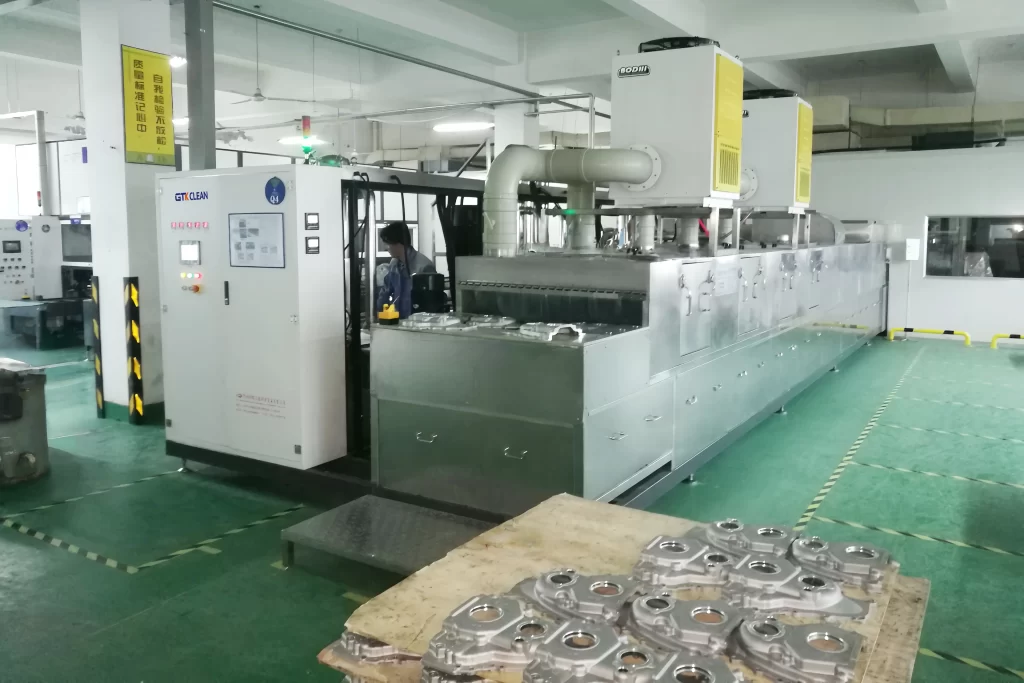
Conveyor cleaning systems process parts without interruption. Parts enter one end, pass through sequential cleaning stages, and exit ready for the next operation. No batching, no waiting, no operator intervention during normal operation.
The architecture integrates directly into production lines. Parts transfer from machining to cleaning to assembly on connected conveyors, eliminating the handling steps that batch processing requires. This in-line cleaning approach reduces work-in-process inventory and shortens the time between machining completion and final assembly.
Sequential cleaning stages handle different functions. Initial stages remove gross contamination—chips, heavy oil films, loose debris. Middle stages address residual cutting fluids and fine particulates. Final stages rinse and dry parts to specification. Each stage operates continuously while parts move through at production pace.
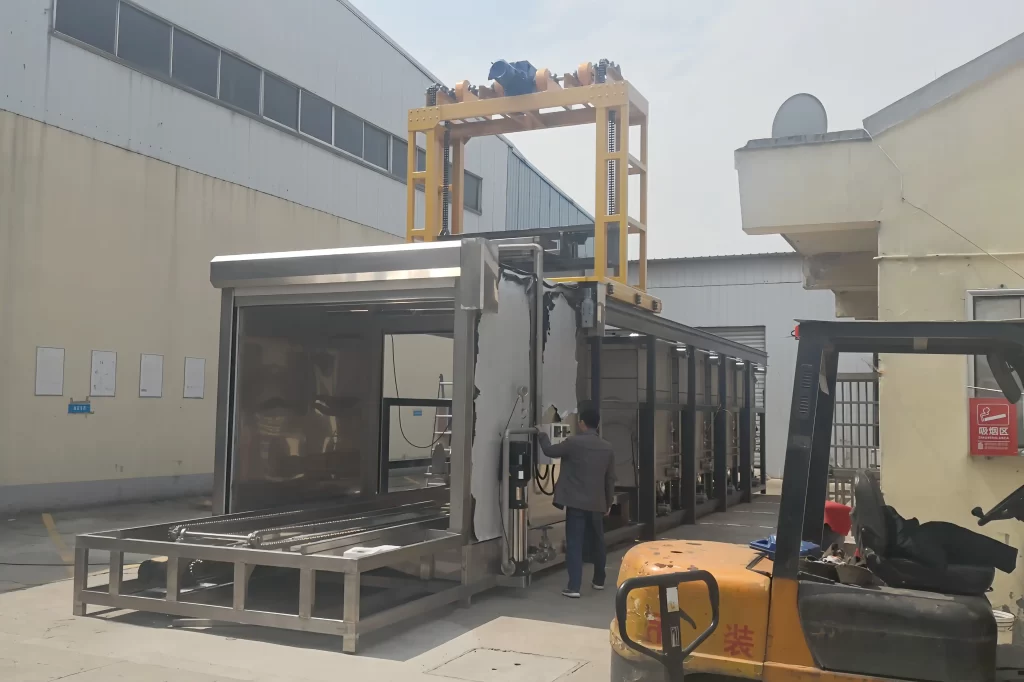
GTKCLEAN's CNC Aluminum Shell Inline Cleaner illustrates the architecture. Multi-directional spray nozzles eliminate dead angles where contamination hides. Integrated heat recovery captures energy from exhaust air and hot rinse water, reducing operating costs without compromising cleaning performance. The system maintains post-machining cleaning standards while keeping pace with upstream machining centers.
| Feature | Conveyor Systems |
|---|---|
| Throughput | High, continuous flow |
| Automation Level | Fully automated, in-line integration |
| Part Uniformity | Best for uniform parts |
| Cleaning Stages | Multi-stage, sequential |
| Labor Requirement | Low |
| Footprint | Linear, integrated into production line |
Conveyor systems demand part uniformity to function efficiently. When part geometry varies significantly, spray patterns optimized for one shape miss critical areas on another. Changeover between part types requires mechanical adjustments that interrupt continuous flow—the primary advantage of the architecture.
Where Batch Systems Outperform Continuous Flow
Batch cleaning systems process parts in discrete loads rather than continuous streams. This architecture sacrifices throughput continuity for flexibility and cleaning intensity that conveyor systems cannot match.
Ultrasonic cleaning technology exemplifies batch system capabilities. High-frequency sound waves generate cavitation bubbles throughout the cleaning fluid. These bubbles implode against part surfaces with enough force to dislodge contaminants from blind holes, internal threads, and surface textures that spray washing cannot penetrate. The physics work regardless of part orientation—contamination in a blind hole facing downward receives the same cleaning action as an exposed surface.
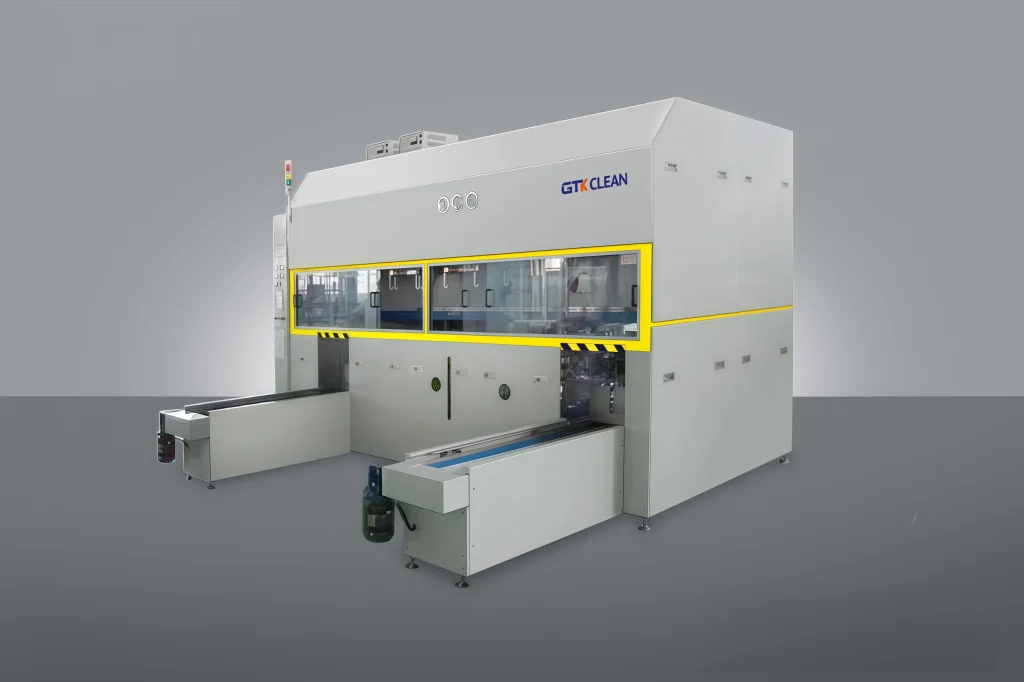
GTKCLEAN's Multi-Tank Hydrocarbon Ultrasonic Cleaners demonstrate advanced batch processing. Rotary baskets tumble parts during cleaning, ensuring all surfaces receive ultrasonic exposure. Vacuum ultrasonic cleaning removes air pockets from recessed features, allowing cleaning fluid to contact surfaces that would otherwise remain contaminated. The result is precision 360° cleaning that addresses the most challenging geometries.
| Feature | Batch Systems |
|---|---|
| Throughput | Moderate to high, intermittent |
| Automation Level | Automated loading/unloading, flexible processing |
| Part Uniformity | Suitable for diverse parts, complex geometries |
| Cleaning Stages | Multi-stage, customizable sequence |
| Labor Requirement | Moderate |
| Footprint | Compact, often standalone |
Solvent cleaning systems and aqueous cleaning systems represent the two primary chemistry options for batch processing. Solvent systems excel at removing oils and greases from precision components where water-based chemistry leaves residues. Aqueous systems handle a broader range of contaminants and avoid the handling requirements that solvents impose. Material compatibility determines which chemistry suits a given application—some alloys react with certain solvents while others tolerate aggressive aqueous formulations.
Multi-stage batch cleaning sequences address complex contamination profiles. An initial ultrasonic stage removes bulk contamination. Subsequent stages address specific residues with targeted chemistry. Vacuum drying eliminates moisture from blind holes and internal passages, preventing water spots and corrosion on finished parts.
Calculating True Operating Costs for Each Architecture
Initial purchase price misleads procurement decisions. A conveyor system with higher capital cost may deliver lower total cost of ownership than a batch system that appears cheaper at purchase. The calculation requires examining labor, energy, consumables, and maintenance over the equipment's operating life.
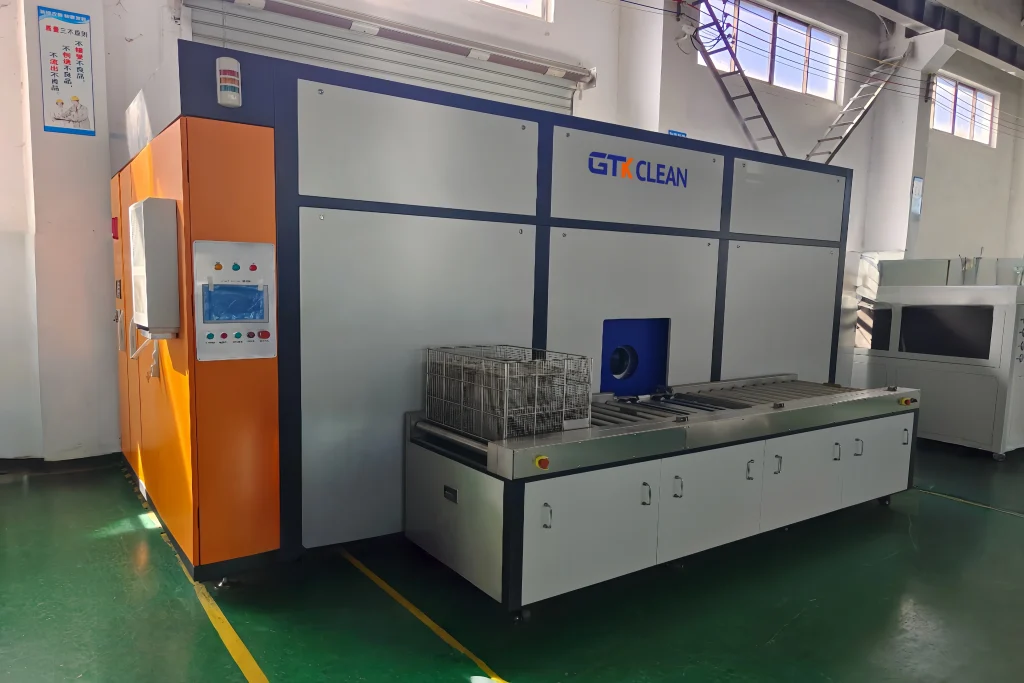
Labor costs differ fundamentally between architectures. Conveyor systems operate with minimal intervention once running—an operator monitors the line but does not handle individual parts. Batch systems require loading and unloading operations that consume labor hours proportional to throughput. Automated material handling reduces batch system labor requirements but adds capital cost and maintenance complexity.
Energy consumption patterns vary with operating mode. Conveyor systems consume energy continuously during production hours, maintaining heated wash stages and running pumps regardless of part flow rate. Batch systems consume energy only during active cleaning cycles, but peak demand during ultrasonic operation and heating phases can exceed conveyor system steady-state consumption.
Consumables cost depends on cleaning chemistry and system design. Water usage, cleaning chemical consumption, and waste treatment requirements all contribute to operating expense. Filtration and circulation systems extend cleaning fluid life by removing contaminants before they accumulate to levels requiring fluid replacement. GTKCLEAN's ultrasonic cleaners incorporate these systems specifically to reduce waste and operating expenses over the equipment's service life.
Return on investment calculations must account for throughput value. A cleaning system that enables higher production output generates revenue that offsets operating costs. The financial comparison between architectures depends on how each system affects overall line capacity, not just direct cleaning costs.
How System Choice Affects Line Integration and Material Flow
Production line integration determines whether a cleaning system enhances or disrupts material flow. Conveyor systems integrate into linear manufacturing processes as another station in the sequence. Parts flow from machining through cleaning to assembly without accumulating at transfer points.
This integration supports lean manufacturing principles by eliminating inventory buffers between operations. Work-in-process stays low because parts move continuously rather than waiting in batches. Production scheduling becomes predictable when cleaning cycle time matches upstream and downstream operations.
Fastener Tunnel Cleaners demonstrate high-throughput conveyor integration. Production rates exceeding 2 tons per hour for screws and bolts match the output of high-speed forming and threading equipment. The cleaning station keeps pace with production rather than constraining it.
Batch systems require different integration approaches. Dedicated loading and unloading stations handle material transfer between production flow and cleaning operations. Buffer inventory accumulates before cleaning to form economical batch sizes, then accumulates again after cleaning while awaiting downstream operations.
Bottleneck analysis reveals whether batch system flexibility justifies the material handling complexity it introduces. If your production involves multiple part families with different cleaning requirements, batch system flexibility may outweigh the integration advantages of conveyor architecture. If part families share similar geometries and contamination profiles, conveyor integration typically delivers higher overall throughput.
Matching Cleaning Requirements to System Capabilities
The selection decision ultimately depends on matching specific cleaning requirements to system capabilities. Neither architecture suits all applications, and forcing a mismatch creates ongoing operational problems.
Regulatory compliance requirements may dictate system selection. Industries with stringent cleanliness specifications—medical devices, aerospace components, precision optics—often require the intensive cleaning that batch ultrasonic systems provide. Industries with less demanding specifications may find conveyor systems adequate for their needs.
Surface preparation requirements vary by downstream process. Parts destined for electroplating require different cleanliness levels than parts going directly to assembly. Degreasing solutions must remove all organic contamination before plating, while assembly-bound parts may tolerate trace residues that do not affect function.
Waste management considerations affect both capital and operating costs. Solvent cleaning systems require vapor containment, solvent recovery, and hazardous waste handling that aqueous systems avoid. These requirements add cost and complexity but may be justified when solvent cleaning delivers superior results for specific applications.
GTKCLEAN's 20 years of R&D experience and 28 technical patents support custom cleaning solutions for unique high-volume production challenges. Standard equipment addresses common requirements, but many applications benefit from modifications that optimize cleaning performance for specific part geometries, contamination profiles, or throughput requirements.
Evaluating Your Production Profile for System Selection
Batch cleaning systems suit diverse part geometries and varied cleaning requirements better than conveyor systems. Processing parts in discrete baskets allows customized cleaning protocols—specific ultrasonic frequencies, solvent types, or cycle times—that address complex geometries, delicate parts, or heavy-duty cleaning needs. Conveyor systems excel when part uniformity allows standardized processing parameters.
If your production involves high volumes of similar parts with consistent contamination profiles, conveyor architecture likely delivers the best combination of throughput and cost efficiency. If your production involves mixed part families, complex geometries, or cleaning requirements that vary between part types, batch architecture provides the flexibility to address each requirement appropriately.
For facilities evaluating cleaning system options, GTKCLEAN provides consultation services that assess production requirements and recommend appropriate solutions. Contact [email protected] or +86 17768507147 to discuss your specific application.
Frequently Asked Questions
What determines whether conveyor or batch cleaning costs less for high-volume production?
Cost-effectiveness depends on throughput consistency, part uniformity, and cleaning intensity requirements. Conveyor systems typically deliver lower per-unit costs when processing high volumes of similar parts because automation eliminates labor costs that scale with volume. Batch systems become more economical when part variety requires flexible cleaning protocols that would force frequent changeovers on a conveyor line, or when intensive ultrasonic cleaning justifies longer cycle times per batch.
How do automated cleaning systems maintain consistent cleanliness across thousands of parts?
Automated systems eliminate operator variability by controlling cleaning parameters precisely. Temperature, chemistry concentration, cycle time, and mechanical action remain constant across every cleaning cycle. GTKCLEAN's systems incorporate sensors and controls that maintain these parameters within specification regardless of production volume. The 28 technical patents underlying these systems address specific challenges in maintaining repeatable cleaning performance at high throughput rates.
Can existing production lines accommodate either cleaning system architecture?
Adaptability depends on facility layout and material flow patterns. Conveyor systems integrate most easily into linear production flows where parts move in sequence from operation to operation. Batch systems offer placement flexibility but require space for loading stations and buffer inventory. GTKCLEAN's system integration planning evaluates existing layouts and recommends configurations that minimize disruption while achieving cleaning performance requirements. Reach out at [email protected] to discuss integration options for your facility.
If you're interested, you may want to read the following articles:
Precision Parts Cleaning Standards: An Expert Guide to Industrial Cleanliness
Boost Automotive Manufacturing Cleaning Efficiency: A Strategic Guide
Ultrasonic Cleaning systems for Pre PVD (Coating) Parts
 English
  German
  Spanish
  French
  Russian
  Portuguese