

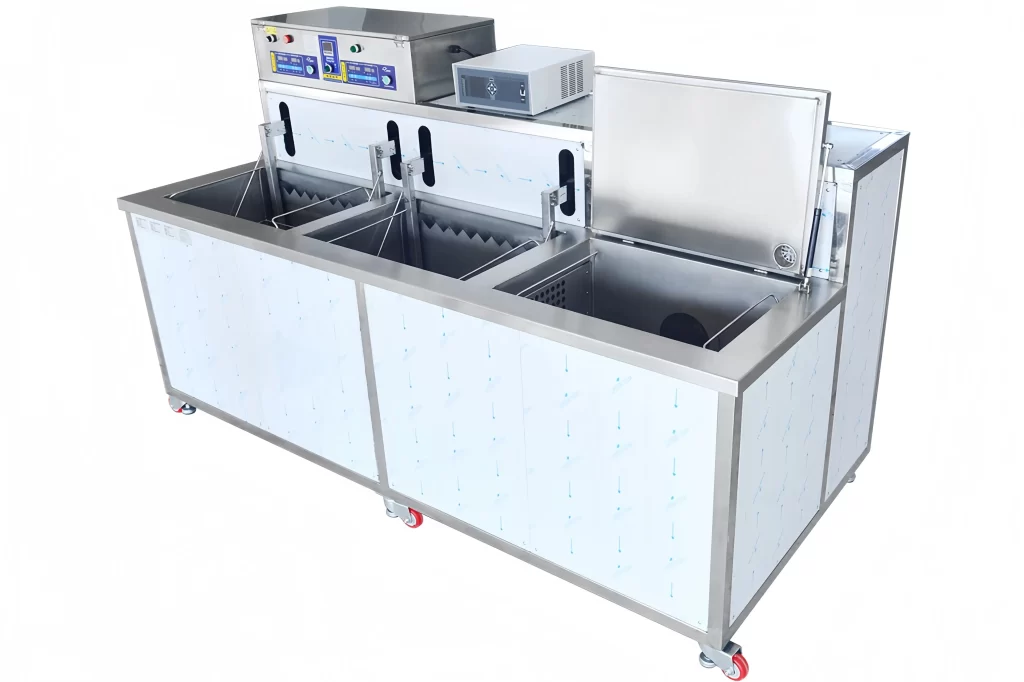
Volatile organic compound emissions from industrial solvent cleaning are one of the first things environmental regulators scrutinize, and I have seen production managers assume that any closed-loop machine will pass. That assumption is expensive. Meeting VOC emission standards for solvent cleaning is less about regulatory paperwork and more about whether your cleaning equipment physically keeps solvent vapors from escaping. At GTKCLEAN, we design vacuum-sealed hydrocarbon and modified alcohol cleaning systems for manufacturers across more than 20 countries, and the biggest difference between a compliant installation and one that fails an air permit is how the machine handles vapor from the moment parts are loaded to the moment they are dry.
What VOC Emission Standards Mean for Solvent Cleaning
Solvent cleaning systems that use hydrocarbon or modified alcohol solvents release VOCs whenever the liquid or its vapor is exposed to the atmosphere. Regulators care about this because VOCs contribute to ground-level ozone, and industrial cleaning operations are a controllable source. In the United States, the EPA's National Emission Standards for Hazardous Air Pollutants (NESHAP) for halogenated solvent cleaning set work practice and emission limit requirements, and many states have their own volatile organic compound limits. The European Union's Industrial Emissions Directive drives VOC thresholds that affect solvent degreasing and cleaning processes, and in countries that adopt EU-style frameworks, the same logic applies: if you use organic solvents, you must demonstrate that you are capturing and recovering the vapor rather than venting it.
What makes this relevant to equipment selection is that standard atmospheric open-top degreasers often cannot meet current limits without expensive add-ons. Automated vacuum cleaning systems, by contrast, run the entire cycle under negative pressure and condense the solvent instead of releasing it. The regulatory expectation is not that you use zero solvent, but that you control the emission rate throughout the process, including during load transfer and drying.
How Solvent Cleaning Equipment Controls VOC Emissions
The core emission control strategy is to operate in a sealed, oxygen-depleted environment. In the hydrocarbon and modified alcohol vacuum cleaning systems we build, a vacuum pump evacuates the chamber before any cleaning begins, so there is no air to carry solvent vapor out. The solvent is heated indirectly to 40–60 °C and circulated through the chamber, and ultrasonic transducers generate cavitation in the liquid to achieve the mechanical cleaning effect. Because the chamber remains under vacuum, any vapor generated during the cleaning step stays inside until it is deliberately drawn through a condensation system.
When the cleaning phase ends, the same vacuum system pulls the vapor back through refrigerated or water-cooled condensers, where the solvent returns to its liquid state and is collected for reuse. Drying also happens under vacuum. Instead of hot air that would carry solvent out of the machine, the chamber pressure is lowered enough that the residual solvent on the parts boils at a low temperature. That vapor is condensed as well. The result is that the only thing leaving the machine at the end of the cycle is clean, dry parts, and there is essentially no uncontrolled emission during normal operation.
Key Equipment Features That Enable VOC Compliance
The difference between a machine that can demonstrate compliance and one that cannot often comes down to specific engineering features. Over years of commissioning these systems, I have seen which ones matter most for emission control.
| Feature | What It Does for VOC Emissions |
|---|---|
| Vacuum-sealed chamber | Prevents vapor escape during cleaning and transfer |
| Indirect solvent heating | Avoids excessive vapor generation and thermal degradation |
| Internal condensation circuit | Recovers solvent from the vapor phase before any venting |
| Integrated distillation recovery | Continuously reclaims solvent from contaminated liquid, reducing waste and emission load |
| Automated closed-loop loading | Minimizes exposure of solvent-laden air to the atmosphere during basket transfer |
| Gas monitoring and interlock | Prevents cycle start if oxygen levels are too high, blocking unplanned emissions |
A system with a vacuum chamber but no integrated distillation will still emit VOCs when the contaminated solvent is eventually handled. Compliance is strongest when the solvent is continuously recycled inside the same sealed loop.
Solvent Recovery Systems: Cutting Emissions and Costs
Solvent recovery is not an optional add-on in a well-designed emission control strategy; it is the mechanism that turns a solvent consumption cost into a reusable resource. In the hydrocarbon solvent ultrasonic vacuum cleaners we produce, each machine includes a built-in vacuum distillation unit. Once the cleaning solvent accumulates oils, additives, or fine particulate, a slipstream is drawn off, heated under vacuum, and the clean solvent vapor is condensed back into the reservoir. The remaining sludge, which is less than 5% of the original volume, is the only waste stream that requires disposal.
This has two direct impacts on VOC emissions. First, because the solvent is purified continuously, the machine does not need to be opened frequently for solvent changes, which would release vapor. Second, the waste oil and sludge contain a much smaller fraction of volatile solvent, so the downstream environmental liability shrinks. I have measured monthly hydrocarbon consumption on a single-station vacuum machine at under 200 liters in continuous production, compared to several times that volume when recovery is absent. For a factory operating under tight VOC limits, that reduction often makes the difference between needing a Title V air permit and operating with a simpler regulatory status.
Choosing a Solvent Cleaning System for Regulated Environments
When I work with buyers in aerospace, precision hardware, or automotive component manufacturing, the conversation about VOCs almost always starts with the local emission thresholds. A supplier that only discusses cleaning throughput without asking about your air permit requirements is leaving the hardest part of the compliance equation to you.
Before investing in a system, I recommend confirming these points with the manufacturer:
- The vacuum pressure achieved during cleaning and drying, and the leak rate the system is designed to maintain.
- Whether the refrigeration condensers cool the vapor to a temperature low enough for your specific solvent's vapor pressure curve.
- The capture efficiency of the integrated recovery — expressed as a percentage of solvent that leaves as waste versus what is recycled.
- Whether the PLC interface can log and export pressure, temperature, and cycle data that air quality inspectors may request.
If your parts involve deep recesses, blind holes, or complex geometries that are prone to solvent retention, follow up by asking the supplier to show emission test data from a machine handling similar components. Most generic emission claims are based on flat plates, which exaggerate compliance for real-world part configurations. Share your product's part number, typical oil loading, and target throughput at [email protected], and we will confirm whether a vacuum-sealed system can meet your emission limits before you commit capital.
Making Emission Compliance Part of the Cleaning Specification
Many factories treat VOC compliance as an after-the-fact permit exercise. The firms that avoid violations and operational disruptions are the ones that write emission control requirements into the initial equipment specification, not the other way around. A vacuum-capable solvent cleaning machine that integrates thermal distillation and closed-loop transfer can reduce solvent consumption and airborne emissions dramatically, but the performance is determined by the engineering choices made before the machine is built.
At GTKCLEAN, we engineer solvent cleaning systems with these controls as standard features because we have seen how even a small bypass in the recovery loop can cause a multi-day compliance gap. Whether you are cleaning high-precision CNC components, stamping parts with drawing oil, or heavy-duty castings requiring pre-coating cleanliness, the principle is the same: the cleaning process should not become a source of regulatory exposure. We configure the machine around your part size, cleaning medium, and target emission rate so that the equipment itself becomes the compliance documentation. To discuss what a system designed for your specific VOC envelope looks like, contact us at [email protected] or call +86 17768507147.
Common Questions About VOC Emissions and Solvent Cleaning
If a machine is listed as "closed-loop," does that automatically mean it meets VOC limits?
A "closed-loop" label can mean anything from a sealed lid to full vacuum operation with integrated recovery. Regulators care about the actual emission rate, not the marketing term. A machine that recycles solvent internally but vents the chamber during drying may still exceed local thresholds. Always verify the capture efficiency and the condensation temperature relative to your solvent's vapor pressure before accepting a claim of compliance.
Our production volume varies widely week to week. Can a vacuum system still operate economically?
Vacuum cleaning systems are particularly well-suited to variable throughput because they stay sealed between batches. There is no continuous exhaust stream that wastes solvent regardless of how many parts are inside. You can run one load per shift or six, and the per-part solvent consumption stays roughly the same. This flexibility often makes vacuum machines more economical than continuous-airflow degreasers for medium to high variety manufacturers.
We already use a hydrocarbon solvent with a high boiling point. Do we still need vacuum sealing?
A high boiling point reduces evaporative loss at ambient conditions, but once the solvent is heated to its effective cleaning temperature, its vapor pressure rises and room-temperature condensation becomes inefficient. The vacuum system solves both problems by lowering the boiling point so that cleaning can occur at a lower temperature and by providing a tight pressure envelope for vapor recovery. Without the vacuum, a significant fraction of that vapor will find its way out through seals and loading interlocks.
How do I prove to an inspector that my cleaning line meets the emission standard?
The proof comes from operational data, not just equipment specifications. Systems we supply log the vacuum pressure, condenser temperature, recovery volume, and cycle count, and these logs can be exported in formats that air quality agencies recognize. Pair that data with a mass balance showing how much solvent enters the system versus what leaves as waste, and you have a defensible compliance record.
What if our facility already exceeds the local VOC cap during certain months?
Seasonal exceedances are often caused by older atmospheric degreasers running in hot weather when their refrigeration cannot keep up. Replacing those stations with vacuum-sealed units removes the weather variable and typically brings the facility back under the cap. If you are already operating a vacuum system and still seeing seasonal spikes, the recovery cycle may be overloaded during peak throughput. Share your monthly solvent usage and production schedule at [email protected], and we will review whether an auxiliary recovery module or process adjustment can flatten the emission curve.
If you're interested, check out these related articles:
Manual Ultrasonic Cleaning Systems: Applications and Limitations Guide
Industrial Cleaning Equipment Suppliers: A Strategic Buyer’s Guide
Pre-Coating Cleaning Solutions for PVD - GTK
Selecting Industrial Parts Washers for CNC Machining Success
Ultrasonic Cleaning systems for Pre PVD (Coating) Parts
 English
  German
  Spanish
  French
  Russian
  Portuguese