
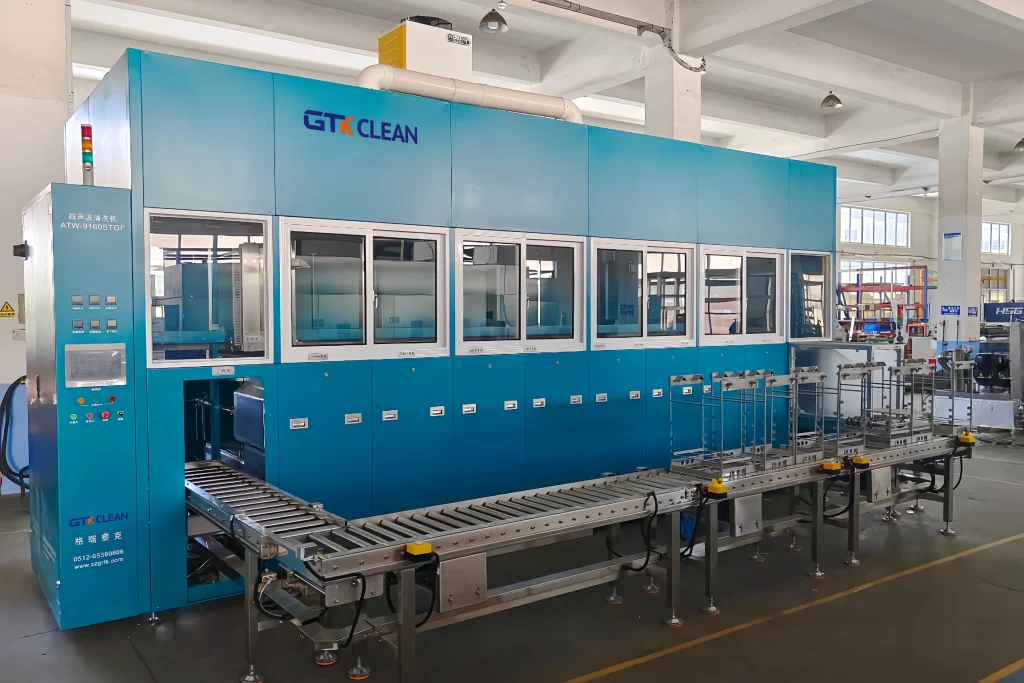
Industrial cleaning equipment runs around the clock in most production environments. When a line stops because a washer fails, the cost is not just the repair bill—it is the lost output, the delayed shipments, and the quality rejects that pile up while the machine sits idle. After-sales support for industrial cleaning equipment is what separates a capital purchase from a long-term operational asset. The right support structure keeps machines running, extends their useful life, and lowers the total amount you spend per cleaned part over a decade of service.
What actually belongs in an after-sales support package for industrial cleaning equipment
A support package that looks comprehensive on paper can still leave gaps in practice. The components that matter most are the ones that shorten the interval between "something is wrong" and "the machine is running again."
Preventive maintenance programs schedule inspections and fluid changes before wear becomes failure. On-site technical assistance puts a trained engineer in your facility when remote guidance is not enough. Spare parts availability determines whether a repair takes two days or two weeks—stocking critical components locally, or at least regionally, is non-negotiable for high-volume operations. Operator training reduces the number of calls that start with "the machine stopped and we do not know why." Remote diagnostics let a technician see real-time parameters from the control system, often identifying the fault before a truck rolls. Warranty management defines what is covered, for how long, and how quickly a claim gets processed. Technical documentation—wiring diagrams, hydraulic schematics, PLC ladder logic—gives your maintenance team a fighting chance at first-pass diagnosis. A customer support portal centralizes service requests, tracks open tickets, and stores historical records that help identify recurring issues.
None of these components work in isolation. A preventive maintenance visit that flags a worn pump seal is only useful if the replacement seal is in stock and the technician has the documentation to verify the correct part number.
How predictive maintenance and remote monitoring reduce unplanned stops
Scheduled maintenance catches problems on a calendar. Predictive maintenance catches problems on a trend line. The difference matters when a bearing is failing faster than the calendar predicted.
Predictive systems pull data from vibration sensors, temperature probes, flow meters, and current monitors. When a parameter drifts outside its normal band, the system flags it before the operator notices anything wrong. A multi-tank hydrocarbon ultrasonic cleaner with automated safety interlocks, for example, can report a gradual rise in solvent temperature that suggests a cooling circuit restriction. Catching that early means cleaning the heat exchanger on a planned weekend, not replacing a burned-out heater element during a Monday morning rush.
Remote diagnostics extend this capability to the equipment supplier. A technician in another city—or another country—can log into the PLC, review alarm histories, and often pinpoint the fault without waiting for a site visit. Systems built around Siemens or Mitsubishi controllers with fault-logging routines make this practical. The technician sees the same screen the operator sees, plus the diagnostic data the operator cannot access.
The payoff is not just faster repairs. It is fewer repairs, because problems get addressed when they are small.
Why response time and technician expertise determine real-world uptime
A support contract that promises 24-hour response means nothing if the technician who arrives cannot diagnose a vacuum leak in a hydrocarbon solvent system. Response time and expertise have to arrive together.
Field service engineers who specialize in industrial cleaning equipment understand the interaction between mechanical systems, fluid dynamics, and process chemistry. A heavy-duty automated ultrasonic cleaner handling 2000 kg components has failure modes that a general-purpose maintenance technician will not recognize. The transducer array, the generator tuning, the tank resonance—these require specific training and specific tools.
Troubleshooting guides help, but only for the problems that follow predictable patterns. When the symptom is "parts are not coming out clean," the root cause could be transducer degradation, contaminated rinse water, incorrect basket loading, or a dozen other factors. A technician who has seen hundreds of these machines can narrow the list in minutes.
Service level agreements formalize the commitment. A typical SLA for critical equipment specifies response within four hours and resolution within 24 hours for priority-one issues. The SLA also defines what counts as priority-one, which prevents arguments when a machine is down and production is waiting.
Global service networks matter for companies operating in multiple regions. A supplier with trained technicians in Southeast Asia, Europe, and the Americas can support equipment wherever it runs, without the delays and costs of flying specialists across oceans.
What to look for when evaluating a cleaning equipment service technician
Certifications signal baseline competence, but the specific certifications matter more than the total count.
Manufacturer training on the exact equipment model is the most valuable credential. A technician certified on multi-tank ultrasonic cleaners from one supplier may not understand the control architecture of a different supplier's system. Equipment-specific certifications indicate hands-on experience with the particular machine in your facility.
Industry certifications from recognized bodies—such as those covering industrial maintenance practices or electrical safety—confirm that the technician meets general professional standards. These are necessary but not sufficient.
Experience with the cleaning media your system uses is often overlooked. A technician comfortable with aqueous cleaning may not understand the vapor recovery requirements of a hydrocarbon solvent system, or the explosion-prevention protocols that apply to flammable solvents.
Ask for references from facilities running similar equipment. A technician who has successfully maintained ultrasonic cleaners in automotive parts manufacturing will adapt faster to your aerospace parts cleaning line than one whose experience is limited to food processing equipment.
How genuine parts and strategic upgrades affect long-term equipment costs
The decision between genuine parts and aftermarket alternatives looks like a cost question. It is actually a risk question.
Genuine parts are manufactured to the original specifications, tested for compatibility, and covered under the equipment warranty. An aftermarket transducer that costs 40% less may also last 40% shorter, or it may introduce resonance issues that reduce cleaning effectiveness across the entire tank. The short-term savings disappear when the replacement cycle accelerates or when cleaning quality drops and rejects increase.
| Factor | Genuine Parts | Aftermarket Parts |
|---|---|---|
| Performance consistency | Matches original specifications | Varies by supplier |
| Expected service life | Full design life | Often shorter |
| Warranty status | Maintained | Frequently voided |
| Fit and compatibility | Guaranteed | Risk of mismatch |
| Initial cost | Higher | Lower |
| Total cost over equipment life | Lower | Higher |
Upgrades are a different calculation. A control system retrofit that adds remote monitoring capability costs money upfront but may extend the useful life of a machine by five years. Enhanced drying systems that reduce cycle time can increase throughput without buying additional equipment. These decisions require analysis of the specific operation, not generic recommendations.
Parts logistics determine how quickly a repair can happen. A supplier who stocks critical components in regional warehouses can ship overnight. A supplier who manufactures to order may quote three weeks. For equipment that runs 24 hours a day, the difference in downtime cost can exceed the difference in parts cost by an order of magnitude.
What separates leading cleaning equipment suppliers in long-term support
The suppliers who retain customers over multiple equipment generations share certain practices.
Customized service plans recognize that a CNC aluminum shell inline cleaner running two shifts needs different support than a heavy-duty automated system running around the clock. The maintenance intervals, the spare parts inventory, and the response time commitments should reflect the actual operational demands.
Customer feedback mechanisms that actually influence product development indicate a supplier who treats support as a learning opportunity, not just a cost center. When field service reports consistently identify a component that fails prematurely, a responsive supplier redesigns that component.
Digital transformation in service delivery is no longer optional. Remote diagnostics, online parts ordering, and customer portals that show real-time ticket status have become baseline expectations. Suppliers who still rely on phone calls and faxed forms are operating with unnecessary friction.
Sustainability alignment matters for companies with environmental commitments. Cleaning systems with overflow and circulation features that reduce water and solvent consumption, combined with support programs that optimize those systems, help customers meet their own sustainability targets.
Regulatory compliance support is particularly valuable in industries with strict cleanliness requirements. A supplier who understands the validation requirements for medical device cleaning or the contamination limits for aerospace components can provide documentation and testing support that a general-purpose equipment company cannot.
Training, documentation, and digital tools that extend equipment value
The most expensive cleaning equipment in the world will underperform if the operators do not understand it and the maintenance team cannot find the wiring diagram.
Operator training covers more than which buttons to press. Effective training explains why the process works, what the warning signs of trouble look like, and what actions the operator can take before calling for help. A rotary basket ultrasonic cleaner with 360-degree rotation capability cleans complex parts effectively only when the operator loads the baskets correctly and selects the appropriate cycle parameters.
Technical documentation needs to be complete, accurate, and accessible. Complete means every schematic, every part number, every calibration procedure. Accurate means updated when the equipment is modified. Accessible means available at the machine, not locked in an office filing cabinet.
Software updates for automated systems address bugs, improve efficiency, and sometimes add capabilities. A fastener tunnel cleaner with PLC-based control may receive updates that optimize the conveyor speed for different part sizes, or that improve the fault-logging detail available for remote diagnostics.
Customer support portals centralize these resources. The operator can download the manual. The maintenance technician can look up the part number. The plant manager can see the service history and the open tickets. When everyone has access to the same information, problems get solved faster.
If your operation depends on cleaning equipment uptime and you are not satisfied with your current support structure, it is worth comparing what different suppliers actually deliver—not just what they promise in the sales presentation.
Why waiting for equipment to fail costs more than preventing failure
The math on proactive maintenance is straightforward, but it requires looking beyond the immediate invoice.
A preventive maintenance visit costs money. The technician's time, the replacement filters, the fresh cleaning fluid—these are real expenses. But the visit that catches a worn pump seal before it fails completely prevents the emergency call, the expedited parts shipment, the overtime labor, and the lost production while the machine sits idle.
Multi-stage cleaning systems, like those used for pre-PVD coating preparation, have multiple points where gradual degradation can eventually cause sudden failure. The ultrasonic transducers lose efficiency over time. The filtration system loads up with contaminants. The heating elements develop hot spots. Any of these can stop production when they finally fail. All of them can be monitored and addressed on a schedule.
Rapid response capability is the insurance policy for the failures that preventive maintenance does not catch. No maintenance program is perfect. Components fail without warning. Operators make mistakes. When that happens, the difference between a four-hour response and a four-day response is the difference between a minor disruption and a major production shortfall.
The combination of proactive maintenance and rapid response creates a support structure that minimizes both the frequency and the duration of unplanned downtime. That structure costs money to maintain, but it costs less than the alternative.
Frequently asked questions about industrial cleaning equipment support
What is the typical lifespan of industrial cleaning equipment with proper after-sales support?
Industrial cleaning equipment with consistent preventive maintenance, genuine replacement parts, and timely repairs routinely operates 30 to 50 percent longer than equipment that receives only reactive service. A well-maintained ultrasonic cleaning system can run productively for 15 to 20 years, while the same system without proper support may require replacement after 10 years or less.
How can after-sales support impact the total cost of ownership of cleaning equipment?
After-sales support affects total cost of ownership through multiple channels. Preventive maintenance reduces the frequency of major repairs. Operator training prevents damage from incorrect use. Genuine parts maintain efficiency and extend component life. Remote diagnostics reduce the cost of service calls. When these factors are combined over a 15-year equipment life, the total cost per cleaned part can be 20 to 40 percent lower than for equipment with minimal support.
What are the benefits of remote diagnostics for industrial cleaning equipment?
Remote diagnostics allow a technician to access equipment data without traveling to the site. The technician can review alarm logs, check operating parameters, and often identify the root cause of a problem within minutes. For issues that can be resolved through parameter adjustments or software changes, the repair happens immediately. For issues that require on-site work, the technician arrives with the correct parts and a diagnosis already in hand, reducing the total time to resolution. To discuss how remote diagnostics and other support options could work for your specific equipment, contact our technical team at [email protected] or +86 17768507147.
If you're interested, you may want to read the following articles:
What Is The Technical Principle Of Hydrocarbon(Solvent) Cleaning Machines?
Ultrasonic Cleaning Systems for Manufacturing A Technical Guide
Automated Tunnel Cleaner
Manual Ultrasonic Cleaning Systems: Applications and Limitations Guide
How to Integrate Automated Cleaning into Production Lines
 English
  German
  Spanish
  French
  Russian
  Portuguese