
Sustainability trends in manufacturing cleaning now demand more than surface-level green pledges—they require measurable reductions in solvent use, energy draw, and water waste. In twenty years of designing industrial automated cleaning systems, I have watched countless production managers claim a sustainability initiative while their cleaning line burned the same solvent volume every shift. Real progress does not begin with a label. It begins with process design, and that is where the strongest new trends concentrate: closed-loop solvent recovery, vacuum-based drying, high-purity water recirculation, and precision automation that eliminates rework. What follows is a practical breakdown of the forces altering how high-performance manufacturers clean parts, and what they mean for your operation.
Solvent Recovery Shrinks Operating Cost and Emissions
Solvent cleaning systems offer unmatched degreasing performance for precision parts, but open-loop consumption quickly erodes both margins and environmental compliance. The single most impactful sustainability improvement available today is a vacuum-based solvent recovery circuit integrated directly into the cleaning machine. Our own hydrocarbon solvent ultrasonic vacuum cleaners include a distillation module that continuously purifies and recycles the solvent, reducing fresh solvent demand by 90 to 95 percent in typical stamping and machining applications.
This approach attacks cost and sustainability simultaneously. Instead of trucking waste solvent and buying replacement drums, the facility treats solvent as a reusable resource. A solvent recovery system sized to the production line’s throughput returns the capital difference against a non-recovery unit in under eighteen months for most medium-volume operations. Regulators are also tightening VOC emission limits in markets like the EU and North America; a closed-loop hydrocarbon system with vacuum vapor handling meets those requirements without switching to less effective aqueous chemistries. When I audit a factory that insists solvent degreasing is too expensive or too dirty, the bottleneck is almost never the chemistry—it is the lack of recovery.
Smarter Drying Cuts Energy Load Without Slowing Production
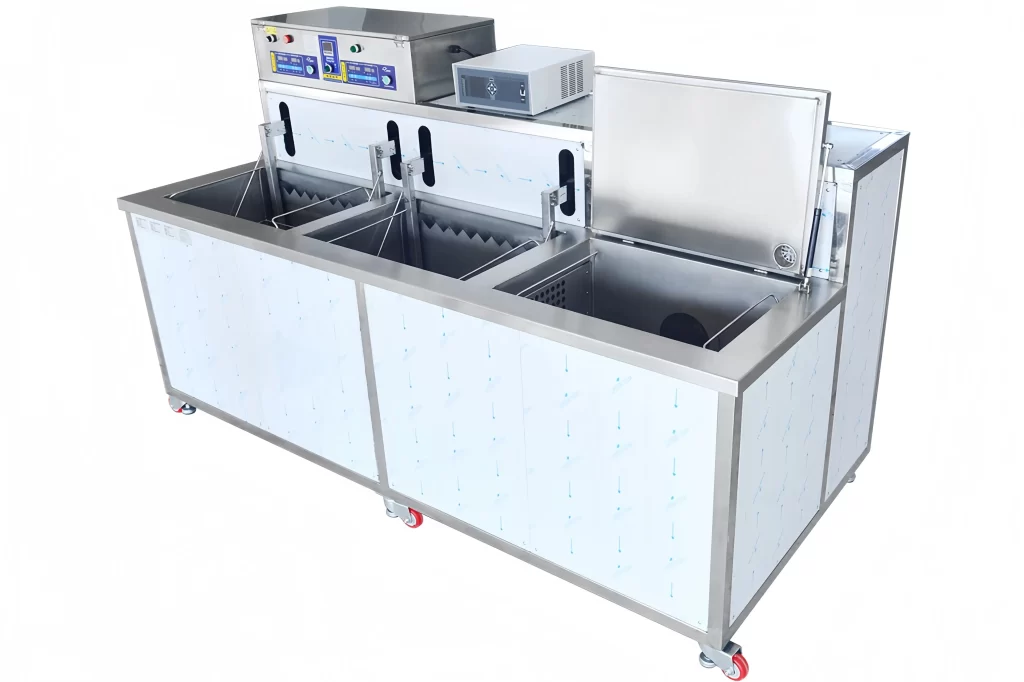
Drying is the hidden energy hog in industrial parts cleaning. Hot air blowers running continuously in a tunnel or conveyor line can account for a quarter of the total machine’s power draw. The 2026 trend is to replace brute-force heat with vacuum drying for complex parts, or with high-velocity air knives that strip water mechanically before any thermal step. Our pre-PVD parts ultrasonic cleaners use a combination of air knife blow-off and hot air or vacuum drying, sequenced so that thermal energy is only applied after mechanical water removal already removes the bulk of surface moisture.
This matters because drying energy does not scale linearly with throughput. A poorly designed drying section that forces workers to slow the line to achieve dryness increases energy per part, while a staged drying sequence can reduce cycle time and power consumption together. In one configuration we developed for an automotive supplier, replacing a continuous hot air tunnel with a vacuum drying module cut the drying stage’s energy demand by roughly 40 percent and eliminated a recurring water spot rejection. The lesson: drying should be treated as a chain of moisture removal stages, not a single bake step.
Closed-Loop Water Systems Convert Rinsing from a Utility Cost into a Process Asset
Multi-stage aqueous cleaning lines can send thousands of liters of water down the drain every shift. That is both a cost and a regulatory exposure, especially in regions with high water cost or strict discharge limits. The mature engineering solution is a closed-loop rinsing circuit with DI or RO water treatment.
Our pre-PVD coating parts cleaners integrate an ultrapure water system that polishes rinse water to a conductivity of 0.06 μS/cm or less. Overflow rinsing captures the first-rinse contaminants, passes them through filtration, and returns clean water to the process. The water that exits the final cascade is so clean it can be reused for upstream rinses, slashing consumption by 70 to 80 percent. For manufacturers who currently buy DI water in totes, the savings alone can pay for the water treatment module within a year. I have rarely seen a sustainability measure that pays back faster than eliminating once-through rinsing.
Automation Improves Consistency—And Consistency Eliminates Waste
A sustainable cleaning process is a repeatable one. When an operator manually controls basket dwell time, temperature, or chemical dosing, even well-intentioned adjustments produce variation. That variation shows up as over-cleaning (wasted chemistry and energy) or under-cleaning (rejects, rework, and scrap). Both outcomes are environmental losses in manufacturing terms.
Fully automated cleaning systems with PLC control and recipe management remove the guesswork. Our automated ultrasonic cleaners for CNC machined parts use Siemens or Mitsubishi control platforms to hold parameters within tight tolerances across shifts. When ultrasonic power, rinse dwell, and drying temperature are locked, chemical and energy consumption become predictable budgets rather than variables that drift. More importantly, first-pass yield rises. In my experience, the single largest source of waste in a manufacturing cleaning line is not a leaking tank—it is parts that must be cleaned twice.
The Investment Trap: Prioritizing CapEx Over Operating Cost
If you are a senior engineer or procurement manager reading this, you already know the dynamic: the purchase order rewards the lowest equipment price, and the operating budget absorbs the consequences. Sustainability-focused cleaning equipment often carries a higher upfront line item because it includes solvent recovery, vacuum drying, or closed-loop water circuits. When I present a quote that includes those modules, the first objection is almost always the capital difference. The second conversation, usually months later, is about why the competitor’s cheaper machine is costing them double in solvent and water.
The only honest way to evaluate cleaning system quotes is total cost of ownership over the intended service life. A solvent recovery module that adds 10 to 15 percent to the equipment price but reduces annual chemical cost by tens of thousands of dollars turns from a premium into a savings machine within two years. Below is a simple cost structure comparison for a medium-production hydrocarbon cleaning installation.
| Cost Category | Open-Loop Solvent System | Closed-Loop with Recovery |
|---|---|---|
| Solvent purchase (annual) | High, consumption steady | Minimal, only makeup |
| Waste disposal | Frequent haul-off | Rarely needed |
| Energy (drying) | Hot air, high draw | Vacuum or staged, lower |
| Regulatory risk | Rising VOC exposure | Compliant return |
| Downtime for changeover | Manual monitoring | Automated, predictable |
If your program involves thin-walled aluminum housings, blind-hole parts, or high-purity pre-coating requirements, the process conditions amplify the cost of unrecovered solvent and inconsistent rinsing. Before locking in a budget, it is worth evaluating your current consumption data against a closed-loop alternative: send your current monthly chemical and utility figures to [email protected] and we will calculate the payback for your specific line configuration.
Frequent Questions About Sustainable Cleaning Implementation
What is the fastest sustainability gain I can implement on an existing line?
Start with adding a solvent or water recovery module. If your line already uses a hydrocarbon or modified alcohol solvent, retrofitting a distillation recovery system often pays back in under a year and immediately slashes hazardous waste haul-off. For aqueous lines, adding a DI water recirculation loop or upgrading to cascade rinsing with filtration is the quickest water-saving action.
Do closed-loop systems add a lot of maintenance burden?
Not if they are designed for the application. A well-built solvent recovery system with automatic sludge discharge and vapor monitoring typically requires visual inspection of the still and a filter change on a scheduled basis—often no more than one hour a week. The biggest maintenance headache I see is when a facility buys a recovery system that is undersized for the throughput; that forces the still to run continuously, accelerating fouling. Right-sizing the recovery capacity avoids that entirely.
Is a fully automated cleaning system always more sustainable than a manual one?
It depends on whether the automation includes the right modules. Add automation without recovery or closed-loop rinsing and you have merely automated waste. But when automation controls chemical dosing, bath life, and drying staging precisely in response to actual part data, it almost always reduces total resource consumption per part compared to an operator-controlled process with the same chemistry and bath setup.
Can we justify sustainability upgrades if we have no external compliance pressure?
Yes, and the strongest justification is operational, not regulatory. Reduced solvent purchases, lower waste disposal invoices, fewer rejects, and predictable maintenance schedules all hit the profit-and-loss statement. I have yet to see a factory where recovering chemicals, reusing water, or cutting drying energy increased unit cost. If your plant tracks process cost per part, those savings show up clearly and permanently.
Our team works with manufacturers worldwide to model the actual return on investment for closed-loop cleaning systems. If you want a payback calculation based on your current production data, send your solvent and utility logs to [email protected]. We will return a custom analysis that shows the cost crossover point for your cleaning line.
For an honest, engineering-based evaluation of your industrial cleaning process sustainability and efficiency, contact our team at [email protected] or call +86 17768507147.
If you're interested, check out these related articles:
Ultrasonic Cleaning Process: A Step by Step Technical Guide
Budgeting for Industrial Cleaning Equipment Upgrades A Strategic Guide
How to Integrate Automated Cleaning into Production Lines
 English
  German
  Spanish
  French
  Russian
  Portuguese