
Procuring custom industrial cleaning equipment represents a significant capital investment for any manufacturing operation. The evaluation process extends well beyond comparing quoted prices—it requires examining how a proposed system will perform under your actual production conditions, what it will cost to operate over five or ten years, and whether the supplier can support you when something goes wrong at 2 AM on a Friday. Getting this assessment right determines whether your cleaning line becomes a reliable production asset or an expensive source of recurring problems.
How Do You Verify That a Cleaning System Will Actually Meet Your Cleanliness Standards?
The technical specifications in a quote tell only part of the story. Cycle times, cleaning methods, and stated cleanliness levels need validation against your specific parts, contaminants, and production volumes. A system that performs well in a supplier's demonstration may struggle with your actual part geometries or contamination loads.
Multi-stage cleaning configurations—combining hydrojet spray, ultrasonic cleaning, and ultrapure water rinsing—address different contamination types sequentially. For precision applications like pre-PVD coating preparation, final rinse water conductivity below 0.06 μS/cm prevents ionic contamination that would compromise coating adhesion. That specification matters because residual salts invisible to the eye can cause coating delamination weeks after processing.
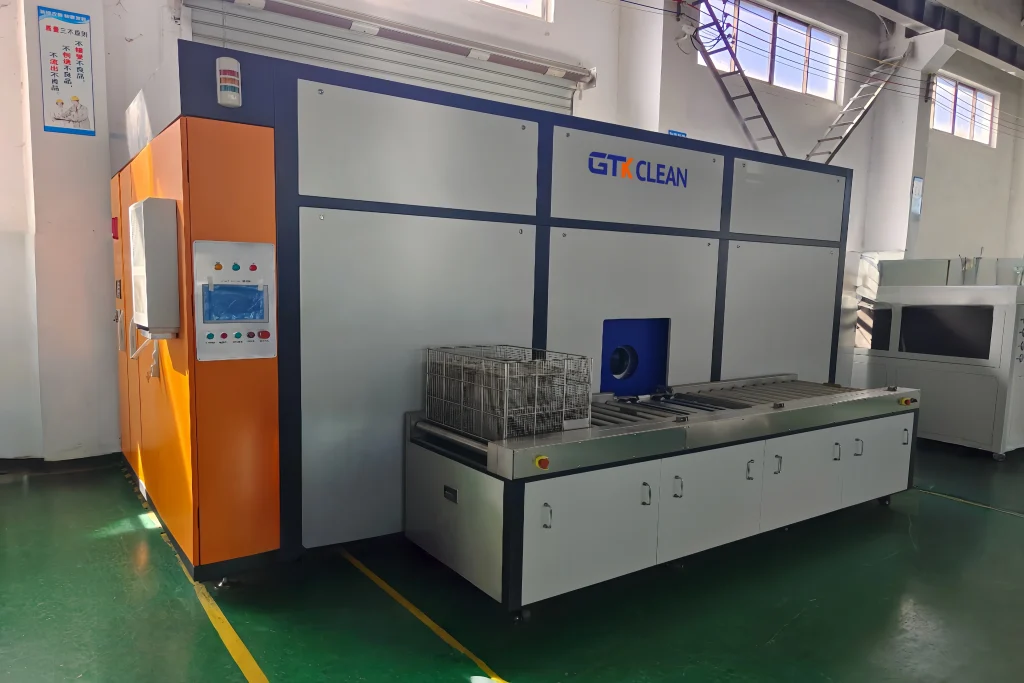
Different contaminants require different approaches. Ultrasonic cleaning excels at dislodging fine particles from blind holes and complex internal passages where spray systems cannot reach effectively. Solvent-based systems handle heavy oils and greases more efficiently than aqueous solutions, particularly when water would cause corrosion or when parts cannot tolerate extended drying times. Conveyor belt systems suit high-volume continuous operations where batch processing would create bottlenecks.
The only reliable validation method is empirical testing with your actual production parts. Request sample processing and independent cleanliness verification before committing to a purchase. A supplier confident in their system's performance will accommodate this request.
Why Chemical Compatibility Deserves More Attention Than It Usually Gets
The interaction between cleaning agents and part materials creates risks that surface only after equipment is installed and running. A solvent that efficiently removes machining oils may attack plastic seals or degrade certain aluminum alloys over time. Alkaline cleaners effective on steel can etch zinc die castings or discolor brass components.
Corrosion prevention becomes particularly important when cleaned parts will be stored before subsequent processing. Residual moisture or incompatible chemical films can initiate corrosion within hours under certain conditions. Systems processing mixed materials—assemblies containing both ferrous and non-ferrous metals, for instance—require chemistry that protects all substrates simultaneously.
Overlooking these interactions leads to rejected parts, customer complaints, and potentially costly recalls. The time to identify compatibility issues is during the quoting process, not after installation.
What Actually Drives Total Cost of Ownership for Custom Cleaning Equipment?
The purchase price of custom cleaning systems typically represents 30-40% of what you will spend over a ten-year equipment life. The remaining costs accumulate through daily operations in ways that are easy to underestimate during procurement.
Energy consumption varies dramatically between system designs. Heating water or solvents to operating temperature, running pumps and ultrasonic transducers, and powering drying systems all draw power continuously during operation. Systems with heat recovery—capturing waste heat from compressors or exhaust air to preheat incoming water—can reduce energy costs by 15-25% compared to conventional designs.
| TCO Factor | Description | Impact on Cost |
|---|---|---|
| Energy Consumption | Power for heating, pumps, ultrasonics, drying | High, if not energy-efficient |
| Water Usage | Volume for cleaning, rinsing, refilling | Variable, depending on recycling |
| Chemical Costs | Detergents, solvents, additives | Ongoing, varies by process |
| Maintenance | Parts, labor, preventative servicing | Predictable with service plans |
| Waste Disposal | Effluent, spent chemicals, filters | Significant, subject to regulations |
Water treatment integration adds upfront cost but often pays back within two years through reduced water purchases and discharge fees. Oil-water separation systems that remove over 98% of surface contamination extend bath life significantly, reducing both chemical consumption and disposal frequency.
Maintenance costs become predictable when systems use standard components and when suppliers stock spare parts locally. Proprietary components or parts sourced only from overseas can turn a minor repair into weeks of downtime.
What Variables Determine Custom Cleaning System Pricing?
Customization level drives cost more than any other factor. Systems engineered for unusual part geometries, extreme cleanliness requirements, or integration with existing automation require more design time and specialized components. A standard ultrasonic tank costs a fraction of a custom fixture designed to hold and rotate irregularly shaped parts during cleaning.
Automation features add cost incrementally. Manual loading systems are least expensive but require operator attention for each cycle. Robotic loading eliminates labor but requires programming, safety guarding, and maintenance of additional mechanical systems. Integrated conveyors suit high-volume continuous operations but demand more floor space and infrastructure.
Material selection affects both initial cost and long-term durability. SUS316 stainless steel costs more than SUS304 but resists chloride-induced corrosion far better—a meaningful difference when processing parts with residual coolant containing chlorinated additives.
How Do You Evaluate Whether a Supplier Can Actually Support You Long-Term?
A manufacturer's track record matters more than their marketing claims. Twenty years of R&D experience and dozens of technical patents indicate sustained investment in cleaning technology development. More importantly, that experience translates into engineers who have encountered and solved problems similar to yours.
References from existing customers in similar industries provide the most reliable insight into actual support quality. Ask specifically about response times when equipment failed, availability of spare parts, and whether the supplier's technical recommendations proved accurate in practice.
Global operations capability matters if your facilities span multiple countries or if you anticipate expanding internationally. Consistent support regardless of location prevents situations where equipment in one plant receives excellent service while identical equipment elsewhere languishes without adequate technical assistance.
If your cleaning requirements are complex or your production volumes are high, discussing your specific situation with potential suppliers early in the evaluation process helps identify whether their capabilities align with your needs.
Can a Cleaning System Adapt as Your Production Requirements Change?
Production volumes fluctuate. Part designs evolve. Cleanliness specifications tighten as customers demand higher quality. A cleaning system purchased today needs to accommodate these changes without requiring complete replacement.
Modular designs allow capacity expansion by adding cleaning stages, drying sections, or parallel processing lines. Heavy-duty automated ultrasonic cleaners handling parts up to 2000 kg can be configured initially for current volumes with provisions for later expansion built into the control architecture and floor space allocation.
Programmable logic controllers enable reconfiguration for different parts or processes without hardware changes. Adjustable parameters—cycle times, temperatures, ultrasonic frequencies, chemical concentrations—accommodate variations in contamination levels or part sensitivity.
Industry 4.0 integration provides operational data that supports continuous improvement. Remote monitoring identifies developing problems before they cause failures. Data analytics reveal optimization opportunities that manual observation would miss.
How Can You Ensure a Custom Cleaning System Meets Future Production Needs?
Discussing potential growth scenarios during the quoting process helps suppliers design appropriate flexibility into the system. If you anticipate doubling production volume within five years, the system should accommodate that expansion without major reconstruction.
Modular design options allow phased investment—purchasing core capability now with defined upgrade paths for later. Adding cleaning stages, integrating new drying technologies, or expanding automation can proceed incrementally as production requirements evolve.
Systems with adjustable parameters or reconfigurable PLCs adapt to different parts or processes more readily than fixed-function equipment. This flexibility proves valuable when product mix changes or when new customers require different cleanliness specifications.
What Safety and Environmental Requirements Must Custom Cleaning Systems Meet?
Regulatory compliance is non-negotiable, and the specific requirements vary by location and industry. Systems using volatile organic compounds require solvent emissions control—typically activated carbon adsorption or condensation recovery—to meet air quality regulations. Wastewater discharge must meet local limits for pH, suspended solids, and specific contaminants.
Multi-tank hydrocarbon ultrasonic cleaners with distillation-based solvent recovery conserve expensive solvents while reducing hazardous waste generation. The environmental benefit aligns with economic advantage when solvent costs are high and disposal fees are significant.
Operator safety features—interlocks preventing access to moving parts, emergency stops within reach of all operating positions, ventilation maintaining safe air quality—protect personnel and limit liability. Proper guarding and lockout/tagout provisions facilitate maintenance without injury risk.
What Certifications Should a Custom Cleaning System Supplier Demonstrate?
ISO certification for quality management indicates systematic processes for design, manufacturing, and service. CE marking confirms compliance with European safety directives—relevant even for equipment installed elsewhere because it demonstrates attention to safety engineering.
Industry-specific standards apply in regulated sectors. Medical device manufacturers require cleaning equipment validated to FDA or ISO 13485 requirements. Aerospace suppliers need systems capable of meeting NADCAP or customer-specific cleanliness specifications.
Environmental permits and compliance history reveal whether a supplier takes regulatory requirements seriously. A manufacturer with a clean compliance record is more likely to deliver equipment that keeps your facility in compliance.
What Should Warranty, Training, and Support Packages Include?
Warranty coverage varies significantly between suppliers. Duration matters, but coverage terms matter more. A two-year warranty excluding wear parts and limiting labor reimbursement provides less protection than a one-year warranty covering all components and including on-site service.
Operator training ensures personnel can run the system safely and efficiently from day one. Effective training covers not just button-pushing but understanding the cleaning process well enough to recognize when something is wrong. Maintenance training enables your technicians to handle routine service without waiting for supplier visits.
Spare parts availability determines how quickly you can recover from component failures. Critical wear items—seals, filters, sensors—should be stocked locally or available for overnight delivery. Proprietary components sourced only from overseas can extend downtime from days to weeks.
Preventative maintenance programs, whether performed by supplier technicians or your own trained staff, extend equipment life and maintain consistent cleaning performance. The cost of scheduled maintenance is far less than the cost of unplanned breakdowns.
A custom cleaning system represents a strategic investment that will affect your production capability for years. Thorough evaluation of technical performance, long-term costs, supplier capability, adaptability, and compliance requirements protects that investment. The time spent on careful assessment during procurement prevents far larger expenditures on corrections, replacements, and lost production later.
To discuss specific cleaning requirements or evaluate system options for your application, contact Suzhou Grintek Environmental Technology Co., Ltd. at [email protected] or +86 17768507147.
Frequently Asked Questions About Custom Cleaning Systems
What Costs Beyond the Purchase Price Should I Budget For?
Ongoing consumables—chemicals, water, and energy—accumulate steadily during operation. Waste disposal fees depend on local regulations and the volume and hazard classification of spent materials. Spare parts and maintenance labor follow predictable schedules when systems are properly maintained but can spike unexpectedly if preventative service is neglected. Projecting these costs over a five or ten-year horizon reveals the true total cost of ownership, which often exceeds the purchase price by a factor of two or more.
How Frequently Does Industrial Cleaning Equipment Require Maintenance?
Usage intensity and system complexity determine appropriate maintenance intervals. Daily checks of fluid levels, filter condition, and basic operation catch developing problems early. Weekly preventative tasks—cleaning sensors, checking belt tension, verifying calibration—maintain consistent performance. Annual professional servicing addresses wear items and validates system operation against original specifications. Following the manufacturer's recommended schedule prevents most unplanned downtime.
Can Custom Cleaning Systems Integrate With Existing Production Lines?
Custom systems are specifically designed for integration with existing workflows. Reputable manufacturers assess your current automation level, available floor space, and upstream/downstream process requirements before proposing a solution. Conveyor heights, transfer mechanisms, and control system interfaces can be matched to existing equipment. Installation planning minimizes production disruption, and phased commissioning allows gradual transition from old to new systems. If you are evaluating integration options, discussing your specific line configuration with potential suppliers early in the process helps identify practical solutions.
如果您有兴趣,可以阅读以下相关文章:
Manual Ultrasonic Cleaning Machines: When to Use Them
Industrial Ultrasonic Cleaning Systems: The Complete Guide
How to Choose Cleaning Equipment for Medical Device Manufacturing
Choosing the Right Ultrasonic Cleaning System for Your Factory
 English
  German
  Spanish
  French
  Russian
  Portuguese