Modified alcohol ultrasonic cleaning systems address a narrow but persistent problem on precision production lines: removing light oils and fine particles without leaving water spots, flash rust, or solvent residue that can compromise downstream coating or assembly. The process combines ultrasonic cavitation with a low-boiling modified alcohol solvent under vacuum so that parts are cleaned, dried, and the solvent is recovered in one enclosed station. In our experience at GTKCLEAN, the deciding factor is rarely raw cleaning power. It is usually drying speed and residue risk. This article explains the working principle, compares modified alcohol with hydrocarbon and water-based systems, and lists the specifications we check before quoting a new installation.
How Does Modified Alcohol Ultrasonic Cleaning Work?
Modified alcohol ultrasonic cleaning is not a single-step process. It starts with the solvent itself. Modified alcohol is a polar, low-boiling solvent blend. Because it boils below the flash point of many hydrocarbon alternatives, the system can use vacuum to dry parts at lower temperatures than atmospheric air drying. The cleaning station typically runs through four stages within the same enclosure: ultrasonic immersion, vacuum vapor cleaning, vacuum drying, and solvent recovery. During ultrasonic immersion, transducers mounted on the tank bottom or sides generate pressure waves at frequencies between 20 kHz and 80 kHz. The alternating pressure creates cavitation bubbles in the solvent. When these bubbles collapse near a part surface, they release local energy that lifts oil film and particles out of blind holes, threads, and narrow gaps. This is not scrubbing. It is pressure oscillation at a scale small enough to enter features that brushes cannot reach.
Ultrasonic cleaning depends on cavitation bubbles collapsing near the part surface. <What Is Ultrasonic Cavitation Effect?> explains how bubble size and energy transfer change with frequency, which is why lower frequencies around 20-28 kHz work better for heavier oils and higher frequencies suit finer particles.
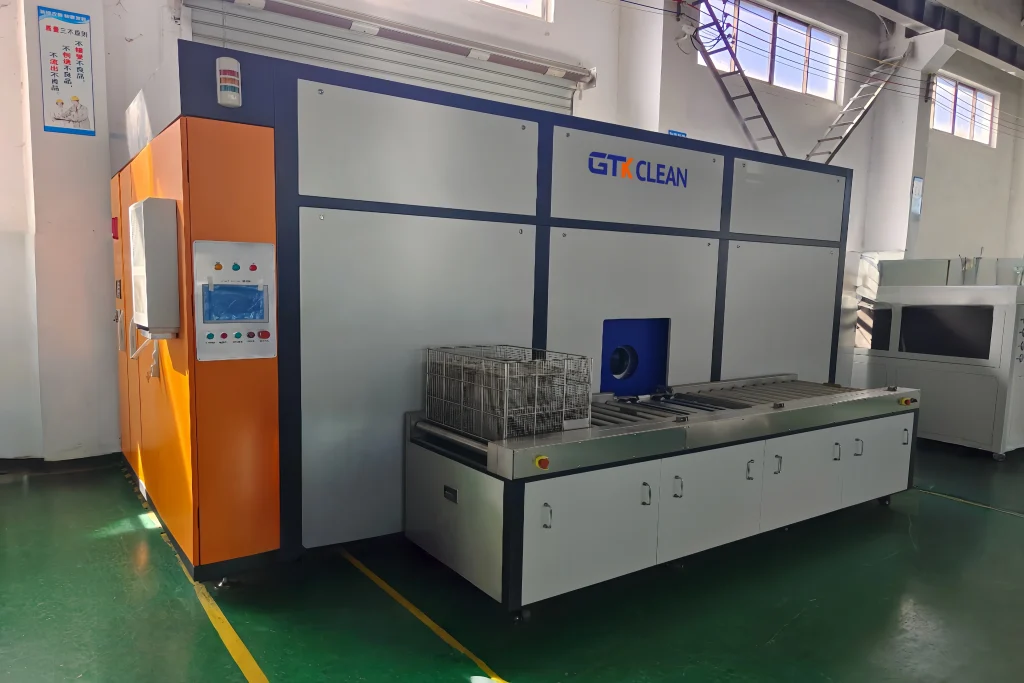
The vacuum step is where modified alcohol earns its place. After immersion, the chamber pulls a vacuum so the residual solvent boils off at a lower temperature. This dries complex parts without leaving water spots, which is the main failure mode of water-based ultrasonic lines on polished or high-tolerance surfaces. It also means the solvent vapor does not escape into the plant. A condensation and distillation circuit captures the vapor and returns clean solvent to the working tank. In a system like the Hydrocarbon Solvent Ultrasonic Vacuum Cleaner we run at GTKCLEAN, the same station can switch between hydrocarbon and modified alcohol, but the process logic stays the same: wash, vapor clean, vacuum dry, recover.
What Contaminants Can Modified Alcohol Ultrasonic Cleaning Remove?
Modified alcohol systems are not the first choice for heavy grease, scale, or water-soluble salts. They are target cleaners. In our project reviews, the parts that benefit most carry light to medium oils: cutting fluids, stamping oil, fingerprint contamination, polishing paste, anti-rust films, and fine metal particles left after deburring. The solvent is also effective on some polar soils that pure hydrocarbon struggles with, which is why we see it used for die-cast components, CNC machined parts, and stamped parts before coating or assembly. The reason for this profile is solvency. Modified alcohol is a polar solvent. Hydrocarbon solvents are non-polar. Many production fluids are blends of both polar and non-polar molecules, so a modified alcohol system often cleans faster on the same part than a hydrocarbon-only setup, especially when the contaminant has aged or contains additives. However, modified alcohol is not a replacement for strong alkaline aqueous chemistry when the goal is rust removal or oxide conversion.
Choosing between modified alcohol and water-based cleaning is not just about residue. <How to Select the Best Cleaning Solution for Metal Parts> covers how part material, contaminant type, and downstream coating requirements determine the safest solvent chemistry.
Blind holes and recessed features are where the combination of modified alcohol and vacuum drying performs well. The cavitation reaches into small cavities, and the vacuum boiling removes solvent from those same spaces without leaving a water trace. This matters for components that go directly into PVD coating, bonding, or cleanroom assembly.
Why Choose Modified Alcohol Over Hydrocarbon or Aqueous Cleaning?
Most buyers reach this question after a bad water-spot incident. The table below summarizes the differences we discuss during specification reviews.
Factor
Modified Alcohol
Hydrocarbon Solvent
Aqueous/Water-Based
Drying mechanism
Vacuum boiling, no water spots
Vacuum or hot air, very low residue
Hot air, requires DI water protection
Typical cycle
8-15 min two-stage
10-20 min depending on part mass
5-10 min per tank, multi-stage
Solvent recovery
Integrated distillation
Integrated distillation
Rinsing water treatment required
Best contaminant
Light polar and non-polar oils, fingerprints
Heavy non-polar oils, waxes
Salts, cutting emulsions, oxides
Main risk
Solvent cost if recovery is bypassed
Higher VOC control
Flash rust or water spots
The decision usually comes down to two factors: drying quality and downstream process. If parts go directly to PVD coating, water spots are unacceptable. If parts are stamped steel and need flash rust protection, aqueous may be better with rust inhibitor. Modified alcohol sits in the middle, offering vacuum drying without the heavier VOC load of some hydrocarbon blends. We have seen programs where a customer tried aqueous cleaning for machined aluminum housings and then moved to modified alcohol after coating adhesion failures. The problem was not visible residue but microscopic water spots. A vacuum alcohol system eliminated the variable.
How Much Does a Modified Alcohol Ultrasonic Cleaning System Cost to Operate?
The operating cost of modified alcohol equipment is driven by solvent consumption, energy, and maintenance labor. Solvent cost is the line item that surprises most first-time buyers. A single-station vacuum system we quote for precision parts carries an initial solvent fill of up to 1,800 liters. Without recovery, that volume becomes an ongoing purchase. With the built-in distillation loop, consumption stays below roughly 200 liters per month on a standard two-shift precision cleaning line. This is where the economics shift. Electricity is the second largest line. A fully automatic single-station vacuum system may have an installed power around 75 kW, but actual average draw is lower because heating and vacuum pumps cycle. On a 12 to 15 minute two-stage cycle for a basket of 670 by 480 by 400 mm loaded up to 200 kg, the load factor is moderate. Compared with a multi-tank aqueous line with heated tanks, blowers, and DI water production, the modified alcohol station often uses less floor space and fewer transfer points.
One specification we ask customers to confirm early is peak batch load. If your parts exceed 450 kg per basket or include deep blind holes, the vacuum pulldown time and basket rotation speed must be verified before you finalize tank dimensions. For that, send your part drawings and expected daily throughput to [email protected] or call +86 17768507147.
What Should Buyers Check Before Selecting a Modified Alcohol Ultrasonic Cleaning System?
Before quoting, we walk engineers through five checks:
Solvent compatibility with the entire part assembly. Check plastics, seals, and coatings because modified alcohol can attack certain elastomers.
Basket load and part orientation. The maximum useful load is not only weight. Parts must be oriented so solvent drains from blind holes before vacuum drying.
Recovery rate at the expected cycle time. Ask for the distillation capacity in liters per hour at the operating temperature, not just nominal solvent volume.
Safety and gas monitoring. A vacuum system reduces vapor exposure but still requires gas detection, pressure interlocks, and exhaust.
Filtration stages. Check whether the system filters before and after distillation, because fine particles recirculate and can redeposit on critical surfaces.
These checks matter more than pump brand. A well-designed modified alcohol system should be able to switch to hydrocarbon if production changes, but only if the seals, heating, and recovery circuit were rated for both solvents from the start. We always confirm this in the initial specification phase. The common thread in these checks is that a modified alcohol system is not a drop-in replacement for an aqueous line. It is a dedicated solvent station with its own safety, recovery, and throughput limits. If you are weighing one for a pre-coating or precision machining line, send your part material, contaminant, and daily throughput to [email protected] or call +86 17768507147. We will confirm the correct tank size, distillation capacity, and cycle time before you issue a purchase order.
What Else Do Buyers Ask About Modified Alcohol Ultrasonic Cleaning?
Is modified alcohol safe for use in a standard production hall?
Modified alcohol is safer than open-top solvent degreasing in most modern production settings because the process runs under vacuum and the vapor is recovered. That said, it is still a solvent. You need gas detection, proper exhaust, and operator training. The enclosed vacuum chamber limits atmospheric release, which keeps workplace exposure below common limits, but the system must be leak-tested and interlocked with the vacuum pump.
Can modified alcohol ultrasonic cleaning replace all aqueous cleaning steps?
It is easy to assume that because modified alcohol dries without water spots, it can replace every aqueous line. That is not correct. Modified alcohol targets light to medium oils and particles. It does not remove rust, heat treatment scale, or heavy water-soluble cutting emulsions. For those soils, an aqueous pre-wash or separate alkaline stage is still the right tool.
How often do we need to replace or top up the solvent?
It depends on your batch load and soil type. On a well-sealed vacuum system with distillation recovery, solvent consumption below 200 liters per month is achievable for precision parts that arrive with controlled contamination. If parts carry heavy oil or the system lacks recovery, top-up volume rises. We tell customers to log weekly solvent usage for the first 90 days and compare it against throughput.
What is the biggest mistake buyers make when specifying a modified alcohol system?

 These checks matter more than pump brand. A well-designed modified alcohol system should be able to switch to hydrocarbon if production changes, but only if the seals, heating, and recovery circuit were rated for both solvents from the start. We always confirm this in the initial specification phase. The common thread in these checks is that a modified alcohol system is not a drop-in replacement for an aqueous line. It is a dedicated solvent station with its own safety, recovery, and throughput limits. If you are weighing one for a pre-coating or precision machining line, send your part material, contaminant, and daily throughput to [email protected] or call +86 17768507147. We will confirm the correct tank size, distillation capacity, and cycle time before you issue a purchase order.
 English
  German
  Spanish
  French
  Russian
  Portuguese