

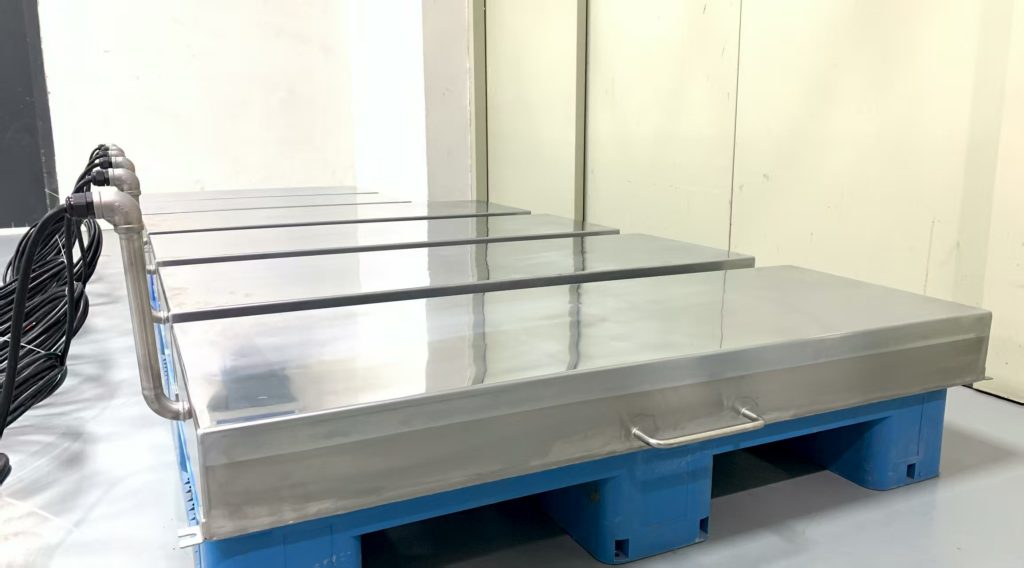
How Ultrasonic Immersible Transducer Plates Are Manufactured?
Ever wondered how ultrasonic transducer plates are made?As the core component for mounting ultrasonic transducers, the fabrication and installation process of ultrasonic transducer plates is critical. Their size and shape vary to fit different cleaning tank configurations. Below, GTKCLEAN walks you through the complete manufacturing process:
- An engineering designer first creates detailed engineering drawings for the transducer plate, specifying all dimensions, materials, and production requirements.
- After cutting the stainless steel sheet to the drawing specifications, surface preparation is required. The smooth stainless steel surface makes transducer installation difficult, so either sandblasting or rough grinding is used to create a textured surface for better bonding. Separately, the ultrasonic transducers must be thoroughly cleaned with a cleaning solution before assembly.
- With preparations complete, the transducers are installed inside the plate assembly. Two reliable mounting methods are commonly used:
- Stud mounting: Mark the exact position of each transducer, then install threaded studs at each center point to secure the transducers.
- Direct welding: Weld each transducer directly onto the plate.Both methods are widely used in production.
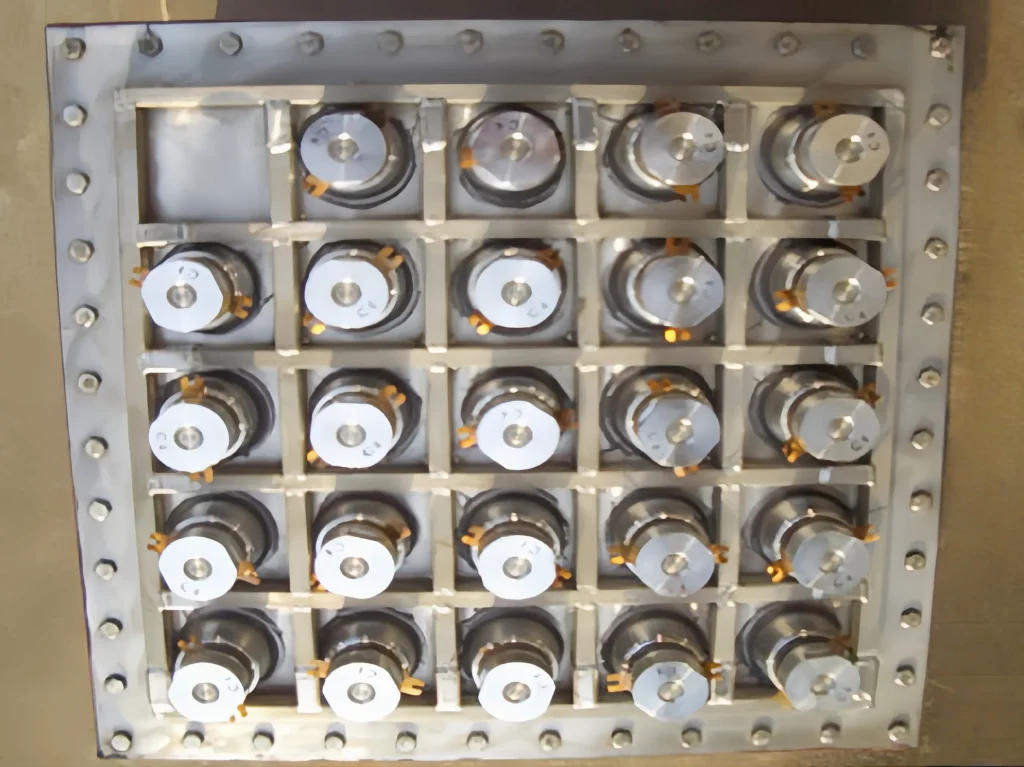
Internal Wiring Layout of Ultrasonic Transducers in the Plate Assembly
- Even after mounting, additional reinforcement is essential for safe and stable operation of the ultrasonic cleaner. A specialized high-temperature adhesive, stable at several hundred degrees Celsius, is applied to secure each transducer. Each unit is inspected for firm attachment, and the adhesive is allowed to cure fully—typically around 48 hours under natural conditions. Wires are then connected to each transducer, with careful attention to correct polarity.
- Once wiring is finished, the plate housing is sealed by welding. A pre-drilled port is reserved specifically for cable routing; the wiring harness must be fed through this opening to connect with the power supply unit.
- After welding the cover plate, a compressed air leak test is performed to verify the seal integrity.
- Finally, an ultrasonic power supply is used to calibrate the operating frequency and other parameters of the transducers. The completed assembly then undergoes a continuous 24-hour reliability test. Only units that perform flawlessly throughout testing are approved as finished ultrasonic transducer plates.
 English
  German
  Spanish
  French
  Russian
  Portuguese