
Picking the right ultrasonic cleaning setup comes down to how your production actually runs. The gap between single-tank and multi-tank configurations shows up fast in cleaning results, cycle times, and what you end up spending over a few years of operation. Two decades of building these systems has made one thing clear: matching the configuration to your actual workflow beats chasing specs on paper.
How Ultrasonic Cleaning Actually Works
Ultrasonic cleaning runs on cavitation—tiny bubbles forming and collapsing in the cleaning fluid, driven by high-frequency sound waves. When those bubbles implode near a part surface, they generate localized scrubbing action strong enough to pull contaminants out of blind holes, threads, and surface textures that spray washing misses entirely.
Transducers do the heavy lifting here, converting electrical input into mechanical vibration that propagates through the tank. The frequency you run determines bubble size and collapse intensity. Lower frequencies around 25-40 kHz produce larger, more aggressive bubbles suited for heavy oils and machining residues. Higher frequencies in the 80-170 kHz range generate finer cavitation that cleans delicate surfaces without pitting or erosion.
Temperature and chemistry matter as much as frequency. Heated cleaning solutions lower surface tension, letting cavitation reach tighter spaces. The detergent or solvent you choose has to match your contaminant profile—alkaline solutions for oils, acidic formulations for oxide layers, neutral options for sensitive substrates.
Where Single-Tank Ultrasonic Cleaners Make Sense
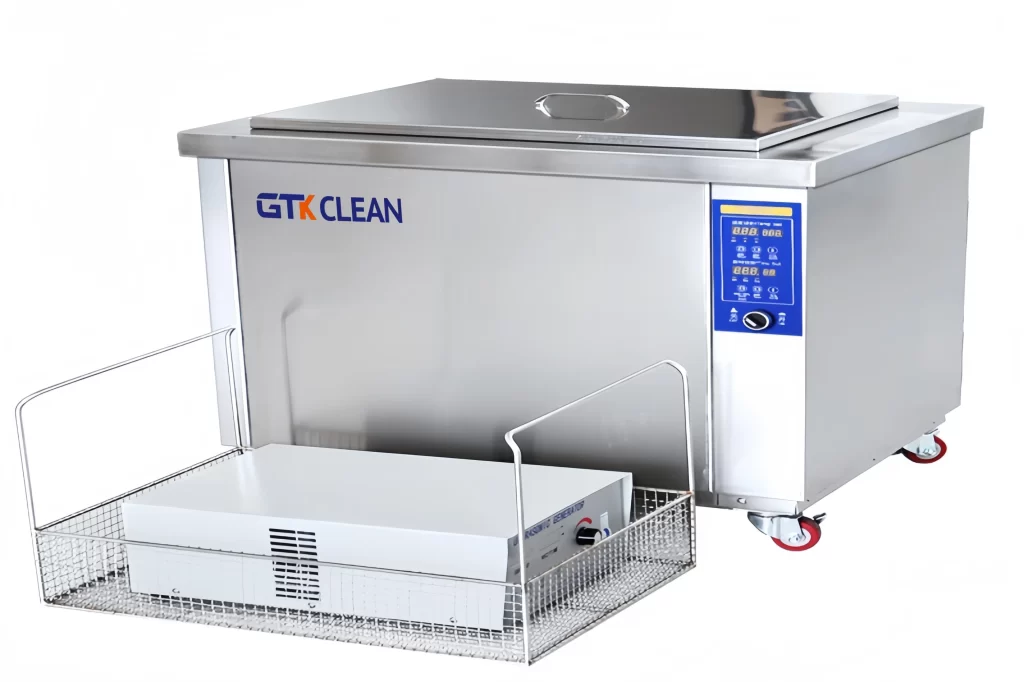
Single-tank ultrasonic cleaners handle straightforward cleaning jobs without the complexity of multi-stage processing. A machining shop running small batches of aluminum brackets through degreasing before inspection doesn't need five tanks and a PLC—a properly sized single tank with the right chemistry gets the job done.
These units work well when your parts share similar contamination profiles and don't require rinsing to tight conductivity specs. Maintenance shops cleaning returned components, prototype facilities processing mixed part types, and operations with limited floor space all find single-tank systems practical.
The trade-off shows up in process control. Everything happens in one bath: cleaning, and whatever rinsing you manage by transferring parts manually to a separate station. Contaminants released during cleaning stay in the same fluid, which means re-deposition becomes a real concern as the bath loads up. You're also looking at longer total cycle times when you factor in manual handling between cleaning and rinsing.
| Feature | Single-Tank Ultrasonic Cleaner |
|---|---|
| Cleaning Stages | Single cleaning stage |
| Footprint | Small, compact |
| Cost | Lower initial investment |
| Throughput | Lower, suitable for batch jobs |
| Cleanliness | Basic to moderate |
| Complexity | Simple operation |
Why Multi-Tank Ultrasonic Systems Handle Complex Production Better
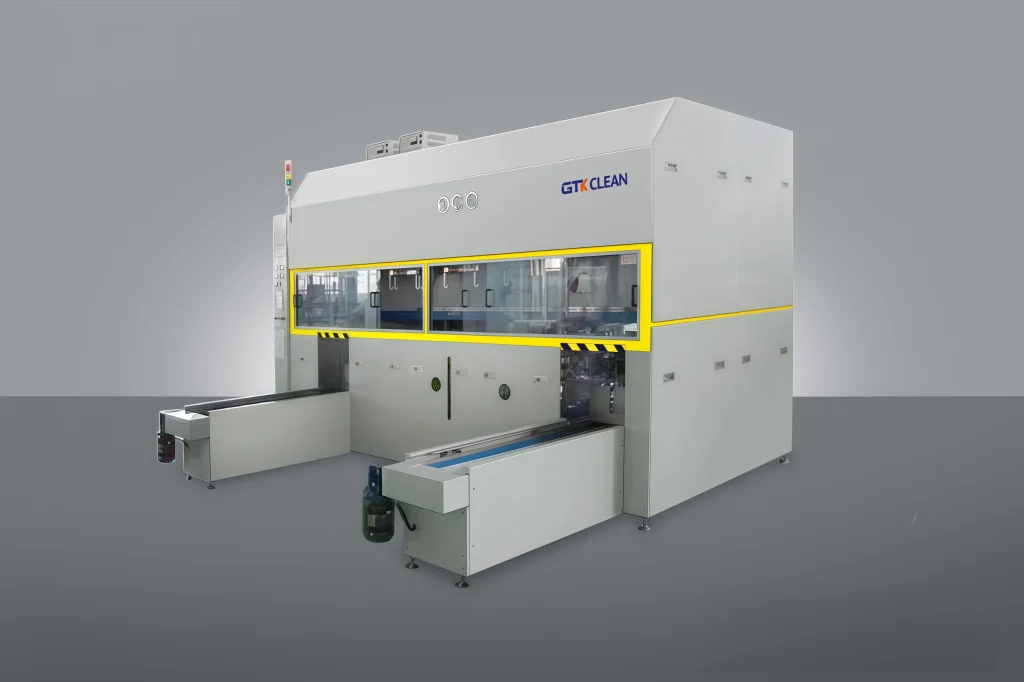
Multi-tank ultrasonic systems break the cleaning process into dedicated stages, each tank optimized for a specific function. A typical configuration runs pre-wash, ultrasonic cleaning, cascade rinsing through two or three stages, and hot air or vacuum drying—all in sequence without manual intervention between steps.
This separation solves the re-deposition problem that limits single-tank performance. Contaminants lifted in the cleaning tank stay there; parts move into progressively cleaner rinse water that flushes residual chemistry and particulates. For applications requiring conductivity below 0.1 μS/cm—common in optical coating prep and semiconductor packaging—multi-stage DI water rinsing is the only practical path.
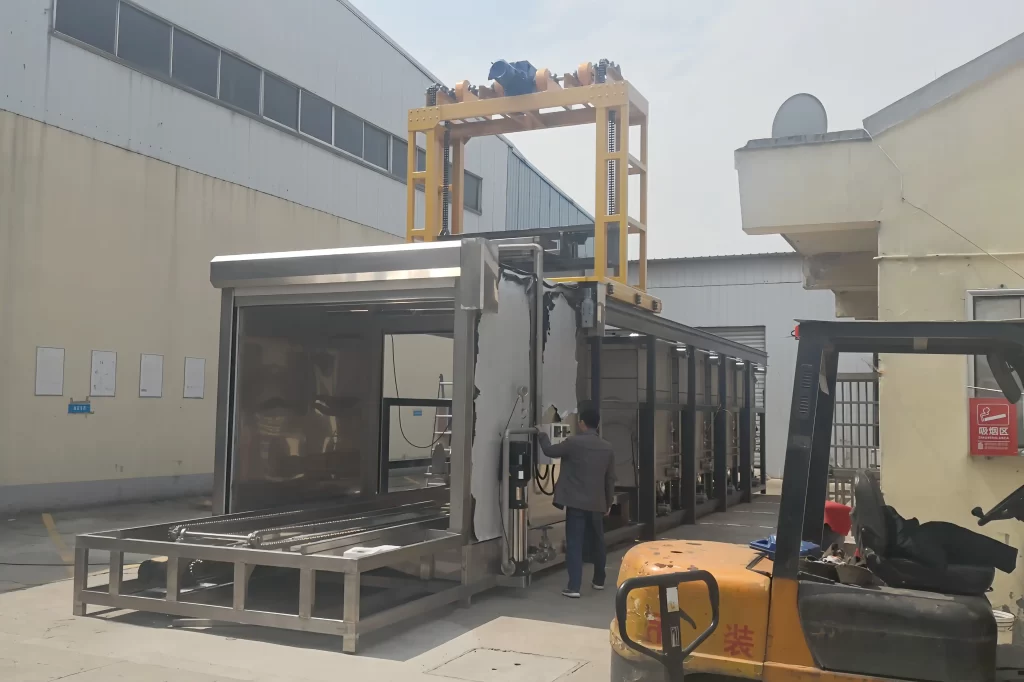
Automated material handling ties the stages together. Hoist systems, conveyors, or rotary indexing move baskets through the sequence on programmed cycles, maintaining consistent dwell times that manual handling can't replicate. PLC control logs process parameters, which matters when your customer audits cleaning validation or when you're troubleshooting a contamination escape.
Production line integration becomes straightforward with multi-tank layouts. Parts flow in one end, exit cleaned and dried at the other, ready for the next operation without staging delays. Throughput scales with tank sizing and transfer speed rather than operator availability.
What separates multi-tank cleaning performance from single-tank results?
The performance gap comes down to process isolation. Multi-tank systems dedicate each stage to one function—cleaning chemistry stays in the wash tank, rinse water stays progressively cleaner through cascade flow, and drying happens in a controlled environment rather than ambient air. Single-tank units ask one bath to do everything, which works until your cleanliness spec tightens or your contamination load increases. Sequential processing also allows different parameters per stage: aggressive cavitation in the wash tank, gentler frequencies in rinse stages to avoid recontaminating sensitive surfaces.
What Should Drive Your Ultrasonic Cleaning System Decision
Production volume sets the baseline. If you're cleaning fifty parts a day with flexible timing, a single-tank system handles the load without tying up capital in automation you won't use. Push that to five hundred parts per shift with delivery commitments, and the math shifts toward multi-tank throughput.
Part geometry complicates the picture. Components with deep blind holes, internal passages, or stacked assemblies need extended ultrasonic exposure and thorough rinsing to flush loosened contamination. Multi-tank systems with rotary fixtures or oscillating baskets address this better than static single-tank processing.
Cleanliness specifications often make the decision for you. Medical device manufacturers, aerospace suppliers, and precision optics producers face validation requirements that single-tank systems can't document or consistently achieve. If your customer requires cleaning validation with measured residue limits, you're looking at multi-tank capability whether the initial cost fits your budget or not.
Floor space and utilities deserve honest assessment. Multi-tank systems need room for the tank array plus material handling equipment, along with electrical capacity for multiple heaters and transducer banks. Some facilities find that a well-specified single-tank system with manual rinsing fits their constraints better than a cramped multi-tank installation.
How does production volume push you toward one configuration or the other?
Low-volume operations—job shops, R&D labs, maintenance facilities—rarely justify multi-tank automation. The capital sits idle between batches, and the flexibility of manual processing matches unpredictable part mixes. High-volume production reverses the equation. Automated multi-tank systems maintain cycle consistency across thousands of parts, reduce labor cost per piece, and eliminate the variability that comes with operator-dependent manual handling. The crossover point depends on your labor rates and cleanliness requirements, but somewhere around 200-300 parts per day, multi-tank systems start showing payback within two to three years.
Running Costs and Long-Term Value
Initial purchase price tells you the least important part of the cost story. A single-tank system might run $15,000 while a comparable multi-tank line costs $80,000, but five years of operation changes those numbers substantially.
Multi-tank systems with filtration and fluid management extend bath life dramatically. Cascade rinsing uses water efficiently, with the cleanest stage feeding backward through progressively dirtier tanks before discharge. Solvent-based systems can include distillation recovery that reclaims 90% or more of the cleaning fluid, turning a consumable expense into a capital equipment feature.
Labor cost differences accumulate faster than most buyers expect. An operator loading and unloading a single-tank system, then manually transferring parts through rinse and dry stations, might spend 15 minutes per batch. The same parts moving through an automated multi-tank line need 2 minutes of operator attention for loading and unloading. Multiply that gap across a year of production shifts.
Energy consumption favors neither configuration absolutely. Multi-tank systems run more heaters and transducers, but they also process more parts per kilowatt-hour when fully utilized. Underloaded multi-tank systems waste energy maintaining heated baths that aren't cleaning anything.
What does each system type actually cost to run over several years?
Single-tank systems carry lower fixed costs but higher variable costs per part. You're replacing cleaning fluid more frequently as contamination builds, paying labor for manual handling, and accepting some reject rate from inconsistent processing. Multi-tank systems front-load the investment but reduce per-part costs through automation, fluid recycling, and process consistency. A hydrocarbon cleaning line with distillation recovery might consume 80% less solvent annually than a single-tank system processing the same volume. The break-even calculation depends on your production volume, labor rates, and how tight your cleanliness specs run—but for sustained production above a few hundred parts daily, multi-tank systems typically show lower total cost of ownership within three years.
Getting Your Cleaning Process Right
The configuration choice matters less than getting the application engineering right. A poorly specified multi-tank system wastes money on capability you don't need; an undersized single-tank system creates a bottleneck that costs more in delayed production than the upgrade would have.
If your parts require validated cleanliness for coating adhesion, assembly reliability, or regulatory compliance, it's worth walking through your specific contamination profile and throughput requirements before committing to either approach. The right system pays for itself; the wrong one just takes up floor space.
How do I figure out which ultrasonic frequency fits my parts?
Frequency selection balances cleaning aggressiveness against surface sensitivity. Heavy machining oils and thick contamination respond to 25-40 kHz frequencies that generate larger cavitation bubbles with more mechanical energy. Delicate parts—thin-walled components, polished surfaces, soft substrates—need 80 kHz or higher to avoid cavitation erosion. Some applications benefit from dual-frequency systems that run aggressive cleaning followed by gentle rinsing. Your contaminant type matters as much as part material: particulate contamination often releases better at higher frequencies regardless of substrate.
Can these ultrasonic cleaning systems connect into existing production lines?
Integration depends on your line layout and material handling approach. Multi-tank systems designed for inline operation include conveyor interfaces, robot-compatible loading stations, or hoist systems that match your existing transfer equipment. Single-tank systems typically operate as standalone stations, though they can feed downstream processes with appropriate staging. The mechanical interface is usually straightforward; the process timing integration—making sure cleaned parts arrive when the next operation needs them—takes more planning.
What maintenance keeps industrial ultrasonic cleaners running properly?
Routine maintenance covers tank cleaning to remove accumulated sludge, transducer inspection for bond integrity and output consistency, and fluid monitoring for contamination loading and chemistry depletion. Filtration systems need element replacement on schedule. Heating elements and temperature controls drift over time and need calibration. Most failures trace back to deferred maintenance—transducers that ran with degraded output until they failed completely, or cleaning baths that loaded up with contaminants until cleaning quality collapsed. Following the maintenance schedule costs less than emergency repairs and rejected parts.
If you're interested, you may want to read the following articles:
Choosing the Right Ultrasonic Cleaning System for Your Factory
Semi Automated vs Fully Automated Ultrasonic Cleaning Systems
Reduce Energy Costs in Industrial Ultrasonic Cleaning
How to Select the Best Cleaning Solution for Metal Parts
What Is Ultrasonic Wave?
 English
  German
  Spanish
  French
  Russian
  Portuguese