High load ultrasonic cleaning systems usually fail because basket design, transducer coverage, and handling equipment are specified as separate decisions. When the workpiece is an engine block, gearbox housing, bearing support, or large mold, the cleaning result is largely fixed before the system is installed. A tank that accepts a 2,000 kg basket will not clean the lower layer if the load shadows the transducers or the frame deflects under stacked weight. This article covers the specification points that matter for large metal parts: reinforced load carriers, power density, process sequencing, drying, and supplier verification.
What Separates High Load Ultrasonic Cleaning From Standard Ultrasonic Tanks?
Standard ultrasonic cleaning machines are rated by tank volume and total watts. A high load system is rated by how much weight can move through the process without distorting the basket, blocking cavitation, or extending dry time. In our equipment design work, the first failure point on an overloaded system is rarely the generator. It is the basket. A standard sheet metal basket may deflect 5 to 10 mm under a heavy part. That small deflection changes how parts sit in the tank, traps air in blind holes, and moves the load closer to or farther from the transducers. The result is not a complete cleaning failure. It is uneven cleaning, with one layer showing excellent oxide removal and another retaining stamping oil after the same cycle.
Specification point
Standard system
High load system
Typical load
100 to 300 kg per basket
500 to 2,000 kg per basket
Tank and frame
Standard tank with light stiffening
Reinforced tank, frame, and lifting points
Basket design
General purpose mesh
Load bearing basket with fixed or rotary configuration
Transducer placement
Uniform tank coverage
Coverage planned around part shadowing and lower layers
Drying
Hot air only
Air knife, hot air, vacuum, or combined drying
How Do Load Capacity and Basket Engineering Determine Cleaning Performance?
Many buyers start with tank size. That order is wrong. The load capacity decision starts with the heaviest batch, but the engineering decision starts with the basket. If the basket cannot hold the parts while keeping cleaning fluid moving across every surface, extra tank volume adds cost without adding cleaning performance.
Why Reinforced Baskets Matter More Than Tank Volume
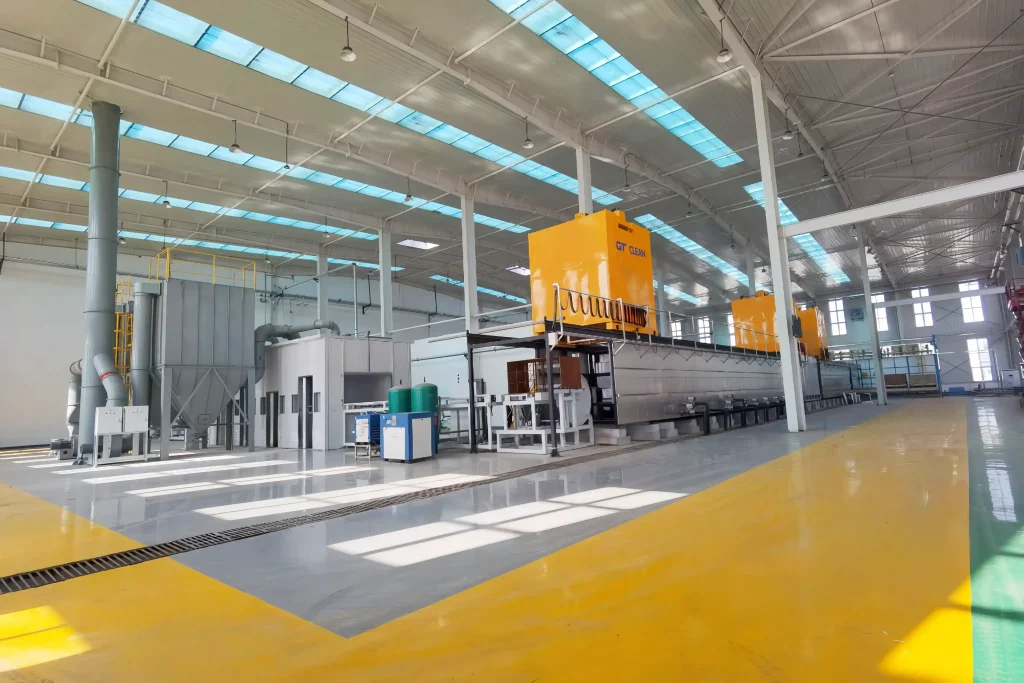
For workpieces such as gearboxes, bearing housings, and engine blocks, stacked weight can exceed 1,000 kg. A standard basket made from light gauge stainless steel will twist under that load. Twisting causes parts to shift during ultrasonic agitation. It also creates contact points hidden from cavitation. In high load systems we specify, the basket frame and mesh are treated as part of the cleaning system, not as a simple container. Reinforced corners, intermediate supports, and lifting points matched to the gantry are included in the mechanical design.
Round Versus Square Baskets for Heavy Parts
Rotary baskets work well for parts with blind holes and recessed areas because the rotation changes orientation during cleaning and rinsing. That movement drains trapped liquid. Square baskets are better for large flat parts, plate type components, and parts that must not collide. The choice is not a verbal preference. It must be confirmed with the part drawing and the required blind hole drainage path before the tank layout is fixed.
The equipment decision for heavy parts starts with part shape, contamination, and throughput rather than tank size. <Parts Washer Selection: A Manufacturer’s Definitive Guide> covers how those inputs narrow the platform choice before high load structural requirements are added.
How Should You Specify Ultrasonic Power, Rinsing, and Drying for Large Parts?
For heavy sections, total ultrasonic power is less useful than power density and how the transducers are distributed around the load. A generator can produce enough watts on paper and still underclean the middle of a dense stack because the ultrasonic field does not penetrate through multiple solid layers. The transducer positions must be set so the lower basket layer receives direct cavitation, not only reflected energy.
Why Power Density Matters More Than Total Watts
Standard cleaning systems often list ultrasonic power as a headline specification. In high load work, I ask a different question: how much of that power reaches the part surface after absorption by the basket structure and the surrounding load? Transducer frequency also matters. Lower frequencies generally produce more aggressive cavitation for heavy contamination. Higher frequencies give finer results on surfaces that need less material removal. For large steel parts, 20 to 28 kHz is normally a practical range, but the final choice depends on whether the surface is machined, coated, or already heat treated.
Rinsing and Drying Large Sections Without Water Spots
A heavy part retains more heat and liquid than a small component. If rinse water quality is not controlled, the part will dry with mineral residue. In our pre coating lines, ultrapure water with conductivity at or below 0.06 μS/cm is used for final rinsing to prevent water spots and secondary contamination. Drying method must also be selected for the part mass. Air knife or hot air drying works for many components, but parts with deep cavities may need vacuum drying to remove trapped moisture. Without that step, the system may pass a cleanliness test after cleaning and fail it later when residual water migrates from a blind hole after storage. If your program involves parts over 500 kg with blind holes or tight water spot limits, it is worth confirming transducer placement, rinse water conductivity, and drying method before you finalize the specification. Send the part drawing, loaded basket weight, and daily throughput target to [email protected], and we will confirm the process sequence for your load.
What Should You Verify Before Buying a High Load Cleaning System?
Specifications on paper are only useful if the supplier can build and service the system. For heavy loads, I look for four things: the control system, the structural engineering, the process validation, and the service commitment. These are often harder to evaluate than cleaning parameters.
Control system: Siemens or Mitsubishi PLC with color HMI and fault diagnostics is our standard for high load automatic systems. It should be something the operator can learn in a short training session.
Structural engineering: tank stiffening, lifting points, basket guidance, and gantry travel must be designed as one system. Ask for drawings that show load distribution, not just outer dimensions.
Process validation: the supplier should run a test cleaning on the actual part or a representative sample. Photos and short videos are not enough. Ask for the cleanliness test report or the method used to confirm contaminant removal.
Service commitment: high load machines have large moving components. Confirm who performs installation alignment, operator training, and remote or on site support after startup.
When production demands continuous flow or large batches, transfer configuration and buffer capacity become part of the cleaning decision. <Conveyor Ultrasonic Washers for Heavy Industrial Parts> covers how heavy workpieces move through multiple stages without manual lifting and why buffer zones protect cleaning quality.
How Do You Start a High Load Ultrasonic Cleaning Specification?
High load systems are usually purchased after a smaller cleaning operation has become a bottleneck, or when a new production line will create a heavy part family from day one. The common failure in both cases is starting with a tank capacity number without defining the loaded basket, the process stages, and the transfer method. GTKCLEAN automation engineers work through those points together before quoting a machine. Send your part drawing, maximum loaded basket weight, and target cycle time to [email protected], or call +86 17768507147, and we will confirm the correct tank configuration, basket design, and drying method for your program.
What Else Should You Ask About High Load Ultrasonic Cleaning?
What is the largest load a high load ultrasonic cleaning system can handle?
High load systems are commonly engineered for basket loads up to 2,000 kg, but the useful maximum depends on the basket structure, the lift path, and the tank floor reinforcement. A system can be built larger, but the cleaning result must still be demonstrated at full load. If parts are stacked, not racked, the effective capacity may be lower than the nominal basket rating because cavitation cannot reach hidden contact points. Confirm the full load test before fixing the specification.
Does a rotary basket always clean heavy parts better than a fixed basket?
It depends on the part geometry. For parts with blind holes, deep pockets, or liquid retention, a rotary basket gives better drainage because it changes the part orientation during cleaning, rinsing, and drying. For large flat parts or collision sensitive components, a square fixed basket may be safer and still effective if transducer placement and nozzle positions are planned around the load. The best choice is determined by the part drawing and a drainage check, not by an equipment category preference.
Can a high load ultrasonic system use solvent instead of water based cleaning?
Solvent based cleaning is an alternative for certain heavy part programs, particularly when water based chemistry risks corrosion or when drying energy is a concern. However, solvent systems add vapor containment, distillation, and safety requirements. The choice should follow the contamination type, the production environment, and the local emission rules. It is not automatically better for large metal parts. In many cases, a well designed water based multi stage system is simpler to operate and easier to maintain.
How do I know if my current cleaning station can be upgraded instead of replaced?


 If your program involves parts over 500 kg with blind holes or tight water spot limits, it is worth confirming transducer placement, rinse water conductivity, and drying method before you finalize the specification. Send the part drawing, loaded basket weight, and daily throughput target to [email protected], and we will confirm the process sequence for your load.
 English
  German
  Spanish
  French
  Russian
  Portuguese