

What Is the Cleaning Process for Metal Stamped Parts?
Machine Structure & Composition
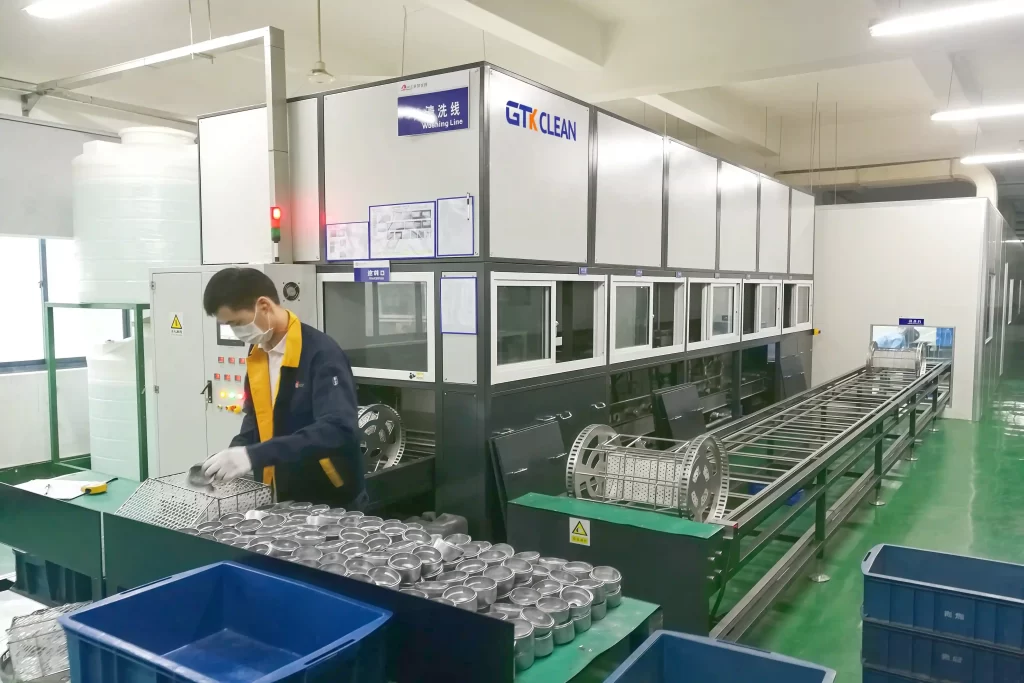
This ultrasonic cleaning line mainly consists of a bubble cleaning tank, rough ultrasonic cleaning tank, fine ultrasonic cleaning tank, tap water rinsing tank, rust prevention tank, hot air drying tank, liquid storage tank, multi-arm manipulator (pneumatic lifting + motor traverse), loading and unloading trolley, PLC system, ultrasonic generator, ultrasonic transducers, automatic temperature heating system, rotating mechanism, machine frame, control panel, fully enclosed housing, and integrated control system.
Application Purpose
Removal of oil grease and surface contaminants on metal stamped components.
Production Capacity
Approx. 20 kg per basket, around 3,000 pieces per 8-hour shift
Cycle Time
5–8 minutes per basket
Cleaning Medium
Water-based cleaning detergent + rust inhibitor
Standard Ultrasonic Process Flow
Automatic Loading → Bubble Cleaning → Rough Ultrasonic Cleaning → Fine Ultrasonic Cleaning → Tap Water Rinsing → Rust Prevention Treatment → Hot Air Drying → Automatic Unloading
This fully automatic, fully enclosed ultrasonic cleaning system is PLC-controlled.The production line includes 11 stainless steel tanks: bubble cleaning, rough ultrasonic cleaning, fine ultrasonic cleaning, tap water rinsing, rust prevention, hot air drying, and liquid storage tanks, forming a continuous automatic workflow.
Operators place baskets loaded with workpieces onto the dedicated trolley.The multi-arm manipulator automatically transfers the baskets through each process station to complete cleaning, rinsing and drying.After the whole process is finished, the manipulator places the finished baskets back onto the outlet trolley for manual unloading.
Control Panel Features
Equipped with Mitsubishi PLC and programmable touch HMI display for fully automatic operation. It shows machine running status, fault alerts, and provides real-time animated workflow monitoring.
Adopts Omron digital temperature controllers to regulate temperature for ultrasonic cleaning and hot air drying zones. Temperature is infinitely adjustable, with control accuracy within ±3 ℃ of the set value.
A pressure gauge is installed on the filter assembly to easily monitor pressure and schedule filter cartridge replacement.
Emergency stop buttons and main power switches are fitted at multiple positions, together with running status warning lights.
Illuminated push buttons on the control panel allow independent manual control of all water pumps, transmission mechanisms, fans, air cylinders, water circulation and heating systems; all working statuses are visually displayed on the panel.
Built-in indicator lights for operation status, system faults, loading/unloading errors, and low liquid level alerts.
The cleaning process design can be specially tailored to your product dimensions and production capacity.If you have any special or detailed requirements, feel free to contact us via email ([email protected]) or WhatsApp (+86 17768507147). We will provide a customized design solution free of charge.
Ultrasonic Cleaner Q&A
Q: How to select a suitable ultrasonic cleaner?
A: The lower the ultrasonic frequency, the stronger the cavitation impact, and the greater the effect on workpiece surfaces.
Q: What are the main application fields of metal stamped parts?
A: Automotive body stamping parts, automotive component stampings, electrical hardware stampings, daily commodity stampings, home appliance structural parts, and aerospace special stamped components.
Q: What are the common defects of metal stamped parts?
A: Blanking deformation and burrs; cracking, warping, surface scratching and angular distortion on bent parts; flange wrinkling, side wall wrinkling, surface damage and tearing on deep drawn parts; flanging cracks and uneven bulging deformation.
Q: Is higher ultrasonic frequency always better?
A: Low frequency is ideal for large particle contamination and heavy oil grime. High frequency is more suitable for tiny precision components requiring fine cleaning.
Q: What are the main stamping processes?
A: Blanking, bending, deep drawing, forming, and sizing / finishing.
Q: Can ultrasonic cleaners work with plain water only?
A: It depends on the application scenario. Small desktop units for items like eyeglasses can work well with pure water alone. For heavy oil and greasy contamination, dedicated cleaning solution is required for optimal results.
 English
  German
  Spanish
  French
  Russian
  Portuguese