

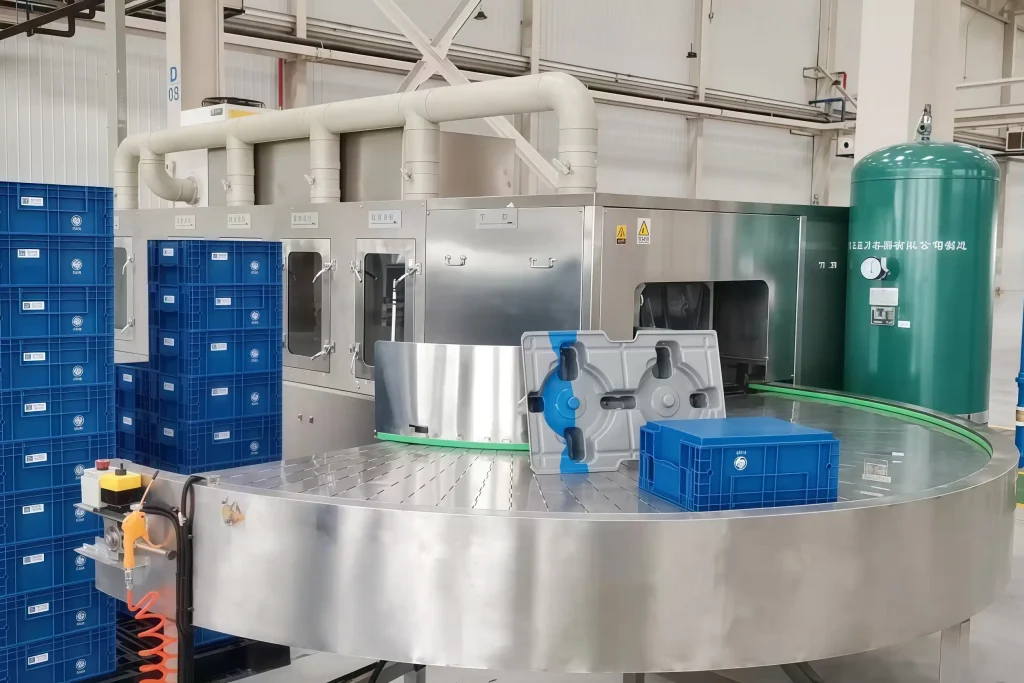
Achieving zero residue on precision parts is less about the cleaning chemistry you choose and more about the system that chemistry runs in. In two decades of designing automated cleaning lines for pre-coating, pre-assembly, and high-reliability applications, I have seen the most common failure mode is not a weak detergent — it is a rinse stage that recontaminates, a filtration bypass, or a basket that traps fluid inside blind holes. When every element of the cleaning system works to prevent recontamination, zero-residue becomes a predictable outcome rather than a lucky run. This article walks through the system-level engineering decisions that make repeatable zero-residue cleaning possible on a production floor.
What “Zero Residue” Really Means in Production Terms
Zero residue on a precision part means no detectable contamination of a type that would interfere with the next operation — typically coating adhesion, bonding, or assembly. The residue itself can be particulate (chips, dust from upstream machining), ionic (chloride, sulfate), or organic thin films (coolants, drawing compounds). Visible cleanliness is not enough. For hydraulic components, ISO 4406 counts particles per milliliter; for manufactured parts, ISO 16232 specifies extraction and particle size limits. A single fiber or water spot can cause a coating to bubble later.
Production lines often fail not because one stage underperforms, but because contaminants move from a dirty tank to a clean surface downstream. The rinse bath that should remove detergent slowly becomes a contaminated bath if overflow and filtration are insufficient. Similarly, an air knife blowing unfiltered plant air deposits fibers and dust onto freshly rinsed parts. Recognizing that residue is a system problem, not a chemical problem, is the first step toward solving it.
Designing a Rinse Cascade That Won’t Recontaminate
A rinse cascade is the sequence of tanks that carries parts from the cleaning solution to the final spot-free state. A properly designed cascade ensures that each rinse stage has higher purity than the previous one. For aqueous systems, a typical sequence is: tap water rinse → reverse osmosis (RO) water rinse → deionized (DI) water rinse. Each tank must overflow continuously so that dirt and detergent float away, not settle back onto parts. The final DI rinse must hold conductivity below 0.06 µS/cm, which means using a dedicated DI water system with inline resistivity monitoring.
Filtration across the rinse line is equally critical. In the final rinse, a 1 µm absolute filter catches particles dislodged during ultrasonic action. I recall a line where a single missing 1-µm filter on the final rinse caused entire batches of machined parts to fail a client’s light inspection for water spots. That experience underscores that cut costs on rinse filtration, and you will pay in rework.
GTKCLEAN’s Pre PVD Coating Parts Ultrasonic Cleaners automate this sequence with ultrapure water rinsing, overflow circulation, and PLC-controlled water quality alarms. For applications requiring the highest surface energy before coating, that level of water control is not optional — it is prerequisite.
If your parts have deep recesses or internal threads, the rinse step becomes even more challenging. <Eliminate Residue in Pre-Coating Parts Cleaning: An Expert Guide> explains how rotary basket cleaning paired with multi-stage ultrapure water rinsing achieves the contaminant-free surface quality that coating shops need.
Basket and Part Orientation: The Hidden Source of Residue
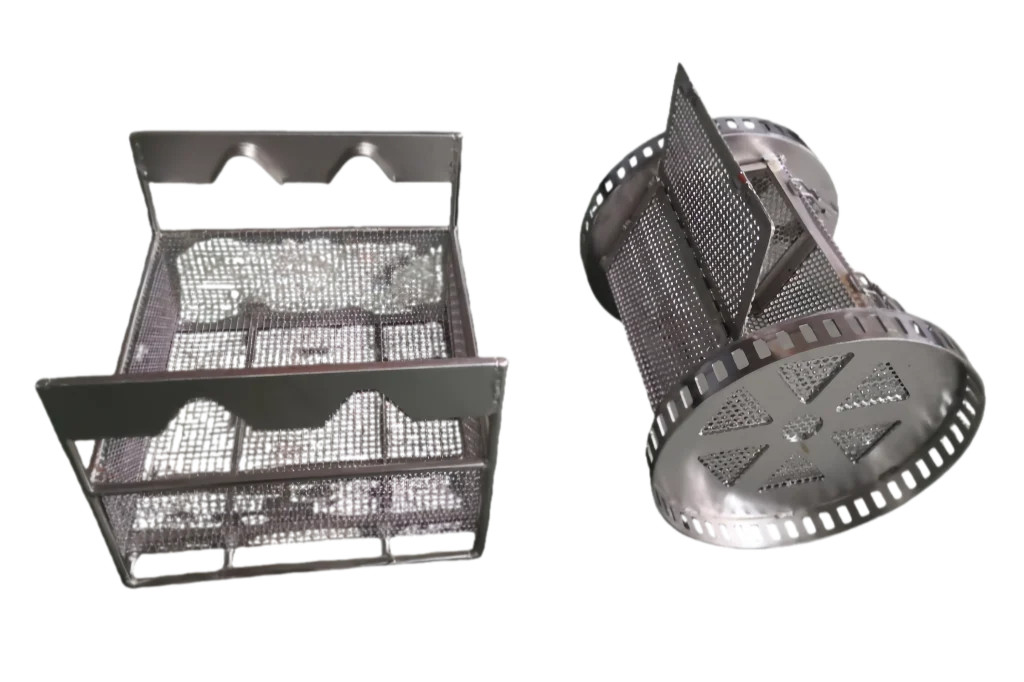
Even with a perfect rinse cascade, if a basket traps fluid in blind holes or part crevices, contamination redeposits during drying. Basket design is not a commodity decision — it requires analyzing part geometry, load distribution, and the required drain time. Stainless steel 304 or 316 is standard, but for highly corrosive chemistries, PTFE-coated baskets are necessary. The basket must hold parts securely without scratching surfaces, while exposing every feature to cleaning fluid and later to air.
Rotary baskets add another dimension: 360-degree rotation during cleaning and drying flushes liquid out of enclosed spaces. For parts with cross-drilled holes or internal galleries, a rotary basket combined with angled loading fixtures can cut post-drying residue by over 80 percent compared to a static orientation. I have seen this transformation in lines processing cylinder head components where a simple change from a flat tray to a rotating fixture eliminated water spots entirely.
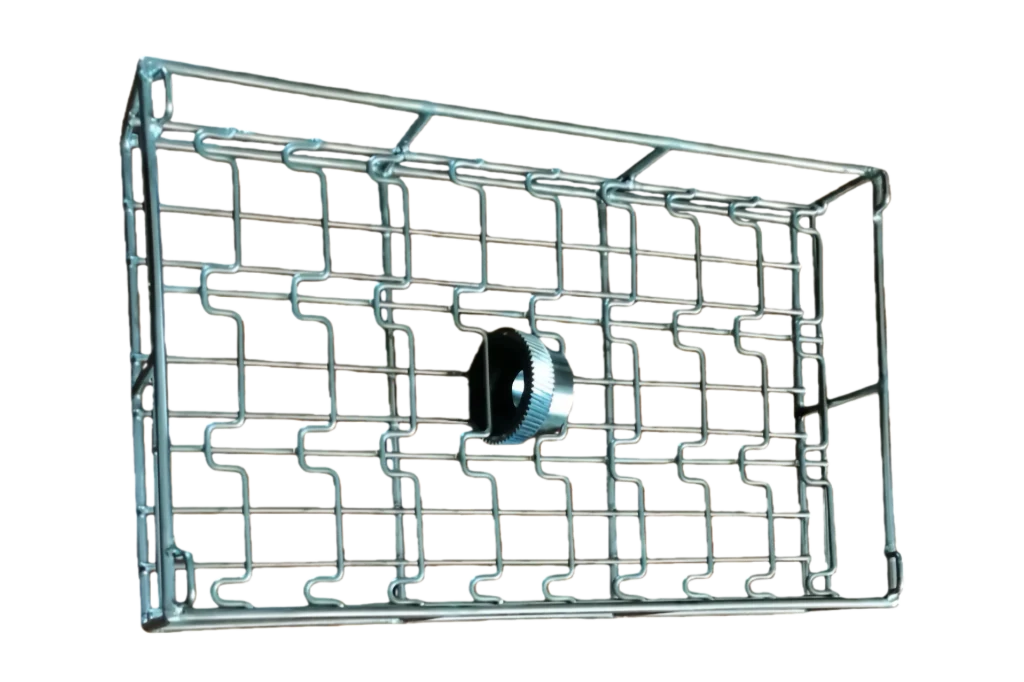
If your parts involve complex geometries, the basket is the make-or-break factor. GTKCLEAN designs custom washing baskets that account for part geometry, production speed, and drying requirements — we start by reviewing your part files to propose the optimal fixture design. Reach out at [email protected] with a drawing or model for a technical evaluation.
Drying and Filtration: The Last Defense
The drying stage is where many cleaning processes lose their grip on zero residue. Moisture left inside a blind hole evaporates and leaves behind dissolved solids, forming a visible spot. Several drying technologies exist:
| Drying Method | Mechanism | Best For | Potential Pitfalls |
|---|---|---|---|
| Hot air knife | High-velocity heated air sweeps liquid off surfaces | Flat, simple geometries | Can blow contaminants onto parts if air unfiltered; may not reach deep recesses |
| Vacuum drying | Lowers boiling point of water so it evaporates at reduced pressure; ideal for deep holes | Complex shapes, high-cleanliness specs | Longer cycle time; higher equipment cost |
| Infrared (IR) drying | Radiant heat dries parts from the surface inward | Small, heat-tolerant parts | Uneven heating; risk of overheating sensitive alloys |
For parts with blind holes, we often specify vacuum drying because it eliminates the liquid entirely without relying on airflow to reach the cavity. Drying air, whether from an air knife or convection, must pass through HEPA filters to avoid adding new particles. In solvent systems with vapor degreasing, the vapor condenses on parts and drips off, carrying dissolved contaminants with it; a vacuum drying chamber then removes residual solvent completely. The solvent recovery system must distil and recycle the solvent to maintain purity.
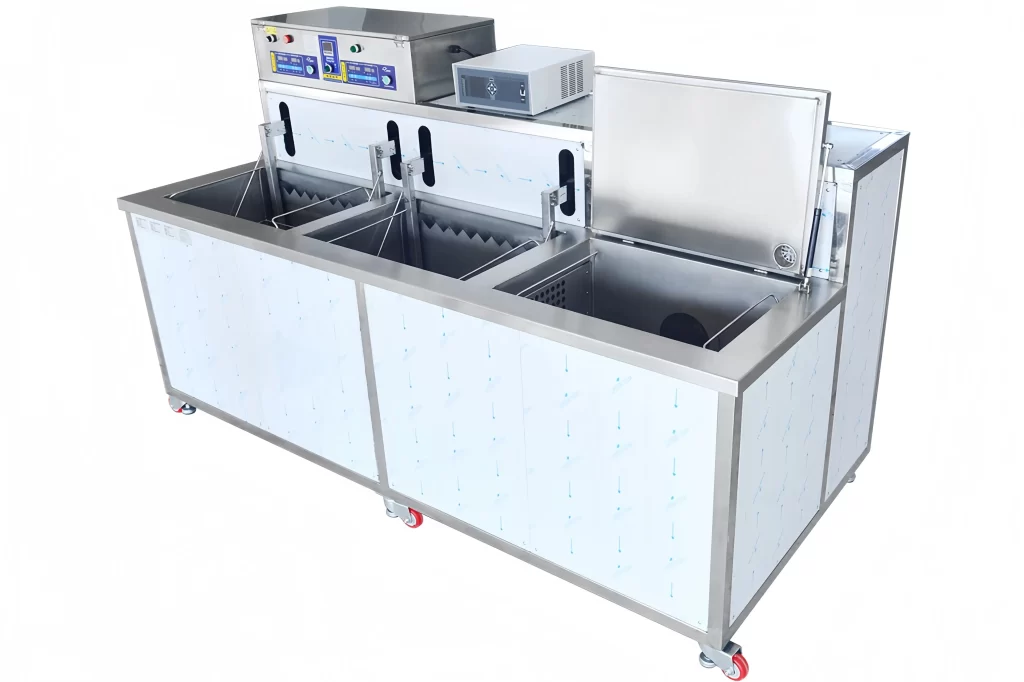
System-level filtration extends beyond rinse tanks. The wash tank itself must be filtered continuously to keep particulate from building up and redepositing. Pressure-drop indicators provide a clear signal for filter replacements. Production teams who track filter pressure trends can schedule changes predictably, avoiding unplanned downtime and residue excursions.
Spot-free drying demands filtration that matches the cleanliness target. <Industrial Ultrasonic Cleaning Systems: The Complete Guide> covers how closed-loop circulation and HEPA-dried air maintain rinse purity over thousands of cycles.
Validating Your Cleaning Process — Proof, Not Assumption
Until you measure, residue is a belief, not a fact. Validation requires a defined protocol that confirms the process can repeatedly meet the cleanliness specification. Common test methods include:
- Visual inspection under 10× magnification under bright, shadow-free lighting (for particles >50 µm and water spots)
- White cloth wipe test: a clean, lint-free cloth wetted with solvent wipes a defined area; any discoloration indicates organic residue.
- Particle extraction and counting: parts are immersed in a clean fluid tank, and an automatic particle counter reports counts per size channel (e.g., >5 µm, >15 µm) per milliliter or per part.
- Gravimetric analysis: residue is extracted, filtered, dried, and weighed — useful for quantifying total non-volatile residue.
- Surface energy measurement: contact angle or dyne pens indicate if the surface is sufficiently clean for coating adhesion (typically >38 dynes/cm for aqueous paints, higher for PVD/PECVD).
For medical devices, ISO 19227 outlines microbiological and particulate cleanliness validation for implants. For aerospace hydraulic components, SAE AS4059 and ISO 11218 specify particle cleanliness levels. Running a validation trial with deliberately contaminated parts demonstrates the process’s ability to clean worst-case loads.
Process capability comes from running multiple consecutive batches and demonstrating consistent results. I typically recommend a minimum of three validation runs with full particle count data before signing off a line for production.
Choosing Equipment Architecture to Eliminate Residue
No single cleaning technology guarantees zero residue; the architecture must be matched to the part, production volume, and cleanliness target. The table below summarizes key architectures:
| System Type | How It Works | Typical Applications |
|---|---|---|
| Multi-tank aqueous ultrasonic | Parts move through dedicated wash, rinse, and dry stations; tanks are separated, preventing cross-contamination. | CNC machined parts, stampings, automotive components |
| Rotary basket ultrasonic | Basket rotates 360° inside wash and rinse tanks, ensuring fluid exchange in blind holes. | Complex housings, bearing components, die-cast parts |
| Solvent vapor degreaser with vacuum drying | Hydrocarbon or modified alcohol solvent vapor cleans parts, and vacuum drying removes solvent without leaving residue. | Precision optics, medical devices, electronics |
| Inline conveyor spray system | Parts pass through spray stations on a conveyor; high throughput. | Aluminum shells, fasteners, die-cast automotive parts |
| Pass-through tunnel washers | Large parts suspended on hangers move through spray and air knife stations. | Engine blocks, gearboxes, heavy fabrications |
For pre-coating applications, multi-tank aqueous lines with DI water rinsing and vacuum drying are a robust choice. If production volumes are high and parts are simple, inline spray systems with adequate filtration can deliver zero residue at high speed. Solvent-based systems with vapor degreasing and vacuum drying often achieve the lowest residual particle counts on intricate electronic or optical components because the solvent fully evaporates without leaving ionic or particulate residue.
Choosing the right architecture influences not only cleanliness but also lifecycle cost and scalability. Working with a supplier that can audit your current process and recommend the configuration proven for your part type is the fastest path to eliminating residue.
From Process Audit to Zero-Residue Production
Residue failures on precision parts rarely trace back to a single factor — they are systemic. If your current cleaning line is not meeting cleanliness specifications, the root cause is likely hiding in the rinse cascade, basket design, or a bypassed filter. GTKCLEAN engineers approach each application with a full system audit and tailor the cleaning solution to eliminate every contamination source. Send your part drawings and target cleanliness specification to [email protected] or call +86 17768507147. We will help you define the system architecture that makes zero residue repeatable.
Common Questions About Achieving Zero Residue in Precision Cleaning
What is the most common reason precision parts fail a residue check?
Insufficient rinsing, followed closely by recontamination during drying. The rinse stage must remove all detergent and suspended particles; if the rinse water quality drops or tanks are not overflowing, residual chemistry dries on parts and creates spots. A single high-purity DI final rinse with proper overflow and monitoring eliminates the majority of these failures.
Can a basic benchtop ultrasonic cleaner deliver zero residue?
Many engineers assume a benchtop unit is enough because it “cleans,” but a single tank with no separate rinse or drying stage cannot meet the repeatable, documented cleanliness required for precision parts. Without a dedicated rinse and filtered drying air, parts simply transfer dissolved contamination back to the surface. Benchtop systems are useful for small-batch or low-criticality work, but for production environments, a multi-tank automated system is necessary.
Which is better for zero residue — aqueous or solvent cleaning?
It depends on your substrate, part geometry, and post-cleaning requirements. Solvent cleaning excels at drying without water spots and is effective on thin films and oils, but requires effective solvent recovery to be cost-effective. Aqueous systems, when combined with high-purity DI water and vacuum drying, can match solvents on many parts and are often preferred for high-volume metal processing. I have seen both achieve consistent zero-residue results when the system engineering is right.
How do I validate that a cleaning process consistently achieves zero residue?
Run a multi-batch validation with deliberately contaminated test parts representing worst-case production conditions. Measure particle counts, non-volatile residue, and surface energy before and after cleaning to establish a baseline, then verify over at least three consecutive runs. For critical applications, follow relevant ISO, VDA, or SAE standards and maintain trend charts. Regular re-validation after significant process changes ensures continued capability.
What maintenance schedule keeps a cleaning system residue-free?
Rinse water filters should be inspected daily and replaced based on pressure drop, typically every 40 to 80 production hours. DI water cartridges need regeneration or replacement when conductivity rises above tolerance. Air knife filters (HEPA) lose performance gradually; manufacturers often recommend quarterly replacement. Trust pressure-drop monitors rather than fixed calendar intervals — a sudden spike means a filter is loading faster than expected. In lines I’ve managed, weekly filter checks and a daily rinse-water quality log prevented almost all unscheduled downtime. If you need help setting up a maintenance plan tailored to your line, email [email protected] — we’ll review your system parameters with you.
If you're interested, check out these related articles:
Choosing the Right Ultrasonic Cleaning System for Industrial Success
Eliminate Residue in Pre-Coating Parts Cleaning: An Expert Guide
Recommended Optimum Cleaning Temperature for Ultrasonic Cleaning Equipment (Including Special Guidance for Aluminum Parts and Polishing Wax)
The Engineer’s Guide to Pre-Coating Surface Preparation
 English
  German
  Spanish
  French
  Russian
  Portuguese