
Ultrasonic cleaning is excellent at removing oils, greases, chips, polishing compounds, and other contaminants that can be lifted from a surface by cavitation and detergent chemistry. Paint, cured glue, and WD-40 occupy different positions on that spectrum. WD-40-type films are usually the easiest target, adhesives depend on chemistry and cure state, and cured paint is often the hardest because it is formulated to resist removal.
Before changing a production cleaning recipe, separate what cavitation does from what the cleaning chemistry does. Ultrasonic energy is the agitation mechanism; the detergent or solvent is the removal agent. If the chemistry cannot dissolve, soften, or undercut the residue, cavitation alone usually cannot compensate.
What Cavitation Actually Does
Ultrasonic transducers create high-frequency pressure waves in a liquid. The alternating low-pressure and high-pressure phases generate microscopic bubbles. When those bubbles collapse against a solid surface, they produce intense localized jetting and surface scrubbing [1]. That mechanical action reaches blind holes, threads, and recesses where spray wands and manual wipes cannot.
The effect is especially useful for dislodging particles and emulsified oils. It is less effective against a fully crosslinked, chemically resistant film that is bonded to the substrate. This is why contaminant classification matters more than tank size.
| Contaminant | Removal mechanism | Ultrasonic outcome by itself |
|---|---|---|
| Cured paint | Chemical softening plus mechanical lifting | Usually incomplete |
| Glue or adhesive | Solvent/detergent plus undercutting | Variable by resin |
| WD-40 or oily film | Emulsification or solvency | Generally good |
| Chips and particles | Cavitation impingement | Excellent |
Paint Removal: Not a Standard Ultrasonic Job
Most industrial paints and powder coatings are designed to resist water, solvents, and abrasion after curing. Even when an ultrasonic bath appears to remove paint, the result is often localized lifting at edges, scratches, or weak adhesion zones rather than complete stripping [2]. If the coating is intact and well adhered, ultrasonic cleaning is not a reliable removal method.
For parts that need coating removal, the practical sequence is a chemical paint stripper selected for the coating chemistry, followed by mechanical removal where required, and only then ultrasonic cleaning to remove residual stripper, loosened film, and surface debris. Solvent-based strippers create additional safety and compatibility requirements, so the part material and tank system must be evaluated together.
Because paint, glue, and WD-40 removal depends heavily on cleaning chemistry, choosing between aqueous and solvent methods changes both speed and safety. <Water Based Versus Solvent Based Ultrasonic Cleaning Systems> covers how water-based and solvent-based chemistries behave in industrial ultrasonic processes.
Glue and Adhesive Removal
Adhesives fall into several families. Pressure-sensitive tapes and labels may lift in warm alkaline cleaning baths, especially when cavitation works at the exposed edges. Hot-melt adhesives can soften with heat, making them easier to remove if the tank temperature is controlled. Cyanoacrylate, anaerobic threadlocker, and two-part epoxy are much more resistant once cured because they form chemically crosslinked networks [3].
For cured epoxies and cyanoacrylates, ultrasonic agitation often cleans the surrounding surface but leaves the adhesive body or bond line intact. The correct starting point is an adhesive-specific solvent, thermal treatment, or mechanical disassembly. If the remaining film is already degraded or partially lifted, ultrasonic cleaning can then help flush away residue.
WD-40 and Oily Penetrant Films
WD-40 is a water-displacing oil and penetrant, so it does not form the hard, crosslinked film typical of cured paints. Warm alkaline detergents or hydrocarbon-based cleaning chemistry can usually emulsify or dissolve the oily film, and ultrasonic cavitation accelerates the process by disrupting the boundary layer and carrying fresh chemistry to the surface [4]. This is the category where ultrasonic cleaning is strongest.
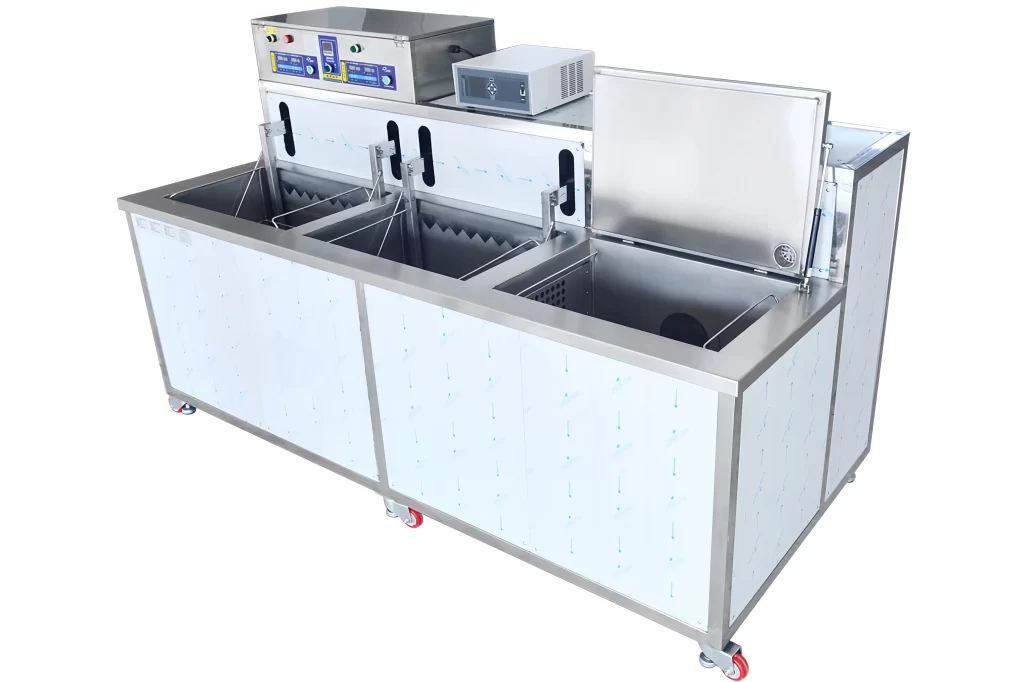
The main caveat is temperature and flash point. If the WD-40 film is heavy or mixed with shop dust, a single-tank ultrasonic wash may produce a soil-loaded bath quickly. A better process uses staged tanks: initial degreasing, rinse, final DI rinse, and drying. That prevents redeposition and keeps the final surface residue-free.
Why Chemistry Usually Decides the Outcome
Cavitation supplies energy, but the solubility and reactivity of the contaminant determine whether that energy produces a clean surface. For example, a cured two-component polyurethane coating may tolerate water and many solvents, so a water-based ultrasonic bath cannot strip it. The same bath may remove a light WD-40 film in minutes because the film is a viscous oil with no significant crosslinking.
For production lines, this means the cleaning specification should identify the exact contaminant, film thickness, cure state, substrate material, and post-cleaning requirement. Once those inputs are clear, the system designer can select the ultrasonic frequency, tank temperature, and detergent family that match the failure mechanism: dissolution, emulsification, softening, or mechanical undercutting.
Process Parameters That Make a Difference
- Frequency: Lower frequencies such as 25–40 kHz generate more aggressive cavitation for heavy soils, while higher frequencies such as 68–80 kHz are gentler and may be preferred for delicate or polished parts.
- Temperature: Most aqueous degreasing works best between 50 °C and 65 °C, but adhesives and coatings may require the chemical supplier’s recommended window.
- Detergent concentration and pH: Alkaline cleaners help remove oily and fatty films; acidic cleaners can address oxides and scale; neutral or mildly alkaline detergents are safer for aluminum, brass, and multi-metal assemblies.
- Time: Longer ultrasonic exposure is not always better. If the chemistry is wrong, more time mainly consumes energy and can damage the substrate.
- Rinsing and drying: Removing residue from the surface is only half the job; adequate DI rinsing prevents redeposition and water spots.
Selecting the wrong ultrasonic frequency can slow contaminant release or damage the substrate. <Optimize Ultrasonic Frequency for Diverse Materials> covers how frequency selection affects cavitation energy, material compatibility, and cleaning speed.
Safety Before You Run the Tank
Paint strippers, adhesive solvents, and even WD-40 cleaning chemicals can introduce flammability, inhalation, and skin-contact hazards. Solvents should only be used in ultrasonic equipment rated for that solvent class and in facilities with proper ventilation, electrical classification, and fire protection [5]. If the solvent or stripper is flammable, do not assume a standard water-based ultrasonic tank is safe.
Also screen the part material. Cavitation and aggressive chemistry can etch or discolor aluminum, zinc, copper alloys, and plated surfaces. For expensive components, start with a cleaner in a small sample bath and test both coating removal and substrate integrity before committing the full production lot.
When Ultrasonic Cleaning Makes the Most Sense
Ultrasonic cleaning is the wrong first choice for fully cured paint removal. It is a strong supporting step after chemical stripping and an excellent workhorse for oily films, light adhesives, residues, and particulate contamination. If a part arrives contaminated with WD-40 and shop debris, an automated multi-stage ultrasonic system will often outperform manual wiping because it reaches recessed surfaces and produces repeatable results. If the part has a bonded coating or structural adhesive, use ultrasonic cleaning only after a compatibility study confirms that the bath chemistry and cavitation will not weaken the bond or attack the coating.
Ultrasonic cleaning is not always the fastest or safest route for heavy paint and adhesive removal. <Industrial Ultrasonic Cleaners Versus Traditional Cleaning Methods> covers when automated ultrasonic systems outperform manual, spray, and solvent wipe-down methods in production.
Factory teams evaluating a mixed contaminant stream can avoid over-specification by running a trial with actual parts. For a cleaning test or technical recommendation, email [email protected] or call +86 17768507147 with part size, material, contaminant, and required output.
Need a Cleaning Process Validation?
GTKCLEAN supports cleaning trial design, chemical compatibility review, and system configuration for industrial parts lines. If you are deciding whether to strip, soak, or automate, email [email protected] or call +86 17768507147 and include the part material, contaminant, and daily throughput.
Frequently Asked Questions
Can ultrasonic cleaning remove cured paint from metal parts?
Usually not reliably. Fully cured industrial paints and powder coatings are designed to resist water, solvents, and abrasion. Ultrasonic cleaning may lift weakened edges or loosened film, but a chemical stripper chosen for the coating is normally required first.
Will ultrasonic cleaning remove cyanoacrylate glue?
It may clean around the bond, but it generally will not dissolve fully cured cyanoacrylate. Adhesive-specific solvents, thermal treatment, or mechanical disassembly are more effective. Ultrasonic cleaning can then be used to flush away loosened residue.
Is WD-40 removable in an ultrasonic cleaner?
Yes, in most cases. WD-40 is an oily penetrant film rather than a crosslinked coating. Warm aqueous degreasing or a suitable solvent bath combined with ultrasonic agitation usually removes it, especially with proper rinsing and drying.
What frequency should I use for paint, glue, or WD-40 residue?
For oily films and loosened residues, 25–40 kHz is a common starting range because it provides stronger cavitation. For delicate parts, 68–80 kHz may be safer. Frequency is secondary to using the correct detergent or solvent for the contaminant.
Can I put solvent paint remover in an ordinary ultrasonic tank?
No. Standard ultrasonic tanks are not automatically safe for flammable or aggressive solvent-based strippers. Use equipment rated for the specific solvent class, with suitable ventilation, electrical protection, and fire safety controls.
References
[1] Blitz, J. and Ebbitt, G. Ultrasonic Cleaning: Fundamental Theory and Application. Academic Press.
[2] ASTM International. ASTM D3359-23: Standard Test Methods for Rating Adhesion by Tape Test. West Conshohocken, PA: ASTM International, 2023.
[3] ISO. ISO 2812-1:2017: Paints and Varnishes — Determination of Resistance to Liquids. Geneva: International Organization for Standardization, 2017.
[4] National Institute for Occupational Safety and Health. NIOSH Pocket Guide to Chemical Hazards: Stoddard Solvent / Petroleum Distillates. Centers for Disease Control and Prevention.
[5] U.S. Occupational Safety and Health Administration. Solvents. OSHA.
If you're interested, check out these related articles:
Design an Efficient Multi-Stage Industrial Cleaning Process
Stamped Parts Cleaning Solutions - GTK
Solvent Recovery Systems: Unlocking Industrial Cost Savings
 English
 German
 Spanish
 French
 Russian
 Portuguese