

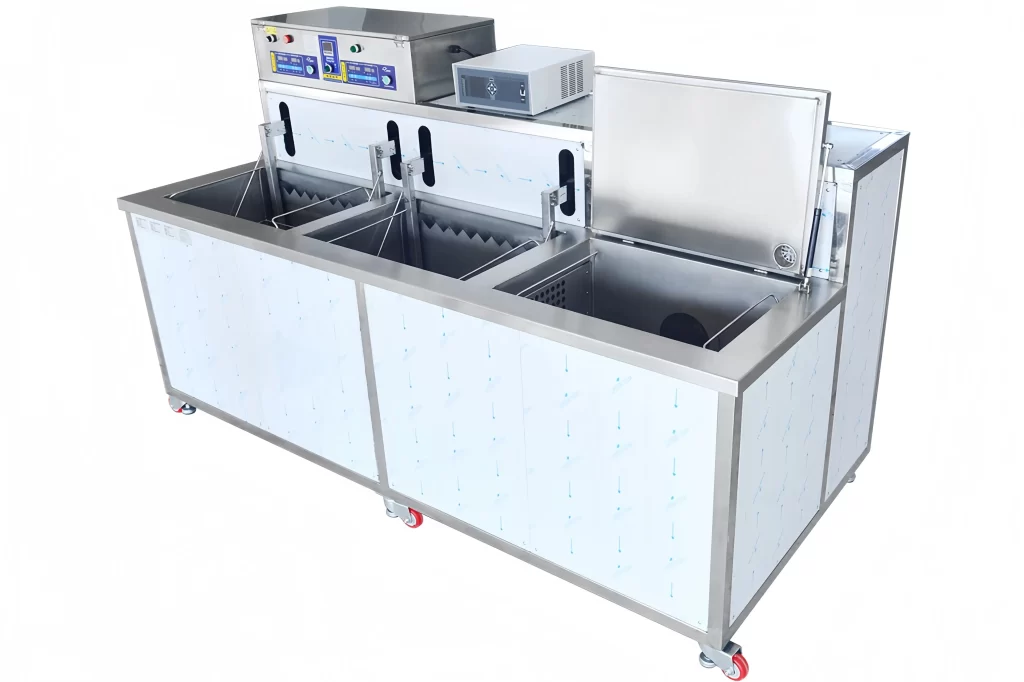
If you move large, heavy parts through a cleaning line manually, you introduce handling damage, operator fatigue, and inconsistent dwell time. Conveyor ultrasonic cleaning systems eliminate those variables by automating the transport through immersion, spray, and drying stages, with the same cycle parameters applied to every unit. The engineering challenge, however, is not simply placing an ultrasonic tank under a conveyor: the load must be supported, the ultrasonic field must penetrate the part uniformly, and the transport speed must match the required cleanliness standard without bottlenecking upstream processes.
Conveyor Ultrasonic Cleaning Systems for Large Parts: How They Work
In a conveyor ultrasonic system, workpieces are loaded onto a belt or chain-driven fixture that moves them sequentially through wash, ultrasonic immersion, rinse, and drying zones. For large parts such as engine blocks, gearbox housings, or structural fabrications, the conveyor must carry the weight while maintaining part orientation so that blind holes and internal cavities drain properly. Ultrasonic transducers are mounted on the tank walls or bottom and driven by generators tuned to the optimal frequency for the contaminant and substrate, typically between 20 kHz and 40 kHz for heavy steel components.
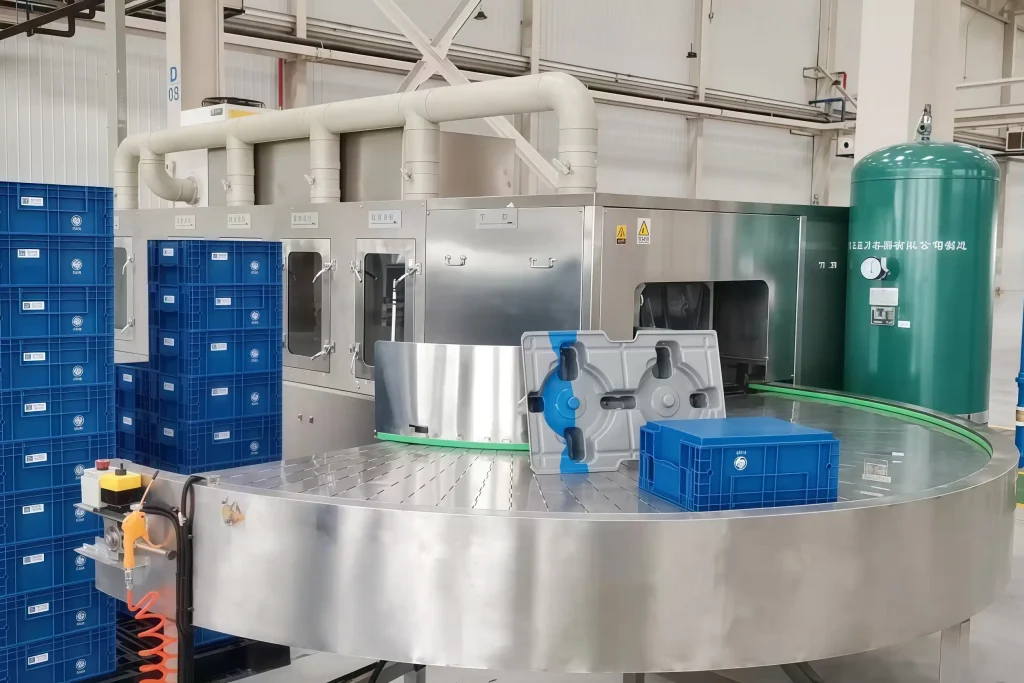
The system differs from a batch rotary basket machine in that the conveyor determines throughput. A typical system moves at 0.5 to 1.5 meters per minute, and the ultrasonic dwell time is a function of the tank length along the conveyor path. To achieve a 5-minute ultrasonic exposure, for example, the conveyor speed must be set so that each part spends that long in the ultrasonic tank. Multi-stage systems add pre-wash spray sections to remove bulk soils before ultrasonic immersion, reducing contamination of the cleaning solution and extending bath life. After ultrasonic cleaning, the part passes through a rinse section and then a drying module, often using air knives, hot air, or vacuum drying for complex geometries.
The decision to use conveyor transport instead of a rotary basket or robotic transfer is driven by part size and production volume. If the parts exceed 500 mm in length or weigh over 100 kg, a conveyor provides continuous flow without requiring overhead handling equipment to reposition parts between tanks. Large parts also often require dedicated fixturing to expose all surfaces, and conveyor systems can accommodate custom baskets or nests that hold the part in a fixed orientation throughout the process.
Engineering for Heavy Loads: Basket and Conveyor Design
The mechanical design of the conveyor and basket is where most systems succeed or fail when cleaning large parts. We have found that three factors dominate: basket strength under cyclic thermal and vibration loading, conveyor roller load rating, and the coupling of the part to the ultrasonic field through the basket structure.
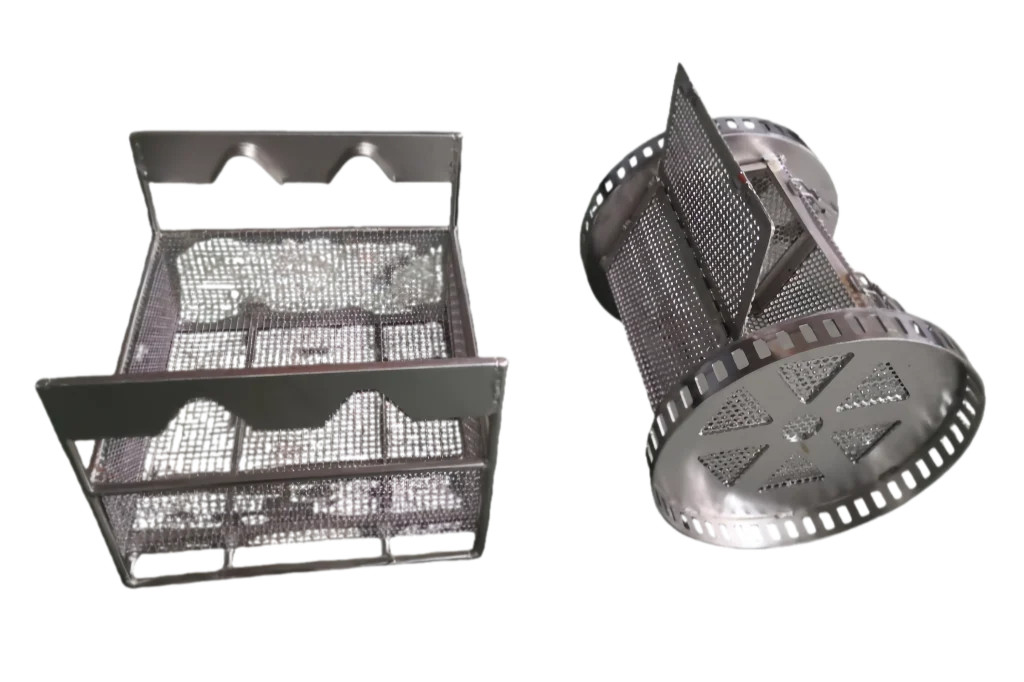
For parts that weigh 200 kg or more, the basket must be constructed of reinforced stainless steel with cross-bracing that does not trap air or create shadow zones for cavitation. The basket floor is often an open mesh, but if the part has small protrusions or sharp edges, the mesh must be sized to prevent marking while still allowing ultrasonic energy to pass upward. The conveyor rollers must be rated for the full basket-plus-part weight with a safety factor, and the drive system must deliver smooth motion; jerky starts can shift heavy parts and cause misalignment, leading to incomplete cleaning or collisions with tank internals.
Basket design also affects cleaning uniformity. If the basket frame blocks the ultrasonic path, the part surfaces directly above the frame may receive lower cavitation intensity. This is particularly visible on transmission housings and large bearing caps, where a dense frame shadow can leave a strip of residual oil. We address this by modeling the ultrasonic field distribution using pressure-mapping transducers during commissioning and adjusting the basket frame geometry to minimize interference. The same principle applies to the conveyor itself: if the conveyor belt or chain runs through the tank above the transducers, metal links can absorb significant ultrasonic energy. Solutions include using plastic chain components or raising the transducers on the tank sides to clear the conveyor path.
Load distribution on the conveyor is another practical detail that is often underestimated. If the production line loads parts only on one side of the conveyor, the belt can drift, causing edge wear and misalignment with the spray nozzles and drying air knives. Ideally, parts are centered or alternated, but when that is not practical, the conveyor tracking and tensioning system must be robust enough to compensate. In high-volume lines where we deploy conveyors with 1-meter belt widths, we use crowned rollers and automatic belt-tracking sensors to keep alignment within a few millimeters over thousands of cycles.
Integrating Conveyor Cleaning into Your Production Line
Conveyor ultrasonic systems are rarely standalone machines; they must interface with upstream machining centers or forming presses and downstream assembly or coating lines. The integration challenge is managing the disparity between the cleaning cycle time and the production takt time. If the cleaning line is too slow, parts accumulate and the system becomes a bottleneck; if too fast, parts pass through without achieving the required cleanliness.
We typically design the conveyor speed and tank lengths so that the cleaning cycle is slightly faster than the production takt, with a buffer accumulation zone before the washer. This buffer allows the cleaning system to run at its designed speed while absorbing short production surges. For a machining line producing one large part every 4 minutes, the cleaning system conveyor must deliver a clean part at least every 4 minutes, which means the conveyor speed must move a part through all stages in that interval. If the ultrasonic tank is 3 meters long, the speed would be set to 0.75 m/min, giving a dwell time of 4 minutes, matching the takt. Real systems often run slightly faster to account for maintenance interruptions.
The cleaning line must also communicate with the factory control system. Modern ultrasonic cleaning lines use PLCs with Ethernet/IP or PROFINET connectivity that report status, alarm conditions, and cycle counts to the plant SCADA. This allows the production manager to see cleaning system throughput in real time and correlate it with downstream quality data. When a part fails a coating adhesion test, the cleaning line data log can be checked to verify that the ultrasonic power, temperature, and dwell time were within specification for that batch.
Fluid management is another integration point. Large parts carry more drag-out of cleaning solution, which must be replenished. The rinse section must therefore be sized to remove residual chemistry, and a water recycling system (RO or DI) can reduce water consumption by returning treated rinse water to the pre-wash stage. For aqueous cleaning lines we have commissioned with 2,000-liter tank volumes, a continuously operating oil separator and bag filtration system reduces solution replacement from weekly to monthly, cutting chemical costs significantly.
Cost and ROI Analysis for Conveyor Ultrasonic Systems
The capital cost of a conveyor ultrasonic cleaning system for large parts depends on conveyor length, number of stages, tank material (304 vs. 316 stainless steel), and automation level. A basic single-stage ultrasonic conveyor with a simple belt and manual loading can start around $80,000, while a fully automated multi-stage system with recipe control, vacuum drying, and robotic load/unload can exceed $350,000. That is the price of a robust, custom-engineered machine.
The return on investment comes from three areas. First, labor reduction: a conveyor system can be operated by one person who loads parts and monitors the line, replacing two or three people performing manual cleaning or operating batch machines. Second, quality consistency: automated cleaning reduces rework and scrap rates. In coating-preparation applications, we have measured a 15–25% reduction in coating adhesion failures after switching from manual spray-and-wipe to an automated conveyor ultrasonic line. Third, throughput: a conveyor can process parts in a continuous stream, whereas a batch machine requires loading, cycling, and unloading. For a plant running two shifts, a conveyor system can increase net cleaning capacity by 30–40% over batch methods.
| Cost Factor | Batch Rotary System | Conveyor Ultrasonic System |
|---|---|---|
| Operator Requirement | 2–3 per shift | 1 per shift (load/ unload) |
| Throughput (parts/hr) | 10–15 (cycle-limited) | 15–25 (continuous) |
| Floor Space (sq. meters) | 12–18 | 20–40 (longer) |
| Solution Consumption (L/month) | 500–800 | 300–500 (with filtration) |
| Typical Capital Range | $60,000 – $150,000 | $80,000 – $350,000+ |
Operating costs are dominated by energy and chemistry. Ultrasonic generators driving a large tank draw considerable power, but they are more efficient than heating large volumes of solution. By insulating tanks and recovering heat from the drying section exhaust, energy consumption can be reduced by 10–15%. Chemical costs can be minimized by using oil-water separators and coalescers to extend the useful life of the cleaning solution. These systems are standard equipment on a well-designed conveyor line and pay back their cost within the first year for high-usage operations.
If your program involves parts with heavy grease or stamping oils, it is worth confirming with the equipment supplier that the solution filtration and oil removal system is sized for your maximum contaminant loading; an undersized system will drive up operating costs and increase maintenance frequency. Reach out to us at [email protected] if you need help defining the required filtration capacity for your part type and production volume.
How to Select a Conveyor Ultrasonic Cleaning System
Selecting the right system begins with a clear definition of the part family, production rate, and cleanliness requirement. We always start with a design of experiments on the worst-case part: the heaviest, the most geometrically complex, and the dirtiest. If the system can clean that part consistently, it will handle the rest. The supplier should provide a test report with gravimetric cleanliness data or surface tension measurements, not just a video of parts looking clean.
Key technical specifications to evaluate include ultrasonic frequency range (20–80 kHz for different contaminants), transducer mounting (side-mounted vs. bottom-mounted, and whether they are replaceable without draining the tank), and the cleaning solution management system, including heating, recirculation, and filtration. The conveyor itself must be specified for the load rating, speed range, and material compatibility with the chemistry. Stainless steel conveyors are preferred for aqueous systems, but if you are using aggressive solvents, special alloys or polymeric belts may be required.
Several internal resources can help you evaluate manufacturers and technologies. Our article on Choosing the Right Ultrasonic Cleaning System for Industrial Success walks through a step-by-step evaluation framework, and Automated Ultrasonic Cleaning Systems for Advanced Manufacturing explains how automation levels affect cleaning quality. If your facility already uses batch cleaning, you may benefit from our design guide for multi-stage processes, which applies many of the same principles to conveyor layouts.
Supplier qualifications matter as much as equipment specifications. Ask for documentation of installed systems similar to your application, including references you can contact. A supplier with global deployment experience has likely solved problems you have not yet encountered. Our team at GTKCLEAN has delivered cleaning systems to more than 20 countries, and each deployment brings lessons that strengthen the next design. We encourage you to send your part drawings and cleanliness targets to [email protected] so we can propose a conveyor ultrasonic configuration specific to your production line.
Questions Manufacturers Ask About Conveyor Ultrasonic Systems
Can conveyor ultrasonic systems handle mixed part families, or do they need dedicated tooling?
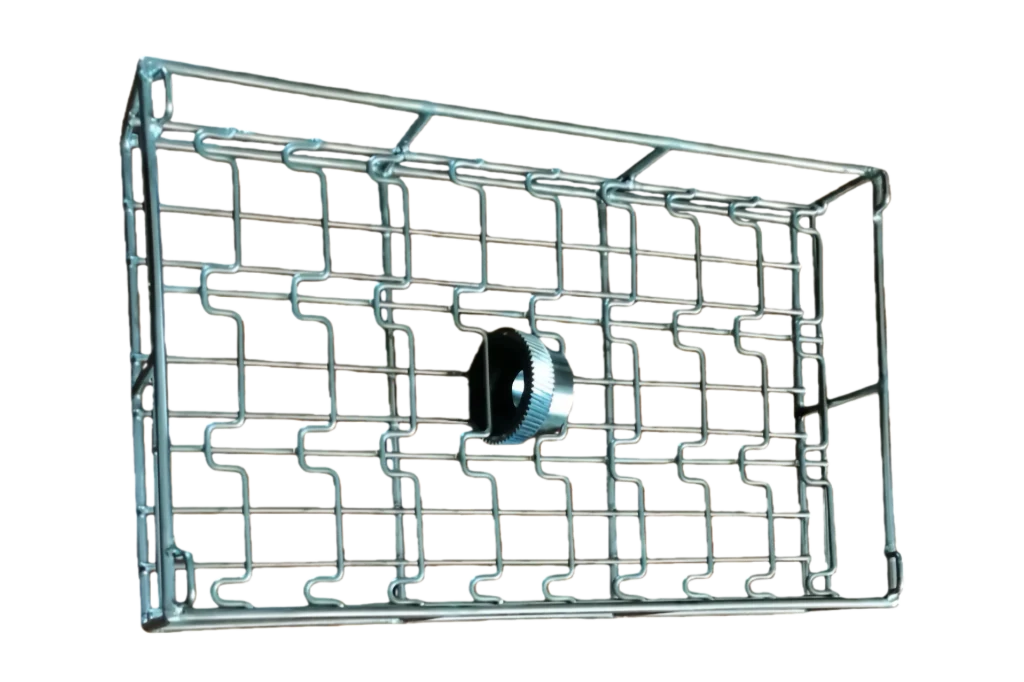
They can handle mixed part families, but only if the extremes of geometry and weight are within the designed range of the basket and conveyor. In production, this means you must either standardize basket inserts for each part family or accept that some parts will not achieve the same cleaning uniformity as the most optimized part. For lines that run a high mix with frequent changeovers, we recommend using a quick-change basket system with locking pins, so that a single operator can swap inserts in under a minute.
How do I know if my part needs vacuum drying instead of air knives?
It depends on whether the part has recesses that trap water. Large parts with open surfaces dry easily with high-velocity air knives. But if your part has deep blind holes, narrow channels, or capped ends, water can remain even after several passes of air. In those cases, vacuum drying pulls water out by boiling it at reduced pressure, which is more effective for complex internal geometries. The additional cost of a vacuum module is about 15–25% of the system price, which is often justified when downstream processes like painting or plating cannot tolerate moisture.
What ultrasonic frequency should I use for large steel parts?
Lower frequencies (20–25 kHz) produce larger cavitation bubbles and more aggressive cleaning, which is good for removing heavy oils, carbon deposits, and heat treatment scale from large steel components. Higher frequencies (40–80 kHz) produce gentler, more uniform cleaning and are better for finishing operations or softer metals. For large steel parts going into coating, we commonly specify 28 kHz as a balance between aggressive cleaning and the risk of cavitation erosion on surface finishes.
How long should a conveyor ultrasonic system last before major overhaul?
With proper maintenance, a well-built stainless steel conveyor system can operate for 15–20 years before the conveyor chain and ultrasonic transducers need replacement. The tank structure and frame are effectively permanent. The most common failure points are the conveyor drive bearings and the ultrasonic generator electronics, which have a service life of 8–10 years. Routine maintenance includes checking transducer bonding integrity, conveyor roller alignment, and pump seals every quarter.
What after-sales support should an equipment supplier provide?
A qualified supplier should provide installation supervision, on-site commissioning, operator training, and a minimum one-year warranty on all components. Remote diagnostics capability, including PLC program upgrade support, is increasingly expected. Before you sign a purchase order, verify that the supplier has a service engineer who can be on site within 48 hours of a critical alarm, especially if the cleaning system feeds a bottleneck production process. We keep spare parts inventory at our Suzhou facility and can ship critical components within 24 hours to major manufacturing regions.
If your plant is preparing to invest in a conveyor ultrasonic cleaning system for large parts, we can provide a detailed technical proposal based on your part geometries, soil types, and production targets. Send your requirements to [email protected] or call +86 17768507147 to discuss the configuration that will deliver the cleaning consistency your process demands.
If you're interested, check out these related articles:
Ultrasonic Cleaning Systems: Precision, Efficiency, and Industrial Applications
Ultrasonic Cleaning Systems for Manufacturing A Technical Guide
Eliminate Residue in Pre-Coating Parts Cleaning: An Expert Guide
Choosing the Right Production-Line Ultrasonic Cleaning System Guide
 English
  German
  Spanish
  French
  Russian
  Portuguese