An industrial ultrasonic cleaning system is not a stronger version of a benchtop cleaner. It is an engineered process cell that combines ultrasonic cavitation, mechanical transfer, filtration, rinsing, and drying to hold a specified cleanliness level at production throughput. For engineers and buyers, the practical question is whether each stage can deliver repeatable results on the real part, not whether the generator makes bubbles. I have seen lines underperform because the ultrasonic stage was specified correctly and the rinse or drying stage was not. That gap is where most selection errors start.
The Cavitation Mechanism Behind Industrial Ultrasonic Cleaning
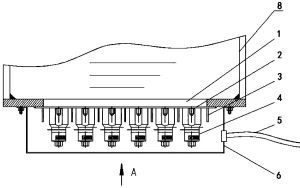
An industrial generator drives a transducer, which converts electrical energy into mechanical vibration. The transducer mounted to a tank bottom or side cycles the cleaning liquid at a set frequency, usually 20 kHz to 80 kHz. Lower frequencies produce larger, more energetic cavitation bubbles that suit heavy oil and thick films. Higher frequencies produce smaller, gentler bubbles that reach fine surfaces and narrow gaps without eroding soft material. The cleaning action itself comes from cavitation, not from vibration alone. A bubble forms during the low-pressure phase, grows across alternating pressure cycles, then collapses near the part surface. The collapse releases a high-speed microjet and localized energy that dislodges oil, chips, polishing compound, dust, and oxide layers from the surface. Liquid temperature matters because viscosity and dissolved gas change cavitation behavior. Water-based systems often run at 45 °C to 65 °C. Hydrocarbon systems used for stamping oil removal are commonly heated to 40 °C to 60 °C. Temperature by itself does not clean; it changes how well the chemistry lifts the contaminant and how stable the cavitation field remains across the tank.
Cavitation is not just bubbles in a tank. A bubble must form, grow, and collapse near the part surface to create a cleaning effect. <What Is Ultrasonic Cavitation Effect?> covers that mechanism and explains why temperature, gas content, and frequency change whether cavitation is gentle enough for precision surfaces or aggressive enough for heavy contamination.
Core Components That Determine Ultrasonic Cleaning Performance
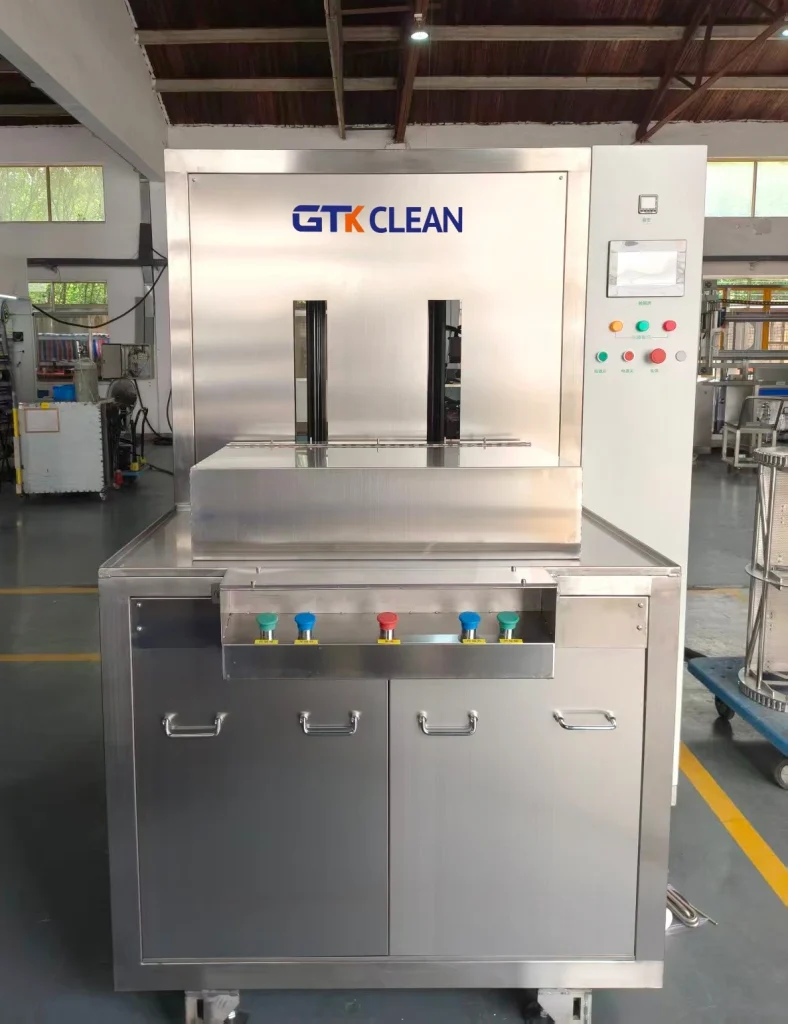
An ultrasonic cleaning system behaves as a chain. The best transducer cannot correct a poorly drained basket or a rinse tank that leaves detergent residue. The generator and transducer set the cavitation energy. The tank volume, liquid level, and fill and drain rate set how much solution stays clean enough to work. The basket determines part orientation, drainage, and whether blind holes are exposed to cavitation. Filtration and circulation systems remove the contaminant load before it redeposits. For precision coating lines, final rinse water quality is one of the more demanding variables. A pre PVD cleaning line at GTKCLEAN uses ultrapure water with conductivity held at or below 0.06 μS/cm so that drying does not leave water spots or conductive residue on the part.
Component
What to verify
Common risk if neglected
Generator and transducer
Frequency and power density per tank area
Weak cavitation in corners or shadow zones
Basket and fixture
Part orientation, drainage, load capacity
Trapped air, blind holes, or contact marks
Filtration and circulation
Filter rating and turnover rate
Contaminant redeposition
Rinse stage
Water quality and overflow rate
Detergent residue or water spots
Drying stage
Air knife, hot air, or vacuum
Moisture retention in threads and recesses
Generators, transducers, tanks, baskets, and filtration only become predictable when they are matched as a system. <Ultrasonic Cleaning System Components Explained> walks through the role of each component and where mismatches usually show up first.
The Process Sequence from Load to Dry
An industrial ultrasonic cleaning system usually follows a fixed sequence. The exact order changes by application, but the logic stays the same: remove the gross contaminant, apply cavitation to the remaining film, rinse the dissolved soil, and dry without leaving residue. A pre PVD system may use hydrojet spray, ultrasonic cleaning, multi-stage ultrapure water rinsing, then air knife, hot air, or vacuum drying. A CNC machined parts line may use high-pressure spray, ultrasonic degreasing, RO water rinse, DI water rinse, then hot air or vacuum drying.
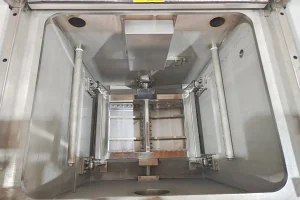
Load and orientation. The part sits in a basket or fixture so that blind holes drain and cavitation reaches the critical surfaces. Rotary baskets help parts with recesses because the rotating motion lets trapped air escape.
Pre-wash or spray. A high-pressure spray or rough ultrasonic stage removes chips, gross oil, and loosely attached particles before they load the fine cleaning tank.
Ultrasonic cleaning. The main tank combines detergent or solvent with cavitation at the selected frequency and temperature. Dwell time often runs from five to six minutes per tank, but that number should be set by the contamination load on the real part rather than copied from a datasheet.
Rinse. RO or DI water, sometimes in multiple cascading stages, removes dissolved contamination and cleaning chemistry. Final rinse quality is often the difference between a clean part and a water spot or residue failure.
Drying. Air knife, hot air, or vacuum removes liquid from threads, blind holes, and close-fitting surfaces. Complex or water-sensitive parts may require vacuum drying.
Cycle time is not just the sum of dwell times. Transfer between stages, basket handling, and heat-up time all consume production capacity. A manual multi-tank machine may work for low volume, but high-volume production needs automated transfer to keep cycle time stable.
Manual transfer and automated transfer do not always produce the same cleanliness, even with identical tanks. Once a system moves to rotary basket, conveyor, or inline handling, repeatability depends on transfer logic and sensor feedback as much as on ultrasonic power. <Mastering Automation Levels in Industrial Ultrasonic Cleaning> explains how to choose the automation level that matches throughput without overbuilding the line.
If your line includes a final rinse with tight conductivity or a vacuum drying requirement, that is the point where many standard machines fall short. Before locking the bill of materials, confirm those stage parameters against your worst part. Send the part drawing and target throughput to [email protected] and we will check the configuration.
The Practical Limits of Industrial Ultrasonic Cleaning
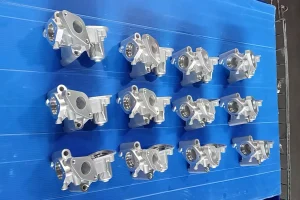
Ultrasonic cleaning is strong in holes, threads, slits, and surfaces that spray or manual wiping cannot reach. It is not a universal process. Heavy lapping compound packed into a blind hole will not clean if the liquid cannot reach the contamination or if trapped air blocks bubble formation. Soft alloys and thin films can show cavitation erosion when frequency is too low and power density is too high. Some contaminants respond better to solvent chemistry, higher temperature, or a pre-soak before ultrasonic exposure. This is why a water-based line is not always the right choice. A hydrocarbon ultrasonic vacuum cleaner may be required for precision hardware with recessed stamped features, while a simple basket system handles larger, less sensitive parts. The weakest stage in the sequence determines the final result, not the strongest stage. A common failure we see in pre-coating applications is residue left after drying. The ultrasonic tank removed the oil, but the final rinse could not flush the dissolved contaminant and detergent from the part before the hot air stage. The residue then cooked onto the workpiece and caused coating adhesion loss. The fix was not more ultrasonic power; it was a rinse stage with lower conductivity and better overflow.
Parameters to Verify Before Selecting a Cleaning System
Most selection errors come from specifying the machine around the easy part and discovering the problem only when the difficult part reaches production. We ask for five inputs before sizing a system: part drawings including blind holes and thread details; the contaminant type and loading; the daily or hourly volume; the post-cleaning requirement such as coating, welding, or assembly; and the cleanliness measurement method. Part geometry drives basket design. A cubic bracket and a thin plate with blind holes need different orientation and support. Production volume drives whether the system is manual, semi-automatic, or inline. Cleanliness requirement drives rinse and drying selection. If parts feed directly into coating, the final rinse conductivity and drying method become the controlling variables. A machine that cannot hold the final rinse quality will not meet the coating bond requirement regardless of how strong the ultrasonic stage is. The reason many cleaning lines miss expectations is not a weak ultrasonic generator. It is an under-specified rinse, a basket that shields critical surfaces, or a cycle time that cannot hold target throughput. If you are at the quoting stage, send the part drawings, contamination description, daily volume, and post-cleaning requirement to [email protected] or call +86 17768507147. We will confirm which process stages need attention and return a configuration matched to the worst part, not the easiest one.
Common Questions About Industrial Ultrasonic Cleaning
Does ultrasonic cleaning remove every contaminant from a part?
No. Ultrasonic cleaning removes contaminants that cavitation can reach and that the chemistry can dissolve or displace. Heavy grease packed into a blind hole, cured adhesive residue, or thick carbon deposits may need a pre-soak, higher temperature, mechanical pre-cleaning, or a solvent-based stage before ultrasonic processing. If air is trapped in a recess, cavitation will not form there. That is why we ask for the worst part and the exact contaminant before proposing a machine. A system can only be specified after the failure mode is clear.
What is the difference between ultrasonic cleaning and cavitation?
People sometimes use the two terms as if they are synonyms. Ultrasonic cleaning is the process. Cavitation is the physical mechanism inside that process. An ultrasonic cleaning system uses high-frequency pressure waves in a liquid. Cavitation occurs when those waves create bubbles that collapse near a surface and produce localized scrubbing energy. You can have ultrasonic waves in a tank without useful cleaning if the frequency, temperature, power density, or part orientation is wrong. The useful result is controlled cavitation, not simply applying sound waves to a tank.
How do I choose between a water-based and solvent-based ultrasonic system?
It depends on the contamination, the material, and the post-cleaning step. Water-based systems handle a range of soils and are often the first choice for general machining residue, but they add drying and rinse quality requirements. Solvent systems, especially hydrocarbon or modified alcohol under vacuum, suit precision parts with recessed features or water-sensitive surfaces because they clean and dry with lower surface tension and less water spotting. If your parts feed directly into coating, the water spot and conductivity risk usually pushes the decision toward a solvent or ultrapure water final rinse.
Why do parts still fail a cleanliness check when the machine passes factory tests?
In programs we have supported, the most common cause is that the factory test used a clean demonstration part rather than the real part at production loading. The basket density, orientation, contaminant load, and final rinse quality all change the result. A machine can produce excellent results on one bracket and leave residue on a stacked tray of the same brackets. We look at load density, basket contact points, rinse overflow, and the cleanliness measurement method before adding more ultrasonic power. Share your current failure data and part drawings at [email protected] and we will confirm which process variable is limiting the result. If you're interested, check out these related articles: How to Choose Between Aqueous and Solvent Cleaning SystemsIndustrial Cleaning Baskets: Why They Matter for Your Parts Washing Efficiency


 English
  German
  Spanish
  French
  Russian
  Portuguese