Solvent ultrasonic cleaning systems are the default choice in applications where water cannot be tolerated or drying time determines throughput. After more than twenty years of designing automated cleaning lines, I reach for this equipment when parts have blind holes, tight internal clearances, or a coating operation waiting downstream. The real advantage is not the ultrasonic energy alone; it is the combination of cavitation, low surface tension solvent, and vacuum or vapor-phase drying that removes both contamination and the drying bottleneck. Whether you are cleaning machined components, stamping parts, or surfaces headed into PVD coating, the system design matters as much as the solvent choice.
How Do Solvent Ultrasonic Cleaning Systems Work?
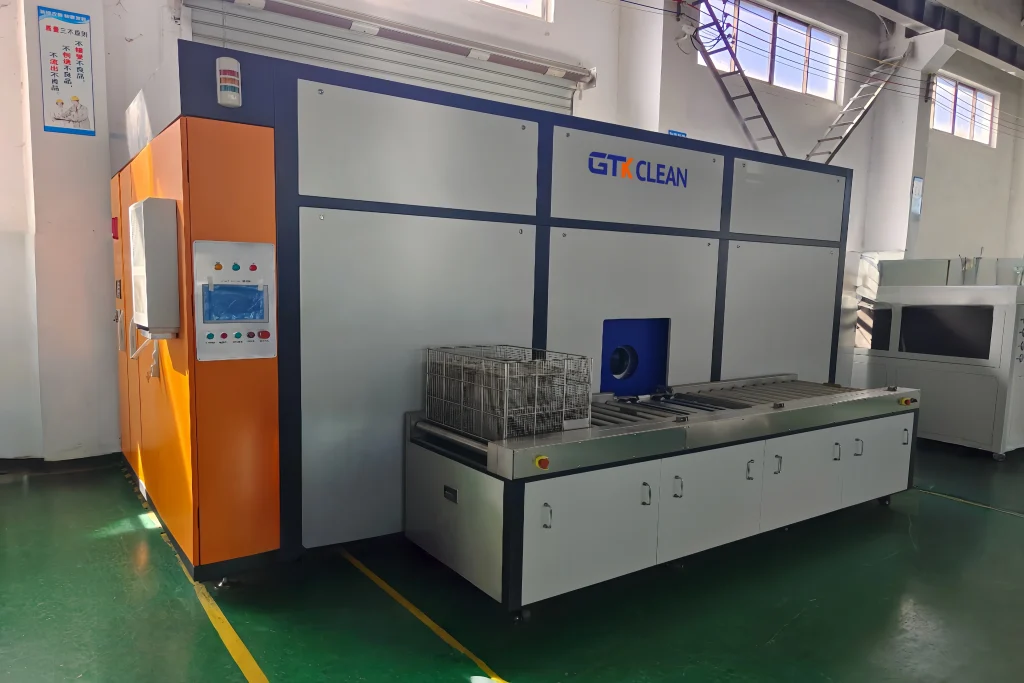
A solvent ultrasonic cleaning system couples ultrasonic transducers to a stainless steel tank filled with a low surface tension solvent. The generator drives the transducers at a set frequency, usually 20 to 40 kHz for industrial degreasing, and the resulting cavitation bubbles collapse against part surfaces. That collapse produces high local energy but at very small scale, which is why it reaches threads, blind holes, and internal bores without damaging precision surfaces. The solvent does more than carry the energy; its lower surface tension lets it wet narrow geometries faster than water can. Most solvent systems heat the medium, hydrocarbon solvents often in the 40 to 60 °C band, to match the contaminant being removed. Heat increases solubility for oils and release agents, but the temperature stays below the solvent's flash point. Vacuum-assisted systems go further by removing air from the solvent before cavitation, so bubbles collapse more completely inside recessed features. That design difference is not theoretical; a rotary basket with vacuum ultrasonic agitation reaches recessed areas that a standard open tank may leave wet or partially cleaned.
Where Do Solvent Ultrasonic Systems Outperform Aqueous Cleaning?
Solvent systems win when three conditions overlap: water sensitivity, blind-hole drying, and low residue tolerance. Aqueous cleaning is effective for removing chips and general soil, but it leaves drying challenges in narrow bores and can oxidize or corrode mixed metals if the rinse and drying sequence is not tight. The solvent's lower surface tension and faster evaporation make the drying stage shorter and more consistent.
Cleaning route
Drying behavior
Best fit
Water-based ultrasonic
Needs hot air or vacuum drying; slower on blind holes
General metal parts, water-tolerant components
Hydrocarbon solvent ultrasonic
Fast drying from low surface tension; vacuum drying for recesses
Precision machined, stamped, and oil-loaded parts
Modified alcohol ultrasonic
Very fast drying, strong solvency for light oils and fluxes
Electronics, optical parts, PVD pre-coating
For pre-coating preparation, the difference is visible in the next process step. A solvent-cleaned surface leaving the vacuum drying chamber is dry and ready for coating adhesion testing. If the solvent system includes a vapor-phase or vacuum drying stage, the part does not carry residual moisture into the PVD chamber. That is why coating manufacturers often ask for solvent or modified alcohol cleaning before deposition rather than a water line followed by extended oven drying.
When coating adhesion is the acceptance criterion, the cleaning process is only as good as what it leaves on the surface. <The Engineer’s Guide to Pre-Coating Surface Preparation> covers the rinse and drying steps that protect PVD and similar coating lines from adhesion failures.
What Production Advantages Matter Most?
The advantage I see most often in high-mix production is throughput from drying. A solvent ultrasonic system can finish a basket of precision-turned parts in less time than a water line because the solvent does not require the same thermal input to remove residual liquid. That shrinks the floor-space and energy burden compared with a multi-station aqueous system with hot air and extended dryers. The tradeoff is solvent management; you cannot ignore vapor control, recovery, and safety interlocks. Residue control is the second production advantage. Water-based lines leave mineral traces unless the final rinse is pure or DI water and the dryoff is perfect. Solvent systems avoid that failure mode if the solvent is kept clean through distillation and multi-stage filtration. A closed-loop solvent system removes oil and particulate continuously, so the solvent bath does not simply move contamination from one rack of parts to another.
Solvent management changes the operating cost picture more than the initial purchase price does. <Reduce Solvent Consumption in Industrial Cleaning: A Guide> covers the recovery and filtration measures that keep monthly solvent use under control on high-production lines.
If your program involves blind holes or mixed metals, it is worth confirming solvent compatibility and drying cycle time before you lock the process specification. Send part drawings and batch quantity to [email protected].
What Should You Check Before Specifying a Solvent Ultrasonic System?
Confirm solvent compatibility with all part materials and incoming soils.
Define the cleaning standard: target particle size, oil removal requirement, or coating adhesion spec.
Match tank and basket configuration to part geometry and load.
Confirm the drying route: vacuum, vapor phase, or hot air.
Verify solvent recovery and VOC controls for local regulations.
These checks are not paperwork. A system specified around the part's internal volume, not just basket weight, cleans blind holes more predictably. Basket design determines whether parts rotate, nest, or shield each other from solvent flow. On recessed stamping parts, a rotary basket and vacuum ultrasonic stage do more for cleanliness than increasing ultrasonic power does.
The selection sequence changes when the cleaning cell has to fit a continuous production line. <Choosing the Right Production-Line Ultrasonic Cleaning System Guide> covers throughput, automation level, and layout constraints that affect how a solvent system integrates with upstream and downstream operations.
When Does It Make Sense to Discuss Your Specific Part?
Solvent ultrasonic cleaning systems are not commodity purchases. The wrong solvent choice, tank sequence, or basket design shows up as residue, slow drying, or excessive solvent consumption after installation. Those problems are easier to resolve on a drawing review than after the line is built. Send your part drawing, material, contamination type, and required parts per hour to [email protected] or call +86 17768507147. The GTKCLEAN engineering team can confirm whether a single-station vacuum system or a multi-stage solvent line fits your process.
What Do Buyers Ask About Solvent Ultrasonic Cleaning Systems?
Is solvent ultrasonic cleaning safe for production use?
Yes, when the system is designed with closed tanks, vapor recovery, gas monitoring, and interlocked doors. Hydrocarbon solvents are flammable, so the equipment must keep the vapor space controlled and keep heating below the solvent's flash point. In the systems I specify, indirect heating and vacuum drying reduce ignition risk while distillation recovers the solvent. The main operational requirement is discipline: operators cannot bypass interlocks or ignore the gas sensor alerts. With those controls, solvent ultrasonic lines run safely in production plants across more than twenty countries.
How much solvent does a system consume each month?
The number people expect is usually too high for closed systems and too low for open top tanks. A single-station hydrocarbon vacuum machine can run with consumption around 200 L per month depending on part loading, basket carryout, and the distillation schedule. Open tanks lose more solvent to evaporation, so monthly use rises quickly if the system does not include condensation recovery. The right question for a supplier is not the tank volume; it is the expected monthly makeup volume at your throughput.
Can one system handle both hydrocarbon and modified alcohol solvents?
It depends on the solvent path. A system built with the proper seals, pump materials, and vapor handling can switch between hydrocarbons and modified alcohol, but this is a design decision, not a routine field change. Sensors and interlock settings differ because the solvents have different flammability and evaporation behavior. If mixed production requires both media, ask for a machine configured for dual-solvent operation from the start. Retrofitting a single-solvent line costs more than choosing the right materials on day one.
Does solvent cleaning leave residue that affects coating adhesion?
In pre-coating work I review, residue failures usually trace back to dirty solvent or an incomplete drying stage rather than the solvent chemistry itself. Distillation and multi-stage filtration keep oils and particles from redepositing on parts, and vacuum drying removes solvent from blind holes before parts enter the coating chamber. If the system maintains clean solvent and a verified dry part, coating adhesion results are predictable. Share your coating requirements and part drawing, and the GTKCLEAN team can confirm which solvent and drying configuration matches your line. If you're interested, check out these related articles: How to Integrate Automated Cleaning into Production LinesMastering Automation Levels in Industrial Ultrasonic CleaningIndustrial Cleaning System ROI: Calculating Your Investment Return

 English
  German
  Spanish
  French
  Russian
  Portuguese