

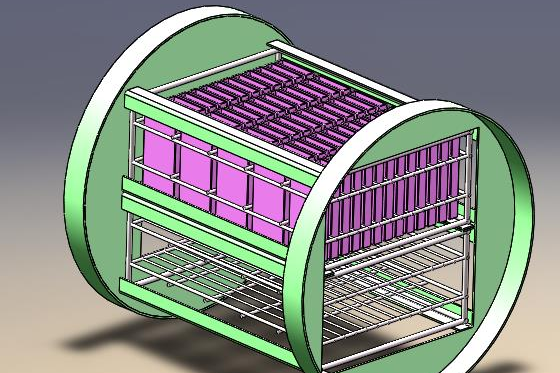
Cleaning baskets for ultrasonic systems are not simple containers. They determine how much cavitation reaches the part, how many parts survive transfer, and how consistently a production line meets its cleanliness limit. A basket that blocks ultrasonic energy or traps water can erase the gains from an expensive multi-tank washer. I evaluate basket design as part of the cleaning system, not after it is purchased. Material, open area, fixturing, and automation interface matter as much as the generator or transducer. This selection guide covers the checks that prevent rework, part damage, and downstream coating failures.
The Role of Basket Design in Ultrasonic Cleaning Consistency
Ultrasonic cavitation loses intensity as distance from the transducer increases, and any metal surface between the transducer and the part absorbs or reflects part of that energy. A basket with too much solid sheet, fine mesh, or tightly spaced wire does not simply carry parts, it changes the cleaning field. I have seen the same ultrasonic tank pass a cleanliness check with one basket design and fail with another, even when the bath temperature, chemistry, and cycle time stayed identical.
Blind holes and recessed surfaces are the first places where this shows. If the part is clamped too closely to another part or shielded by a solid divider, cavitation never reaches the area that matters. The basket should hold parts in a fixed orientation without nesting, and the open area must let the cleaning medium pass through with minimal reflection.
Parts that leave a basket with liquid trapped in blind holes create coating risks at the next process step. <Eliminate Residue in Pre-Coating Parts Cleaning: An Expert Guide> covers why basket drainage and part orientation belong in the same specification review as the cleaner itself.
Basket Materials for Different Cleaning Chemistries and Temperatures
Basket material selection follows the cleaning chemistry first, then the operating temperature, then the part weight. Stainless steel 304 and 316 cover most water-based and high-temperature systems. Polypropylene and PVDF handle aggressive chemicals and delicate surfaces, but their temperature ceilings are lower. PTFE is used where strong chemicals or viscous residues make release difficult.
| Material | Best suited for | Operating limit to watch |
|---|---|---|
| 304/316 stainless steel | Aqueous cleaning, high-temperature washing, heavy parts | Chloride or strong acid attack |
| PP | Ambient corrosive chemical cleaning, scratch-sensitive parts | Softening above moderate heat |
| PVDF | Strong acids and solvents, higher temperature than PP | Higher cost and stiffness |
| PTFE | Harsh chemical or sticky residue cleaning | Lower mechanical strength |
Stainless is the default for automated ultrasonic lines because it resists heat, impact, and most water-based detergents. For pickling or acid cleaning, material and weld quality become decisive, because a basket that corrodes will contaminate the bath and mark every part that follows. Plastic baskets reduce contact marking, but they must be checked for dimensional change after repeated thermal cycles.
If your process combines high temperature with chloride-containing chemistry, confirm the basket alloy and passivation treatment before issuing the purchase order. Send the chemistry pH, chloride content, and peak temperature to [email protected].
Load Capacity, Fixturing, and Drainage for Complex Parts
Basket load rating must cover the workpiece weight plus fluid drag, not just the dry part mass. In our heavy-duty ultrasonic cleaning systems, reinforced baskets and tank structures carry parts up to 2000 kg, but the same machine will fail early if the basket deforms or the hoist points are undersized. Overloading bends wire, closes drain slots, and shifts parts into contact, which produces scratches and inconsistent cleaning.
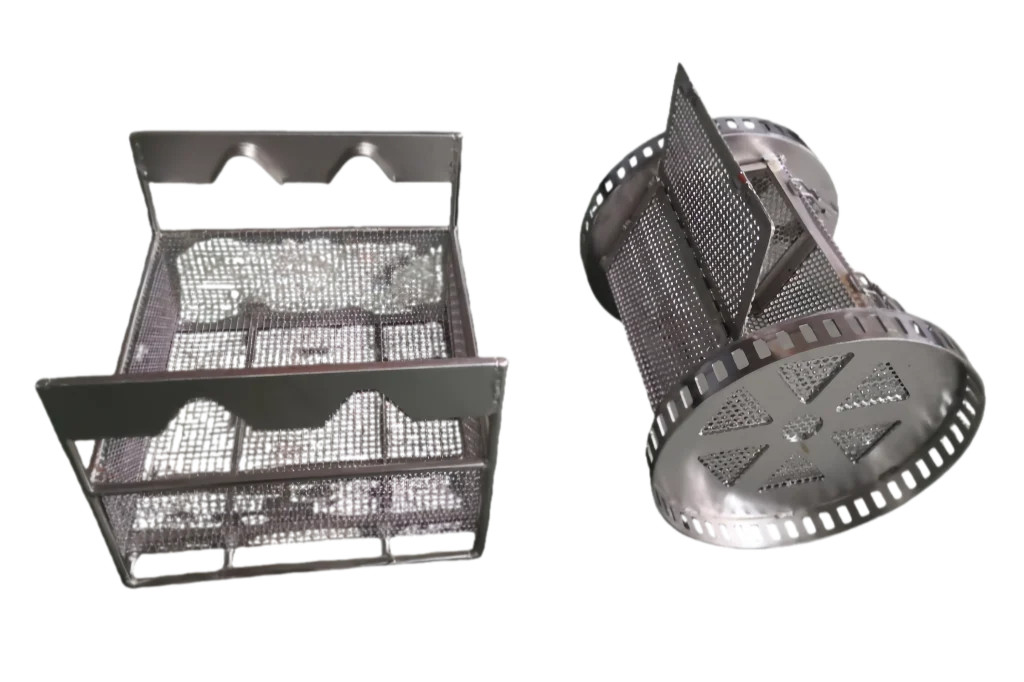
Fixturing is the next check. Circular baskets rotate products with blind holes so trapped air can escape. Sheet-like baskets keep flat parts separated and prevent contact marks. Heavy-load baskets prioritize structural strength over open area, but the slot pattern must still drain quickly from every part surface.
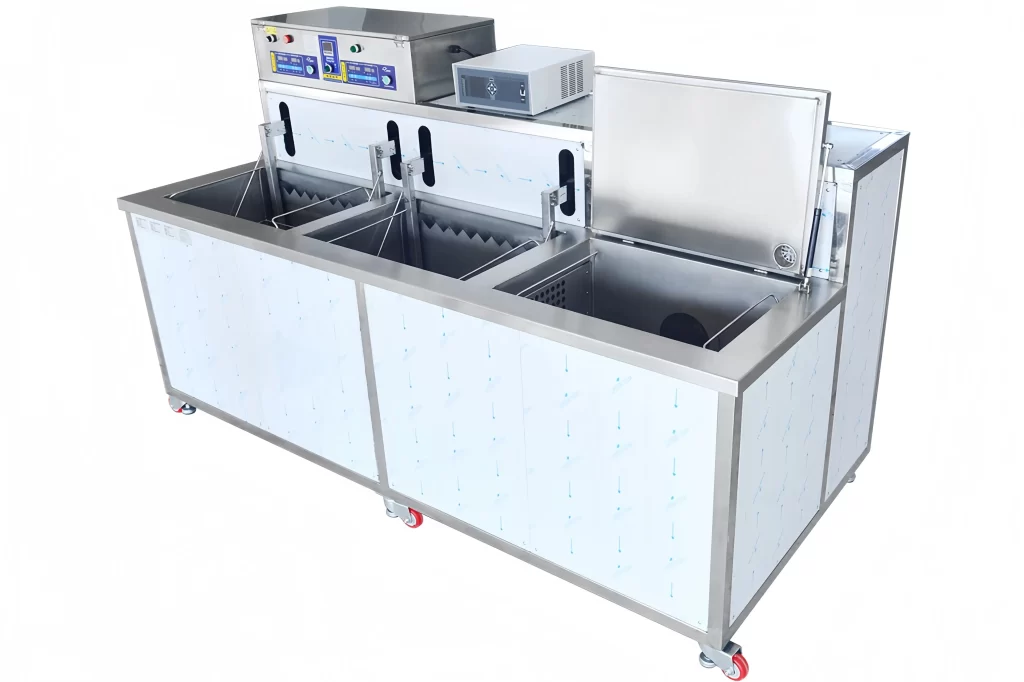
Multi-tank ultrasonic lines rely on basket transfer between stations to keep cycle time predictable. <Multi-Tank Ultrasonic Cleaning: A Deep Dive into Industrial Configurations> covers how tank sequencing and basket handling affect cross-contamination and drying after the final rinse.
Liquid left in blind holes or narrow threads turns into residue after drying. For pre-coating or precision parts, drainage holes should be located at the lowest point in the fixture orientation, and air knife or vacuum drying must be able to reach the inside of the basket.
Automation-Ready Basket Features for Production Flow
Basket features must match the transfer system: conveyor, lift, turntable, or rotary table. We review automatic loading and unloading points together with basket dimensions, because a small mismatch in locating features can stop a line. Registration holes, stacking lugs, and lifting points must be built into the basket, not added later.
Automated cleaning also rewards baskets that keep batch weight consistent. If baskets are too light, cycle time is wasted. If they are overloaded, cleaning and drying times drift. We specify basket capacity with the machine throughput target, not just the part dimensions.
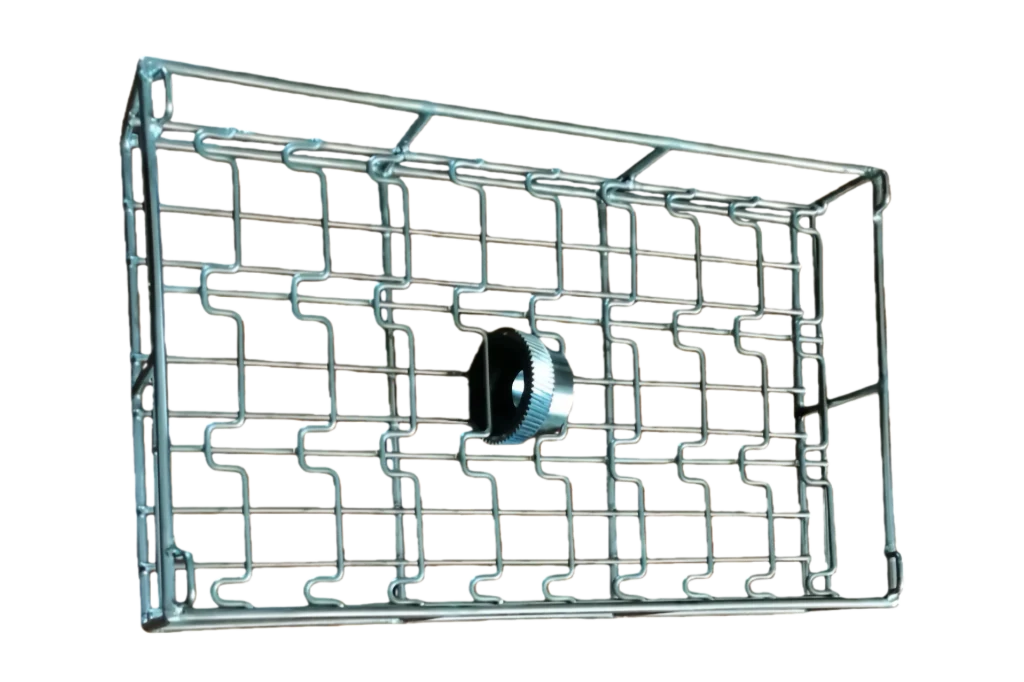
Basket design becomes part of the automation concept rather than a separate accessory. <Mastering Automation Levels in Industrial Ultrasonic Cleaning> covers how manual, semi-automated, and fully automated lines place different demands on basket registration, sensor positions, and load handling.
After cleaning, wash baskets to remove residues, inspect for cracks or deformation, and store them in a dry, ventilated area. This protects both the basket and the parts it carries.
Confirming Cleaning Basket Specifications with Your Supplier
Many plants buy standard baskets and then live with damaged parts, slow drainage, or poor cleaning because the basket did not match the process. That rework cost is usually larger than the difference in basket price. We ask clients to share the part drawing, material, dry and wet load weight, cleaning chemistry, and target cycle time before we quote.
GTKCLEAN reviews the basket together with the ultrasonic cleaning system so the open area, material, fixture points, and transfer interface are confirmed as one package. Send your part drawing, batch size, and cleaning requirements to [email protected] or call +86 17768507147. We will return a basket specification with the tank, hoist, and drying station clearly matched.
Common Questions About Ultrasonic Cleaning Baskets
What open area should an ultrasonic cleaning basket have?
For most industrial single-frequency work, keep open area above 50 percent. Cavitation travels through liquid, not through solid sheet, so every solid surface reduces energy at the part. Wire mesh and perforated sheet can both work if the hole or mesh size does not trap air. Lower frequencies such as 20 or 28 kHz tolerate more structure than 40 or 80 kHz, where finer open patterns become more important. If a part has blind holes, orient the opening vertically so gas can escape quickly.
Are plastic baskets safe in heated ultrasonic tanks?
Plastic baskets cannot be assumed safe just because they resist a chemical at room temperature. Polypropylene softens as temperature rises, and PVDF performs better but costs more and is stiffer. The safety limit depends on the liquid, the ultrasonic load, and the continuous exposure time. We confirm the material grade and operating temperature before using plastic in a heated ultrasonic tank, especially when the bath contains strong acid or solvent. For high-temperature production, stainless steel usually presents fewer dimensional and contamination risks.
Do we need custom baskets for blind-hole parts?
It depends on part geometry and how the basket moves through the line. If the part is simple and the line uses a fixed orientation, a standard basket may be acceptable. Blind holes, deep recesses, and internal threads usually justify a custom fixture because the part must be held so gas escapes and liquid drains. Rotary basket cleaning is often the better route for complex parts. The decision is not mainly about price. It is about whether a standard basket will consistently deliver the same orientation and drainage from load to unload.
What causes most basket failures in production?
In production lines we support, most basket failures come from overloading and mechanical deformation, not chemical attack. Operators exceed the rated weight, forks hit the basket, or hoist points wear and cause one corner to sag. A bent basket closes drain slots and lets parts contact each other. We inspect baskets after cleaning, check welds and lifting points, and replace deformed units before they damage parts or automation tooling. If your basket is failing repeatedly, the first check is actual loaded weight and material grade, not the cleaner. Send your part geometry and loaded weight to [email protected], and we will confirm the basket rating and replacement point before you order.
If you're interested, check out these related articles:
Productivity Comparison: Manual Versus Automated Ultrasonic Cleaners
Ultrasonic Cleaning Systems for Manufacturing A Technical Guide
Industrial Cleaning Basket Design: Optimizing Performance & Durability
Semi-Automated Ultrasonic Washers: Cost vs Performance Analysis
Ultrasonic Cleaning Equipment Explained: The Ultimate Guide
 English
  German
  Spanish
  French
  Russian
  Portuguese