

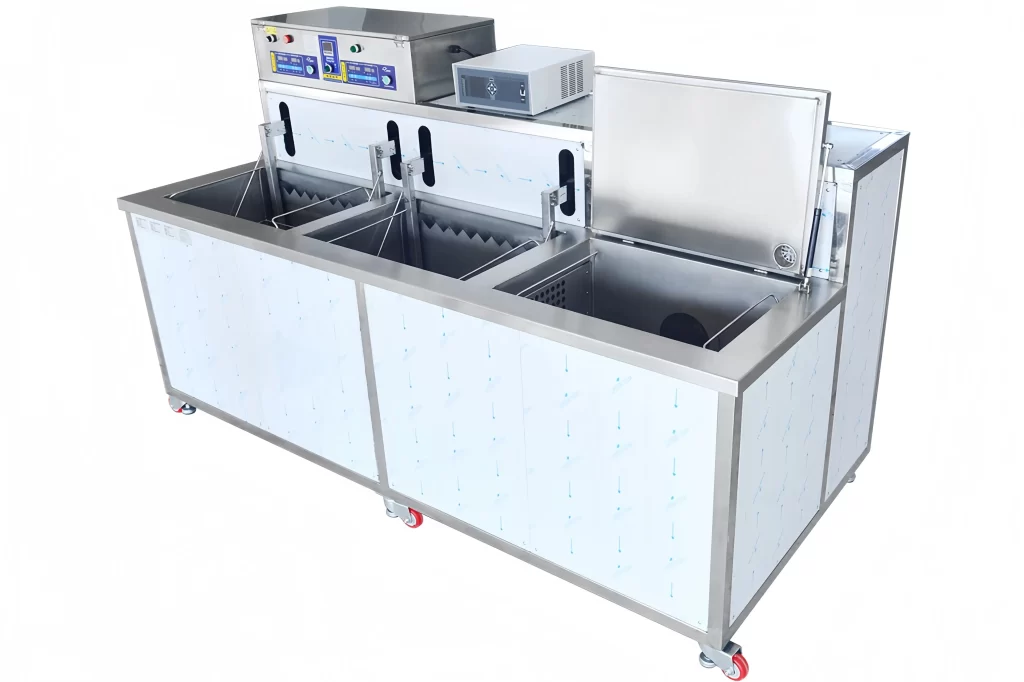
A surface-level clean is not enough when a single microscopic particle can cause a coating to delaminate or a hydraulic valve to seize. Vacuum ultrasonic cleaning for precision parts addresses the root cause of many contamination failures: trapped air and solvent residue in blind holes, narrow gaps, and complex internal passages. We have seen machining shops lose entire batches because a standard ultrasonic bath could not fully wet internal threads, leaving cutting fluid residues that later caused adhesion failures after PVD coating. The answer is not more ultrasonic power alone; it is combining cavitation with vacuum to pull contaminants out of places a bubble cannot reach.
How Vacuum Ultrasonic Cleaning Works
Ultrasonic cleaning relies on high-frequency sound waves creating microscopic cavitation bubbles that implode against part surfaces, physically dislodging contaminants. Standard ultrasonic tanks work well for open geometries, but when parts have blind holes, cross-drilled passages, or fine internal channels, air pockets prevent the cleaning fluid from entering those spaces. All the energy in the world cannot clean a dry cavity.
Vacuum ultrasonic cleaning solves this by first evacuating the air from the cleaning chamber before or during ultrasonic operation. When the pressure drops, trapped air expands and escapes from internal recesses. Introducing cleaning fluid under vacuum then forces liquid deep into every void. We then apply ultrasonic energy in a fully wetted environment. The result is cavitation reaching surfaces that standard ultrasonic simply bypasses.
This process is not a laboratory curiosity. We design fully automatic systems where the cleaning basket is lowered into a sealed chamber, a vacuum pump pulls the air out, hydrocarbon solvent or modified alcohol enters under vacuum, and ultrasonic transducers apply 28 kHz or 40 kHz energy while the basket rotates for 360° coverage. After cleaning, the system moves to vapor degreasing and vacuum drying, leaving zero residue. The entire sequence runs under PLC control with recipe storage for different part families.
Why Vacuum Makes a Difference for Precision Parts
The difference for precision components is not just "better cleaning." It is the elimination of two specific failure modes that surface-level cleaning cannot address.
First, vacuum degassing removes air from blind holes and internal cavities. In one of our projects for a hydraulic component manufacturer, parts with intersecting oil passages deeper than 80 mm consistently failed post-coating adhesion tests after standard ultrasonic cleaning. Adding a vacuum pre-treatment step before ultrasonic cleaning eliminated those failures entirely because the fluid could reach the junction of the cross-drilled holes where cutting oil had accumulated. The cleaning fluid itself, once fully penetrating, could transport contaminants out rather than leaving them trapped behind an air plug.
Second, vacuum drying removes solvent residues from those same complex geometries. Standard hot-air drying blows across external surfaces but often leaves wet films inside deep recesses. When the part later enters a high-temperature coating chamber, any residual solvent vaporizes and disrupts the coating bond. Vacuum drying lowers the boiling point of the solvent, causing it to boil off uniformly from every surface, including inside passages. This is particularly important for parts destined for PVD, CVD, or plasma spray coating where any contamination at the interface becomes a failure origin.
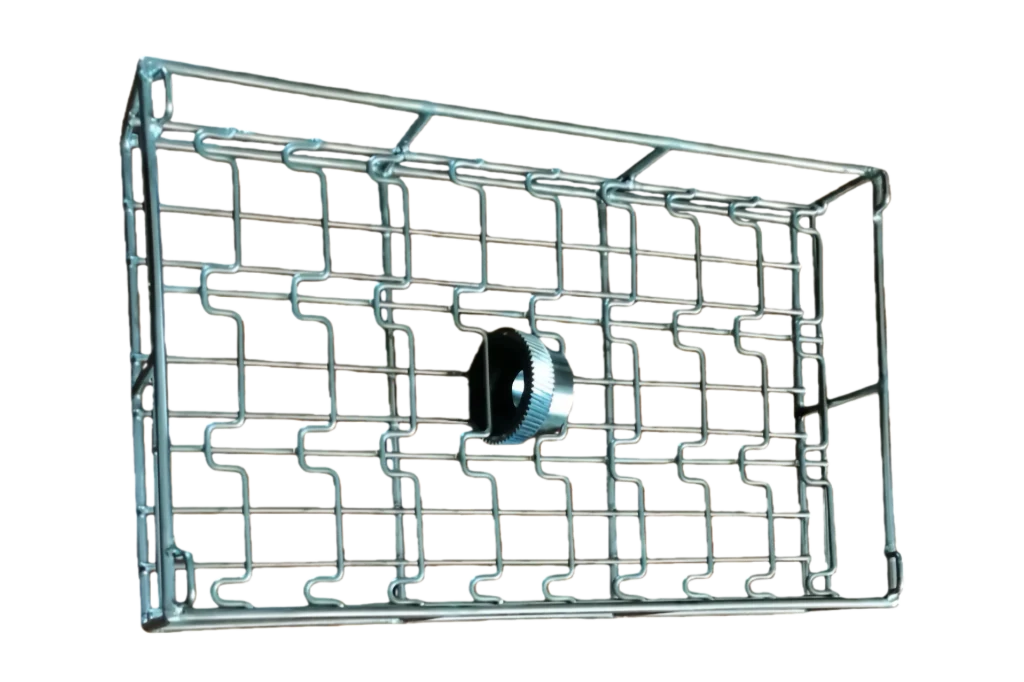
The choice of solvent matters here. Hydrocarbon solvents with higher boiling points can be fully removed only under vacuum. We have seen manufacturers try to use standard evaporation drying with high-boiling solvents on parts with blind holes and get unexpected coating defects weeks later when residual solvent slowly migrated out.
Choosing the Right Solvent and Drying Method
The solvent is not a generic "cleaning fluid." It needs to match the contaminant, part material, cleanliness target, and subsequent process. For vacuum ultrasonic cleaning, two solvent families dominate: high-purity hydrocarbon solvents and modified alcohols.
Hydrocarbon solvents excel at dissolving stamping oils, cutting fluids, and heavy grease. They are chemically stable, have a high flash point, and are compatible with most metals including aluminum, copper, and stainless steel. In a vacuum ultrasonic system, hydrocarbon solvents are typically heated to 40–60 °C for optimal oil solubility. After cleaning, vacuum distillation recovers the solvent, separating it from oil and water for reuse. In a system we supplied for cleaning new-energy vehicle battery housing stampings, the solvent consumption stayed below 200 liters per month on a single-shift operation because the built-in distillation loop continuously purified the solvent.
Modified alcohol solvents offer faster evaporation and lower surface tension, which helps penetrate very fine gaps. They are often chosen for electronics, optical components, or any application sensitive to residue. The drying phase is shorter, but the solvent cost is typically higher. The decision often comes down to whether the part can tolerate a slightly longer drying time for hydrocarbon, or if the production throughput demands the speed of modified alcohol.
Solvent recovery directly impacts operating cost, especially with vacuum systems. <Implement Solvent Recovery Systems: A Factory Efficiency Guide> details how closed-loop distillation can cut solvent consumption by 70% or more compared to open tanks, a factor that changes the total cost of ownership calculation for high-throughput vacuum cleaners.
| Solvent Type | Advantages | Typical Drying Method | Best For |
|---|---|---|---|
| High-purity hydrocarbon | High oil solubility, low reactivity, recyclable | Vacuum vapor drying | Metal stampings, machined components, heavy oils |
| Modified alcohol | Fast evaporation, low surface tension, residue-free | Vacuum or hot-air drying | Electronics, optics, parts sensitive to hydrocarbon |
| Aqueous detergents (non-solvent) | Fire-safe, low odor, rinsable with DI water | Air knife plus hot air | Open parts with no tight passages |
Vacuum drying is not a separate step you add on. In a properly integrated system, the same vacuum pump used for degassing also serves the drying phase. After the cleaning fluid is drained, the chamber is evacuated again, and any residual solvent boils off at a temperature well below its atmospheric boiling point. This simultaneous boiling from every wetted surface eliminates the water spots and solvent residue common in conventional drying. For complex parts that will go directly to coating, we insist on vacuum drying because the alternative is a statistically certain failure rate at coating.
How Part Orientation and Basket Design Determine Cleaning Success
Even with vacuum and the right solvent, poor basket design can block fluid flow and leave parts uncleaned. We learned this lesson early: a customer with small bearing cages reported inconsistent cleaning despite maintaining all parameters. The issue was that flat parts were nested together in the basket, shielding internal surfaces from both the vacuum and the ultrasonic field.
The basket must allow full fluid access to every surface while securely holding parts in position. For cylindrical parts with blind holes, the basket should orient those holes facing upward so that buoyant air can escape during vacuum degassing, and downward during draining so liquid does not pool. Rotary baskets add an extra mechanism: by slowly rotating the entire basket, gravity and fluid motion flush particles out of cavities that no fixed position could drain.
Part orientation is not a detail to leave to the operator. <Eliminate Residue in Pre-Coating Parts Cleaning: An Expert Guide> shows how pre-coating cleaning failures often trace back to simple basket mistakes, not the cleaning technology itself.
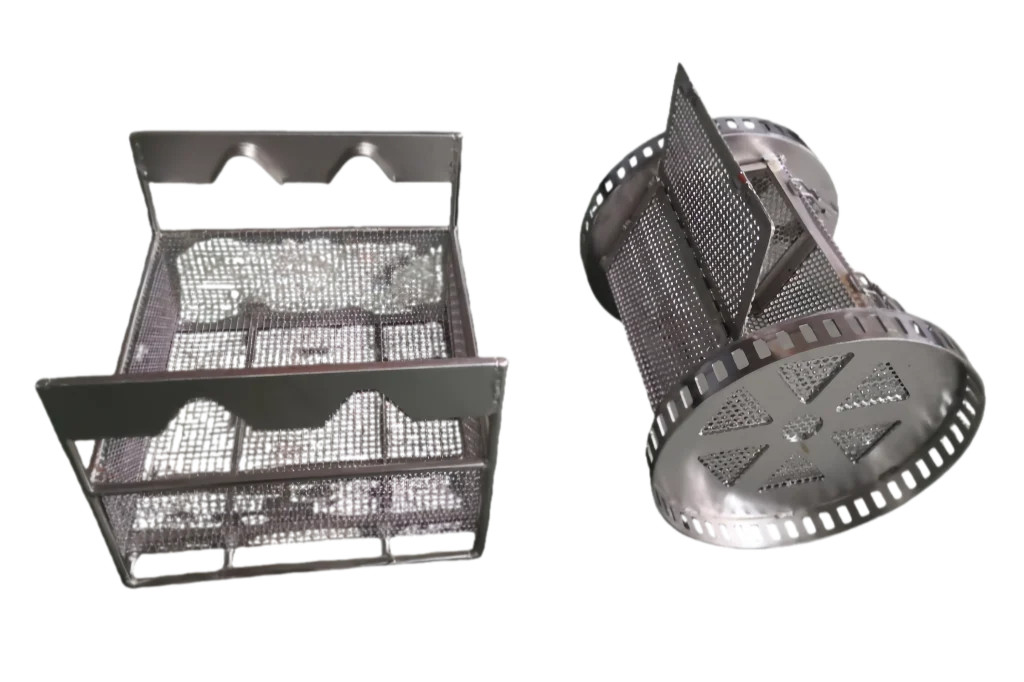
For heavy parts, the basket itself must be reinforced to withstand the loads during rotation and movement through multiple tanks. We routinely specify stainless steel baskets rated for loads up to 2000 kg in automated lines. The material choice—304 or 316 stainless—is driven by chemical compatibility with the solvent and the required service life. Plastic baskets, less common in vacuum systems due to outgassing concerns, are used only with aqueous detergents at lower temperatures.
Integrating Vacuum Ultrasonic Cleaning into a Production Line
Adding vacuum ultrasonic cleaning to an existing line is not a matter of replacing one tank. The vacuum chamber, pump, solvent distillation unit, and control system require dedicated space and utility connections. In practice, we integrate it as part of a multi-stage cleaning system: a pre-wash spray to remove bulk chips, the vacuum ultrasonic stage for deep cleaning, a spray rinse with clean solvent or DI water, and the vacuum drying stage. The automation controller communicates with upstream and downstream conveyors so that parts do not sit idle between stages.
This matters for throughput. A single-chamber vacuum ultrasonic cleaner processes one load at a time, with a cycle typically 8–15 minutes depending on soil load and required cleanliness. For production lines requiring continuous flow, we design systems with multiple vacuum chambers operating in parallel, each with an independent pump, while a gantry robot transfers baskets between them. The control logic staggers the cycles so that one chamber is always ready to accept a new load.
Cost is the first question every buyer raises. A vacuum ultrasonic system costs more than a standard ultrasonic tank of equivalent capacity because the pressure vessel, vacuum pump, and safety interlocks are not trivial. However, the cost must be weighed against coating rework, field failures, and the loss of a qualified supplier status when contamination is detected at the customer. For a manufacturer supplying hydraulic components to an aerospace prime contractor, one rejected lot can erase the capital cost difference many times over. We often advise clients to calculate the cost of cleaning not as the equipment price divided by the number of parts washed, but as the sum of equipment, rework, and lost revenue when parts are not clean enough.
Typical Questions About Vacuum Ultrasonic Cleaning
Is vacuum ultrasonic cleaning necessary for all precision parts?
No. If your part has no blind holes, no deep recesses, and the cleanliness requirement is general machining residue removal, a well-engineered standard multi-stage ultrasonic system with good basket design may be enough. Vacuum becomes a requirement when air entrapment is demonstrably causing cleaning failures, or when the final cleanliness specification is so tight—as in pre-coating or implantable medical device cleaning—that any residue is unacceptable. We run test washes with customer parts to determine whether vacuum adds enough value to justify the cost before specifying the system.
Can I use aqueous detergents in a vacuum ultrasonic system?
Technically yes, but it is uncommon. Aqueous detergents are typically used in open-tank systems because they are fire-safe and less expensive. Applying vacuum to an aqueous tank adds complexity without the same benefit because water does not evaporate under vacuum at the same rate as solvents, and the vacuum does not enhance the cleaning chemistry as much as it does for solvents penetrating tight gaps. In most cases, if the part geometry demands vacuum, manufacturers also choose a solvent-based process.
How long does a full cycle take?
Typical cycle times range from 8 to 15 minutes per load, depending on the number of stages, the required cleanliness, and the part mass. A single-stage vacuum ultrasonic wash for a basket of small machined components might complete in 8–9 minutes. A two-stage process with separate wash and rinse tanks under vacuum, followed by vacuum drying, might take 12–15 minutes. The basket transfer between stations is automated and adds only seconds. Throughput calculations should account for loading and unloading time at the ends of the line.
Does vacuum ultrasonic cleaning eliminate the need for solvent recovery?
No, it makes solvent recovery more important because the sealed vacuum chamber lends itself to distillation-based closed-loop recovery. In an open system, solvent evaporates into the air and is lost. In a vacuum system, the vapor is condensed back into liquid and returned to the process. This not only reduces solvent purchase costs but also maintains consistent cleaning quality because the circulating solvent stays clean. The distillation unit can be integrated into the same machine, recovering over 95% of the solvent automatically. If your process uses hydrocarbon solvent and you are not recovering it, you are paying for the same solvent twice—once to buy it and once to dispose of the contaminated waste.
What happens when part designs change?
We design vacuum ultrasonic systems with programmable recipes so that operators or engineers can adjust vacuum level, ultrasonic power, temperature, and cycle timing for different part families. The basket is typically the only hardware component that needs replacement when part geometry changes, because it must cradle the new parts correctly. If your contract involves frequent part changes, it is worth discussing basket interchangeability and quick-release mechanisms with your equipment supplier at the specification stage. Share your likely part range and we can confirm which drying method and solvent type will accommodate all of them without re-engineering the system.
For a vacuum ultrasonic cleaning specification that matches your part geometry and coating process, send your part drawings and required cleanliness standard to [email protected] or call +86 17768507147. We can run a test wash and provide a cycle time and solvent consumption estimate before you commit to a purchase.
If you're interested, check out these related articles:
Aqueous Parts Cleaning: A Manufacturer’s Technical Guide
Industrial Ultrasonic Cleaning Systems: The Complete Guide
Automated Tunnel Cleaner
How to Select the Best Cleaning Solution for Metal Parts
Choosing the Right Production-Line Ultrasonic Cleaning System Guide
 English
  German
  Spanish
  French
  Russian
  Portuguese