Ultrasonic generator settings decide how much electrical input becomes useful cavitation, and wrong settings can leave residues even when wattage looks sufficient. A generator does more than supply power. It sets frequency, sweep behavior, and how precisely the output tracks the transducer load as bath temperature and part mass shift. In production cleaning, those control details often matter more than the rated watts printed on the cabinet. This article explains how generator selection and setup change industrial cleaning performance and which parameters to specify before purchase.
Generator Frequency and Cavitation Size
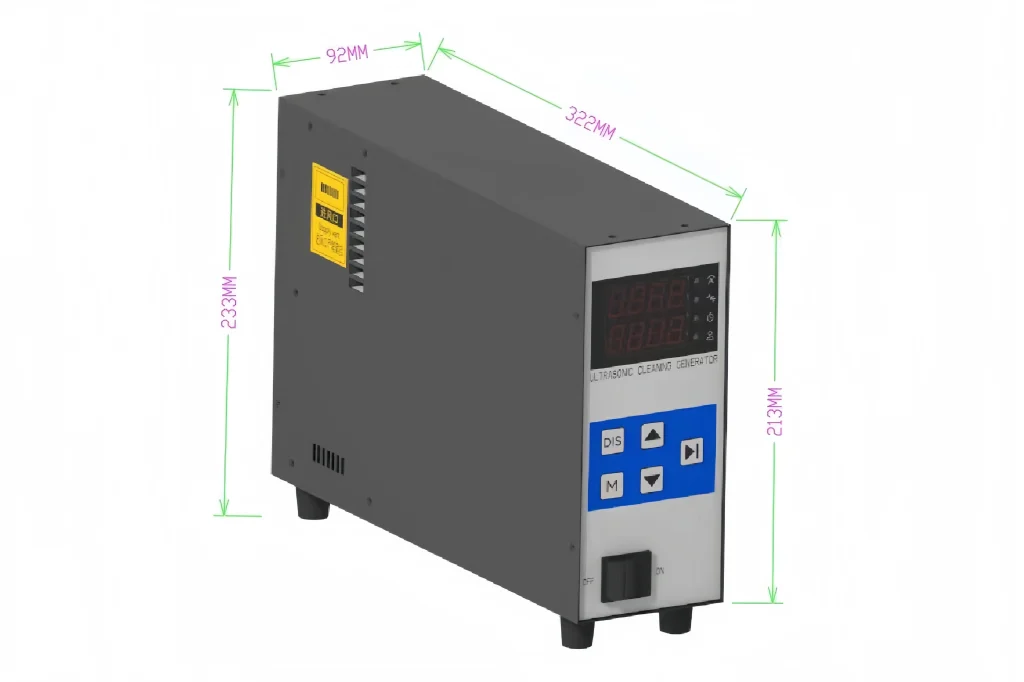
Ultrasonic generators convert 50 or 60 Hz line power into a high frequency electrical drive signal for the transducers. The selected frequency controls cavitation bubble size and cleaning intensity. Low frequency operation from 20 to 28 kHz produces larger, more energetic bubbles that release more impact energy. This is the right starting point for heavy stamping oil, carbon, grease, and heat treatment residues. The tradeoff is that aggressive low frequency action can damage thin or polished surfaces if treatment time is too long.
Low Frequency for Heavy Soils
For steel stampings, fasteners, and machined parts with heavy cutting fluid, I usually begin evaluation at 25 or 28 kHz rather than jumping to maximum power. The larger cavitation bubble removes thick oil and chips quickly. The generator still needs to be matched to the transducer bank. Adding power without confirming the resonance match only heats the bath and wears the driver. | Frequency range | Cavitation character | Typical production role |
| 20 to 28 kHz | Large bubbles, high impact | Heavy oil, carbon, rough stamped parts |
| 40 kHz | Balanced bubble size and scrub density | General machining residues, mixed production |
| 68 to 80 kHz | Small bubbles, finer scrubbing | Precision parts, soft metals, polished surfaces |
High Frequency for Precision Parts
High frequency operation at 68 or 80 kHz creates smaller bubbles and a denser cavitation field. This suits parts with fine features, polished surfaces, or thin sections. We also use higher frequency when the cleaning goal is submicron particle removal rather than bulk degreasing. The cleaning action is gentler, but it reaches tight gaps and reduces the risk of surface pitting on aluminum or soft alloys.
Power Density and Transducer Matching
Power density is the rating most buyers ask about first, but it is only one part of the cleaning equation. A generator can deliver enough watts per liter and still produce poor cavitation if the transducers are not matched to the drive frequency, badly positioned, or mounted on a tank wall that flexes under load. In our line designs, I treat 10 W/L as a baseline for light precision work. Oily stamping parts often need 20 W/L or more, but only after the basket load, chemistry, and temperature are fixed. More wattage cannot correct a frequency mismatch or a standing wave that leaves dead zones in the bath. The generator must also track the transducer's changing load. As the bath heats and as heavy baskets lower the liquid's acoustic coupling, the electrical impedance shifts. A generator that locks onto the resonant frequency under load keeps cleaning energy stable. A fixed output that drifts off resonance wastes power as heat and shortens transducer life.
If line consumption is part of the purchase justification, <Ultrasonic Cleaning Energy Costs Minimizing Strategies> covers how generator duty cycle, bath insulation, and chemistry temperature affect operating cost on continuous lines.
Sweep, Pulse, and Degas Mode Selection
Fixed frequency output can create standing waves inside the tank. The result is a visible cleaning pattern: aggressive bands on flat parts where cavitation concentrates, and weak zones where soil does not release. Sweep mode broadens the generator output across a small frequency band, which moves the cavitation nodes and gives more even coverage on large or flat surfaces. Pulse mode is useful when high impact is needed without continuous heat input. The generator delivers short bursts of high energy followed by off periods. This can break up hard soils and reduce the temperature rise in the bath during long production runs. Degas mode is the setting most likely to be ignored in a busy plant. Fresh cleaning solution contains dissolved gas, which cushions bubble collapse and weakens cavitation. Running a degas cycle before the first production basket restores full cavitation intensity and shortens the soak time needed to reach a stable cleaning result.
The generator response described here only becomes useful when the rest of the cleaning system is sound. <What Is the Principle of an Ultrasonic Cleaning Machine?> explains why generator and transducer matching matters before cleaning chemistry can do its job.
If your line mixes heavy steel parts with soft brass or aluminum, the same generator program will not behave the same across both loads. Send your tank volume, transducer layout, and part mix to [email protected], and we will confirm whether sweep and pulse settings can cover the range or whether the line needs separate recipes.
Generator Response Under Load in Automated Cleaning
Automated lines add a requirement that bench cleaning often ignores: repeatability across hundreds of baskets. A generator that cannot hold its frequency and output level under changing load will produce variable results even when the recipe looks stable on screen. Digital generators with phase and impedance monitoring adjust the drive signal to keep the transducers operating near resonance. This matters most in multi-tank and rotary basket systems, where one generator may drive multiple transducer arrays and the load changes as baskets enter and leave the bath. If the drive signal drifts, cleaning intensity drops silently. The PLC still reports that the cycle ran, but the parts come out with patchy residue. We prefer generators that can be controlled through the line PLC with recipe-based parameter sets. Frequency, power, sweep bandwidth, and degas duration then change automatically with the part number. Manual adjustment between jobs introduces errors and slows a line that is supposed to run without attendance.
Generator Settings for the Parts You Run
The most reliable way to specify an ultrasonic generator is to start with the production load, not the wattage on an old machine. Define the largest basket mass, the worst soil, the required cycle time, and the material risk. Then work backward to frequency, power density, and control functions. If fine scratches are a reject condition, start at 40 kHz or higher and use lower power density. If a heavy steel housing comes in with drawing compound, start at 25 or 28 kHz and add sweep to avoid hot bands. If the same line must clean both, the generator should store multiple recipes and switch with the part number through the PLC. Do not overbuy wattage as insurance. A generator that is oversized for the transducer bank runs inefficiently and can drive the transducers outside their safe operating band. Match the generator to the existing or planned transducer array, then verify the cleaning result with production parts. A foil erosion test does not replace a contaminated part from the actual process.
Most generator problems we see come from copying a wattage number without confirming the frequency, transducer layout, and liquid level. If your line has mixed materials, blind holes, or residue that only appears after drying, send your tank volume, transducer layout, and part drawing to GTKCLEAN at [email protected] or call +86 17768507147. We will confirm whether the generator settings, not the cleaning chemistry, are the limiting factor.
Common Questions About Ultrasonic Generators and Cleaning Performance
Does higher generator wattage always clean faster?
No. Higher wattage cleans faster only when the extra power is delivered at the transducer's resonant frequency and distributed across the bath. An oversized generator connected to a badly matched transducer bank often heats the liquid without producing proportionally stronger cavitation. In practice, I would first confirm that frequency and transducer placement match the part geometry. If both are correct, increasing power density from a low baseline can shorten cycle time. If the existing generator already runs at the transducer's safe output limit, more wattage adds risk without making the parts cleaner. The best next move is to check the match, not the label.
What frequency works best for blind holes?
The common assumption is that lower frequency is always better for blind holes, but the answer depends on the geometry and the contaminant. Low frequency generates larger cavitation bubbles with more impact energy to remove thick grease inside deeper cavities. High frequency produces a denser field of smaller bubbles that can penetrate narrow openings more evenly. For blind holes with heavy cutting oil, I would start around 25 or 28 kHz and confirm that the part orientation lets liquid flow into the cavity. For fine threads or small drilled holes, 40 kHz may be a safer starting point.
Can a generator compensate for worn transducers?
In production audits, I have seen generators mask worn transducers for months. The control system reports normal output while the transducer response weakens, and parts begin showing patchy residue in the same locations each cycle. A well-designed generator with load monitoring may continue driving the load without exposing the fault. We check transducer response separately from generator output during service calls for this reason. If cleaning becomes uneven after months of stable operation, inspect the transducer bonds and impedance before changing the generator program.
How do we confirm generator settings before ordering?
The question to answer first is not which generator to order but what the production load requires. Tank volume, transducer layout, part material, basket weight, soil type, and cycle time target determine the generator specification. We look for a match between the generator output and the transducer bank rather than picking the highest available wattage. Part geometry and process requirements set the frequency and power density limits. Send your part drawing and current tank dimensions to [email protected] and we will verify the generator specification against your production load. If you're interested Automated Tunnel CleanerSemi-Automated Ultrasonic Washers: Cost vs Performance AnalysisDesign an Efficient Multi-Stage Industrial Cleaning Process


 | Frequency range | Cavitation character | Typical production role |
| 20 to 28 kHz | Large bubbles, high impact | Heavy oil, carbon, rough stamped parts |
| 40 kHz | Balanced bubble size and scrub density | General machining residues, mixed production |
| 68 to 80 kHz | Small bubbles, finer scrubbing | Precision parts, soft metals, polished surfaces |
| Frequency range | Cavitation character | Typical production role |
| 20 to 28 kHz | Large bubbles, high impact | Heavy oil, carbon, rough stamped parts |
| 40 kHz | Balanced bubble size and scrub density | General machining residues, mixed production |
| 68 to 80 kHz | Small bubbles, finer scrubbing | Precision parts, soft metals, polished surfaces | We prefer generators that can be controlled through the line PLC with recipe-based parameter sets. Frequency, power, sweep bandwidth, and degas duration then change automatically with the part number. Manual adjustment between jobs introduces errors and slows a line that is supposed to run without attendance.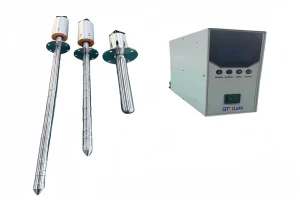
 English
  German
  Spanish
  French
  Russian
  Portuguese