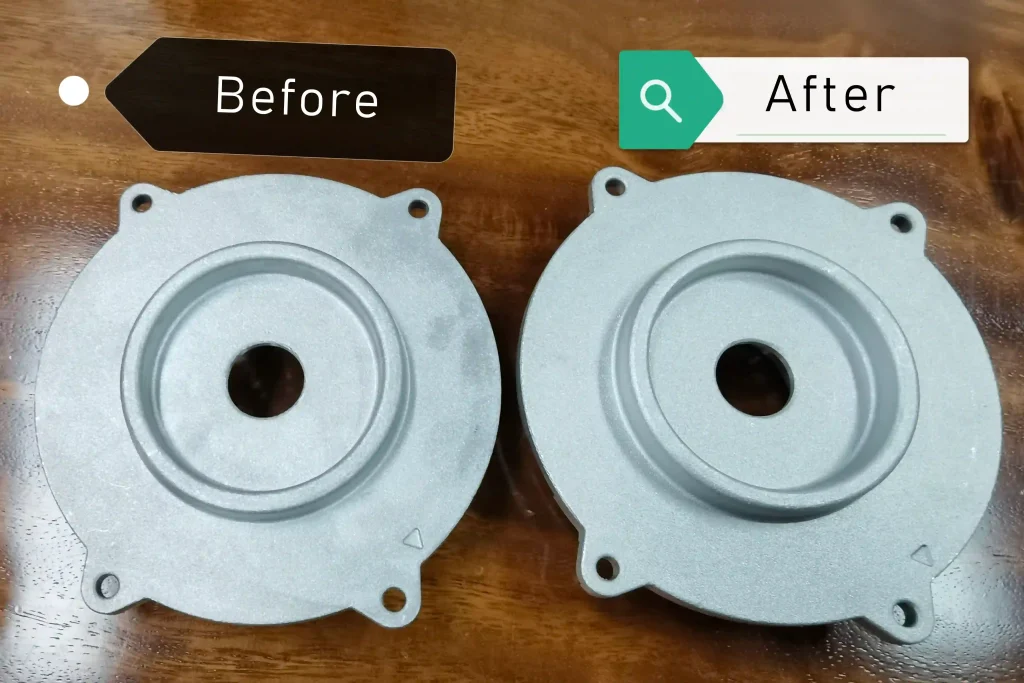
Post-machining cleaning is where a machining process either proves itself or passes a problem downstream. The failure I see most often is not the washer itself; it is a line designed around the tank instead of around the chip load, coolant chemistry, and the next operation. Removing chips and coolant after CNC machining reliably means treating the step as a process boundary, not a wash station. A machined part leaves the machine carrying loose chips, packed chips in blind holes, and a coolant film that will harden or react if the sequence does not remove it cleanly.
Why Does Post-Machining Cleaning Fail Before the Washer Starts?
The parts arriving at the cleaning line are not the same parts shown in the equipment layout. One batch can carry long stringers, another fine compacted chips, another a coolant that has begun to separate under heat. When the line is sized around a clean part in a basket, every real contaminant becomes a downstream surprise. Two decisions cause most failures. The first is applying heat before mechanical removal. A heated tank bakes wet coolant into a film and turns loose chips into a bonded deposit. The second is trusting one stage to do the work of three: knock down the bulk, dissolve the film, and rinse the surface. I have watched a production line load wet chip-laden baskets directly into a heated tank and then struggle with baked fines in the corners of every part. The fix was not a stronger detergent; it was moving chip separation ahead of the heated stages so the downstream tanks were not trying to remove a cured layer.
How Do You Remove Chips and Coolant From the Machine Side?
Loose chips should not get a chance to settle. A high-pressure spray stage immediately after machining, before the parts enter a heated tank, removes the bulk of chips and keeps most of them out of the filtration loop. The spray does not need to make the part clean. It needs to stop the main contaminant load from turning into paste. For blind holes and cross-drillings, orientation does more than spray pressure. If the hole stays upright, gravity works against the process and the jet can push chips deeper. Rotating the basket or tilting the part lets the wash fluid flush chips out and drain them before the next stage.
When Does a Rotary Basket Make Sense?
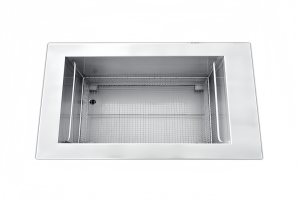
A rotary basket makes sense when a part has blind holes, cross-drillings, or recesses that hold chips in more than one plane. The rotation moves fluid through the feature and lets it drain. Flat parts in a static basket often need no rotation, and the simpler orientation makes high load density easier. Coolant should also be treated as a contaminant, not a lubricant for the cleaning line. Water-soluble emulsions that enter a solvent rinse or a rinse tank can contaminate the following stages. That is why the machine-side spray should be combined with a dedicated first-stage collection system instead of carrying over into the ultrasonic tank.
What Wash, Rinse, and Drying Sequence Fits the Part and the Next Operation?
The wash sequence starts with the coolant chemistry and ends with the next operation. A water-soluble coolant is not the same cleaning problem as a neat cutting oil, and a part going to assembly is not the same problem as a part going to coating. | Coolant type | Residue behavior | Better first wash stage | Reason |
| Water-soluble | Emulsion film with fines | Alkaline aqueous at 45 to 65 °C | Breaks the emulsion and suspends fines |
| Semi-synthetic | Waxy film after water leaves | Alkaline aqueous plus agitation | Needs heat and movement to saponify the film |
| Neat cutting oil | Viscous oil film | Hydrocarbon or modified alcohol solvent | High solvency with low surface tension |
| Chlorinated EP coolant | Sticky sulfur and chlorine film | Solvent with vacuum or strong aqueous | Needs sustained contact and controlled temperature |
| Dried-on coolant | Hardened coating | Solvent pre-soak then ultrasonic | Aqueous alone cannot lift a cured film quickly | Temperature matters because solubility changes with the coolant, not just the detergent. A hydrocarbon solvent system cleans stamping and cutting oils best between 40 and 60 degrees Celsius, while an aqueous alkaline stage often runs from 45 to 65 degrees Celsius. Those ranges are starting points, not guarantees; a wash trial with the actual coolant is the only way to confirm contact time and concentration. The rinse is the part most buyers compress. If the final rinse is not low-mineral water, the part will dry with water spots that become defects in the next operation. We specify ultrapure water at no more than 0.06 microsiemens per centimeter for pre-coating and precision lines because stray minerals are hidden residue. If your parts combine blind holes with chlorinated extreme-pressure coolant, the wash chemistry and drying sequence are worth confirming before you finalize the line. We can check the process against your part drawing and coolant SDS at [email protected].
Choosing a washer for CNC-machined parts depends on contaminant type as much as part size. <Selecting Industrial Parts Washers for CNC Machining Success> covers how wash stages, basket motion, and filtration are matched to chip and coolant load.
How Do You Verify Post-Machining Cleaning Results?
A line that looks clean in the tank can still leave residue in a blind hole or water in a cross-drilling. Verification has to happen at the part, not at the machine status screen. The simplest checks are still useful: wipe a white cloth across the surface, run a water break test, and inspect the worst feature on the part before the basket moves on. Process control keeps those checks repeatable. Temperature, stage time, rinse conductivity, and detergent concentration should be monitored and alarmed. If the rinse water drifts above its conductivity limit, the line is no longer producing the same cleanliness, even if the cycle time has not changed. For critical parts, we add periodic particle counts and a defined sample plan. The key is not to measure everything; it is to define the few failure modes that matter for the next operation and check those the same way each shift.
What Should a Shift-Level Check Look Like?
At minimum, record the cleaning temperature, rinse conductivity, cycle time, and a visual check of the hardest feature on a sampled part. If the line has automatic alarms, use them to trigger quarantine rather than sorting parts after the fact. A stable record makes it easier to trace a coating or assembly issue back to cleaning or to rule cleaning out.
What Should You Do Before You Buy a Post-Machining Cleaning Line?
Most post-machining cleaning problems are not solved by buying a larger washer. They are solved by sequencing the process around the actual chip and coolant load. Before you fix the equipment list, send the part drawing, material, chip type, coolant SDS, weekly volume, and the next operation. That information is enough to check whether the line should start with spray, solvent, or ultrasonic, and which drying method will hold up. Contact us at [email protected] or +86 17768507147 and we will work through the process sequence with you.
What Else Do Buyers Ask About Removing Chips and Coolant?
Does ultrasonic cleaning work for both chips and coolant?
Yes, but only when the system is staged correctly. Ultrasonic cavitation removes fine particles and coolant films from complex surfaces, including blind holes and threads, but it is not the first step for heavy loose chips. A high-pressure spray or mechanical chip removal stage should carry the bulk load first. When cavitation is used after spray and paired with the right chemistry, it reaches the places that manual wiping cannot. The generator frequency and power density also matter; lower frequencies give stronger scrubbing for tough films, while higher frequencies clean finer surfaces more gently.
Can I skip the dry stage if the next process is wet?
Skipping the dry stage seems like a cost-saving move, but it usually moves the problem into the next operation. Water left in blind holes can contaminate coolant in a later machining step, interfere with assembly lubrication, or flash under heat. A wet-part rack is also harder to handle and may carry rinse water into packaging. If the next process is genuinely wet, a partial drain may be enough, but only when the water cannot be trapped. For most CNC parts, hot air or vacuum drying is a mandatory stage.
How do I know if the line can handle my production volume?
It depends on how many baskets per hour you need and how much chip load each basket carries. Volume is not only the number of pieces; it is the contaminant mass the first stage must remove and the drying time the last stage must complete. A high-volume part with deep holes may need more tanks or a tunnel configuration, while a low-volume mixed batch may run in a semi-automatic multi-tank line. Ask the supplier to calculate cycle time from your worst-case part, not the simplest one. Include loading and unloading time in that calculation.
When is solvent cleaning better than aqueous for post-machining cleaning?
In lines we have specified for neat cutting oils, solvent cleaning often wins on drying time because the solvent leaves a fast-drying surface, while aqueous systems need hot air and sometimes vacuum to dry recesses. Aqueous still works for many water-soluble coolants, especially when the next step is plating or welding. The choice comes down to the coolant, the part geometry, and the downstream tolerance for water spots or solvent residue. Send your part geometry, coolant type, and target cleanliness to [email protected] and we can confirm which sequence fits before you commit to a process. If you're interested, check out these related articles: Automated Tunnel CleanerOptimize Ultrasonic Frequency for Diverse Materials


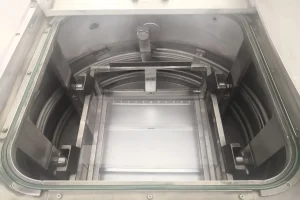 The rinse is the part most buyers compress. If the final rinse is not low-mineral water, the part will dry with water spots that become defects in the next operation. We specify ultrapure water at no more than 0.06 microsiemens per centimeter for pre-coating and precision lines because stray minerals are hidden residue. If your parts combine blind holes with chlorinated extreme-pressure coolant, the wash chemistry and drying sequence are worth confirming before you finalize the line. We can check the process against your part drawing and coolant SDS at [email protected].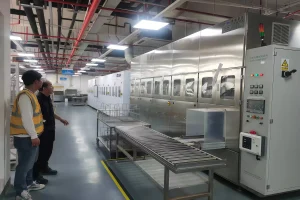
 English
  German
  Spanish
  French
  Russian
  Portuguese