Ultrasonic vibration plates convert generator output into mechanical vibration at the tank wall, and that vibration is the direct driver of cavitation intensity in an industrial cleaning system. I specify these plates by frequency, radiating area, mounting method, plate material, and the load the generator sees, not by wattage alone. The wrong plate choice produces uneven cleaning, detaches from the tank after repeated thermal cycling, or burns transducers. This article covers how vibration plates work, the specifications that matter, placement rules, media and material matching, power selection, and the checks to make before ordering.
How Do Ultrasonic Vibration Plates Generate Cleaning Action?
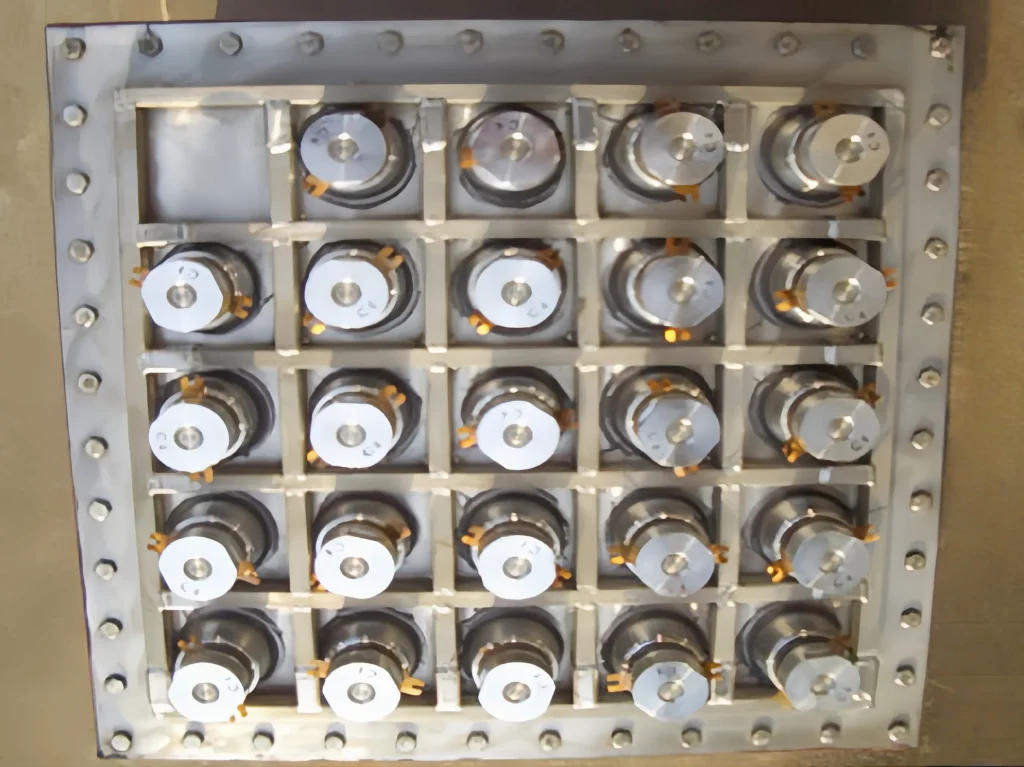
An ultrasonic vibration plate is a stainless steel panel with piezoelectric ceramic transducers bonded to the side away from the liquid. The generator drives those ceramics at their resonant frequency. The ceramics expand and contract, the plate flexes slightly, and the wetted side transmits pressure waves into the cleaning liquid. When the liquid cannot follow the oscillation, it forms microscopic voids that collapse violently. That collapse, not the vibration itself, removes oils, chips, polishing compound, and fine particles from part surfaces and blind holes. The plate frequency changes bubble size and energy release. Lower frequencies create larger, more aggressive bubbles. Higher frequencies create smaller bubbles that reach tighter clearances with less impact. On deep blind-hole parts, a 28 kHz plate removes cutting oil from threads more reliably than spray alone, but only when the plate coverage and power density are correct.
Cavitation intensity starts with the piezoelectric behavior of the ceramic. <What Is The Piezoelectric Effect?> covers how the reverse piezoelectric effect converts electrical drive into mechanical expansion at ultrasonic frequency, which is the starting point for cavitation intensity.
Which Specifications Matter Most in Ultrasonic Vibration Plates?
Four parameters dominate vibration plate selection: frequency, radiating area, material grade, and power density. Frequency sets cleaning aggressiveness and reach. In general, 20 kHz works for heavy stamping residues and heavy structural parts. 28 kHz covers most machining oil and chip removal, including threads and blind holes. 40 kHz suits precision parts and fine particle removal. 80 kHz serves delicate surfaces where low surface damage matters more than high bulk cleaning force.
Frequency
Typical use
Geometry fit
Notes
20 kHz
Heavy oil, scale, stamping residues
Large, heavy-duty parts
Highest cavitation intensity; can erode soft surfaces
28 kHz
Cutting oils, chips, general machining
Blind holes, threads, medium parts
Balanced intensity and penetration
40 kHz
Fine particles, precision parts
Small parts, tight features
Gentler; good for polished or coated surfaces
80 kHz
Submicron particles, delicate surfaces
Optics, small electronics
Low damage risk; lower bulk cleaning force
Material selection follows the cleaning chemistry. SUS304 is the default for most aqueous and hydrocarbon systems. SUS316 offers better resistance to chlorides and corrosive alkaline or acid conditions. The plate sits in the liquid path, so a lower-cost material substitution can become a maintenance problem after repeated exposure to low pH rinses or high chloride concentrations.
How Should Vibration Plates Be Sized and Mounted in Cleaning Tanks?
Plate placement matters as much as plate quality. A vibration plate mounted only on the tank bottom works for flat parts and moderate loads. When parts are tall, shielded, or loaded in baskets, side mounted plates can reduce shadow zones and place cavitation closer to blind holes. The usual starting point is to cover roughly 60 to 80 percent of the active tank bottom or side area, then adjust power density to the part mass and contamination load. A plate that covers too little area cleans unevenly. A plate that covers too much area can overload the generator and reduce intensity. Mounting detail determines service life. Transducers must bond to the plate at the correct nodal positions, and the plate must attach to the tank without creating a rigid perimeter that fights thermal expansion. We have replaced systems where plates were perimeter welded with no allowance for expansion at 65°C operation. The plate cracked after about a year, and cavitation dropped before the crack became visible. The failure was not the transducer; it was the mounting detail.
What Media and Part Materials Work Best with Ultrasonic Vibration Plates?
Aqueous detergents handle oil and chips well and can run at 45 to 65°C. Hydrocarbon or modified alcohol solvents fit higher cleanliness requirements, but they place different demands on sealing and plate material. Chloride-bearing media push the plate toward SUS316. Acidic or alkaline chemistry also demands gasket and bond compatibility, because the plate is exposed to the bath just like the parts are. For aluminum parts, 28 kHz or 40 kHz operates well if the process time is controlled. Extended exposure at high power on sharp edges can produce cavitation erosion. For hardened steel, 20 kHz can be aggressive enough for stamping residues, while stainless and plated surfaces often respond better at 40 kHz because the smaller bubble size reduces surface marking.
If your program involves chlorinated solvents, high chloride baths, or continuous duty above 60°C, confirm plate grade and gasket sealing before finalizing the bill of materials. Send the cleaning chemistry and bath temperature to [email protected] and we will confirm the plate material and transducer sealing choice.
What Should You Confirm Before Ordering Ultrasonic Vibration Plates?
Most vibration plate inquiries start with a part number or a plate size, but the specification should start with the tank, the chemistry, and the generator. When a buyer sends only a plate drawing, we often find that the replacement plate matches the tank but not the generator frequency or output impedance. The result is a system that runs, but cleans unevenly and overheats transducers. To get a reliable plate layout, we need the tank internal dimensions, liquid volume, contamination type, part material, and a photo of the generator nameplate. Send those details, plus your required cleaning cycle time, to [email protected] or call +86 17768507147. We will return a plate layout, frequency recommendation, and power density calculation before you commit to procurement.
What Do Buyers Ask About Ultrasonic Vibration Plates?
Is higher ultrasonic power always the better choice for vibration plates?
A common assumption is that higher wattage always cleans faster. That is not true. If the plate area is too small, extra power produces localized cavitation, transducer heating, and poor cleaning outside the hot zone. More power is useful only when the plate area and frequency are already correct for the part geometry and dirt type. The priority is a matched combination of frequency, radiating area, and generator output.
Which frequency is the right starting point for machined parts?
For most machining shops, 28 kHz is the safest starting point. It balances oil removal, blind-hole penetration, and moderate cavitation intensity. If the parts have polished surfaces or tight tolerance bores, move to 40 kHz. If the parts carry heavy stamping residues, start at 20 kHz. The plate selection then follows from the tank dimensions and the required cycle time.
Should vibration plates be mounted on the bottom or the sides of a tank?
It depends on the tank geometry and part orientation. Bottom mounting works for flat parts and standard baskets. Side mounting benefits tall parts, stacked loads, or close stacking where a single bottom plate leaves shadow zones. In many multi tank lines, a combination of bottom and side plates is the most productive, but that requires more careful generator matching and more plate area control.
How do you replace failed vibration plates without repeating the same failure?




 English
  German
  Spanish
  French
  Russian
  Portuguese