Cleaning process validation for critical applications is not a paperwork exercise. I have watched lines pass a written protocol and then ship parts with residue trapped in blind holes because the fixture blocked cavitation. A validated process has to prove one thing: that a defined part, in a defined basket, through a defined cycle, meets the required cleanliness limit every time. That means specifying contaminant type, particle size, test method, and worst-case geometry before equipment selection. It also means treating the cleaning tank, filtration, rinsing, and drying stages as one controlled system rather than separate steps.
Defining the Cleanliness Specification First
Critical applications cover more than aerospace and medical devices. PVD coating lines, hydraulic systems, fuel injection components, precision bearings, and optical assemblies all qualify as critical when a residue-related failure stops the process. The specification has to name the contaminants that must be removed, the acceptance limit, and the method used to measure that limit. A generic requirement such as visually clean is not a validation target. Start with the worst-case contaminant. Cutting fluid and chips from machining behave differently in ultrasonic cleaning than stamping oil or lapping compound. A pre-coating line must also control rinse water quality because a thin mineral film can survive as a water spot and later lift under vacuum. Our pre-PVD systems use an ultrapure water rinse with conductivity held at 0.06 microsiemens per centimeter or lower, which prevents that failure mode before the part reaches coating. For aqueous systems, the detergent and rinse stages are part of the specification, not an afterthought.
For aqueous lines, defining the cleaning specification has to include rinse water quality. <Aqueous Parts Cleaning: A Manufacturer’s Technical Guide> covers how detergent selection and rinse stages affect final residue levels, which is where many validation plans fail before a single part is counted.
One of the most common validation failures is writing a particle limit but not defining how particles will be extracted from blind holes. If the test method cannot extract and count what is trapped in the recess, the acceptance result means nothing.
Accounting for Blind Holes and Fixture Design
The difference between a coupon passing validation and a production part failing often comes down to how the part sits in the basket. Ultrasonic energy travels through liquid, but a dense basket or a part orientation that traps air creates shadowed zones where cavitation is weak. A blind hole facing down may not release the air pocket. A cross-drilled passage may collect debris from the same bath it was cleaning in. Validation has to be performed with the worst-case orientation and a full production load, not a single part placed in the best position. If the production basket is loaded densely, the validation basket must be loaded densely. If the part rotates in production, the validation cycle must rotate it. I have seen a process pass with a polished sample placed face up near the transducers and then fail on the real batch because every part sat flat in a stack. The table below shows the failure modes we look for first when a critical cleaning process goes out of control.
Validation failure
Typical root cause
Equipment design response
Blind hole residue
Dense basket shields cavitation
Rotary basket with 360 degree part movement
Rinse water spots
Final rinse conductivity too high
Ultrapure water system at 0.06 microsiemens per centimeter or lower
Solvent heating controlled at 40 to 60 degrees Celsius
Basket design is therefore part of process validation. Circular baskets that rotate parts with blind holes expose recesses to cavitation from multiple directions. Sheet-like baskets protect flat surfaces from contact marks. The choice changes the validated state, so a validation run is only meaningful if it documents the exact basket, load pattern, and orientation.
Locking Process Parameters Before Validation
Once the worst-case part and fixture are fixed, lock the parameters that directly control cleaning energy and chemistry. The major ones are frequency, power density, temperature, detergent concentration, rinse conductivity, cycle time, and drying method. Validation is not a search for the settings that finally produce a clean part. It is a demonstration that the chosen settings remain inside the control window. Ultrasonic frequency is the first variable to fix. Lower frequencies such as 20 kHz or 28 kHz create stronger cavitation for heavy oil and stamping residue. Higher frequencies such as 40 kHz or 80 kHz create smaller, gentler bubble collapse for polished surfaces, optics, and parts with delicate edges. A cleaning line that validates at 40 kHz cannot automatically claim the same result at 28 kHz.
Frequency selection changes cavitation intensity and must be fixed before validation. <How to Select the Frequency for Ultrasonic Cleaning Equipment ?> covers the trade-off between 20 kHz, 40 kHz, and 80 kHz for different part materials and contaminant types, and why validating at one frequency does not transfer to another.
Temperature and chemistry have similar locked boundaries. Our multi-tank solvent systems hold hydrocarbon solvent at 40 to 60 degrees Celsius for stamping oil solubility. Aqueous systems may run at 45 to 65 degrees Celsius and rinse at 30 to 40 degrees Celsius. If the operator can change temperature or skip a rinse without an alarm, the process is not validated; it is merely repeatable by habit. PLC control matters here because it is what prevents drift. A Siemens or Mitsubishi PLC with a stored recipe, automatic alarm, and fault diagnostics keeps the cycle from drifting outside the validation window. Manual pushbutton systems can clean well, but the process evidence is harder to defend.
Choosing Validation Methods That Match the Part
Different failure modes require different proof. A particle counter may show low total counts while a residual oil film still causes coating delamination. A water break test may look clean but cannot detect submicron particles inside a thread root. The validation method must match the failure mode the application cannot tolerate. For machined hydraulic components, gravimetric extraction and particle counting against ISO 16232 or VDA 19 are a useful acceptance path. For pre-coating applications, surface energy testing, black light inspection, or a cleanroom wipe test adds information that particle counting alone misses. For medical or optical parts, the final rinse may need to be tested for conductivity, total organic carbon, or biological load depending on the program. The key is to validate the process at the point of worst-case exposure.
Validation depends on cavitation reaching the target surface. <What Is Ultrasonic Cavitation Effect?> explains how cavitation bubbles form and collapse, and why zones with trapped air or shadowed geometry receive far less mechanical cleaning energy than open surfaces. If a validation sample is placed in a fully exposed position, it may overstate the process capability for production parts.
If the cavitation field does not reach the recess, no amount of test sophistication will make the part clean. Put the measurement where the failure occurs: extract from the blind hole, inspect the thread root, and test the surface that will be coated or bonded. If your program involves blind holes, mixed alloys, or a pre-coating step, confirm worst-case geometry consistency before finalizing the equipment specification. Send your part drawing and target cleanliness standard to [email protected] and our engineering team will compare it with the basket and rinse design before quoting.
Building a System That Stays Validated
Validation also depends on the system maintaining the same condition between qualification runs. Filtration and circulation are the two elements that keep a process stable. A tank that filters out oil and chips preserves cleaning chemistry longer. An overflow rinse that removes dragged-out detergent prevents the next stage from becoming a contamination source. A multi-tank line separates rough cleaning, precision cleaning, fresh rinse, and drying into distinct stages. This matters because cross contamination is one of the main reasons a validated process slowly drifts out of tolerance. The part leaves the first tank clean, then picks up residue from a rinse tank that has not been changed or filtered. We design rotary basket systems and multi-tank lines so the basket moves through each stage without requiring the operator to touch the part or change parameters. The same control logic applies to inline and conveyor systems. An inline washer with an oil-water separator can hold surface oil removal above 98 percent and keep separated oil at under 2 percent water content. That figure is taken from our fastener tunnel cleaner specification, and it matters because the separator is what keeps oil from returning to the final rinse. PLC recipe control and remote upgrades also matter after installation. If a process engineer changes a timer or temperature setpoint, the change should be recorded and repeatable. A system with barcode-based recipe switching can pull the correct cycle for each part family, which reduces the chance that a process validated for one part runs on another.
Asking Suppliers the Right Questions Before You Commit
Before you sign off on a critical cleaning line, ask the supplier to prove that the system can hold the validation parameters on your part, not on a standard demo part. The most useful questions are:
Have you run a trial with our worst-case geometry and full basket load?
Will the PLC store recipes and alarm if temperature, conductivity, or cycle time drifts?
What final rinse water quality can you guarantee at the production tank, not at the inlet?
Do you offer a pre-shipment Factory Acceptance Test with our actual parts?
If the supplier cannot answer the first question with a specific test plan, the validation burden falls entirely on your team after installation. The best way to reduce that risk is to make the supplier's engineering team prove the basket, ultrasonic field, rinse path, and drying method before the line ships. We take a different path. Our process is to review your part drawing, contamination source, and cleanliness limit, then define the worst-case orientation and test method before we quote. If you are validating a new process now, send your part number, production volume, and target standard to [email protected] or call +86 17768507147. We will confirm which cleaning stages, fixture design, and acceptance data match your requirement.
Common Questions About Cleaning Process Validation
What is the difference between cleaning validation and routine cleanliness testing?
Validation is the controlled demonstration that a specific part, basket, cycle, and chemical set stays below the acceptance limit across multiple runs. Routine cleanliness testing checks the sample you happened to pull. Validation should use worst-case geometry, full loads, and deliberate cycle parameters; routine testing often uses the easiest available part. If a line only relies on routine testing, it can pass samples while production parts fail because the test never challenged the blind hole or the thread root. For critical applications, validation establishes the control window, and routine testing monitors it.
How many parts should we run during process validation?
It depends on how much contamination risk exists and how variable the part geometry is. For a single part number with one material and one fixture, three consecutive production loads may be enough to show cycle stability. For mixed part families, multiple materials, or complex blind holes, run enough loads to include worst-case loading density, the most difficult part orientation, and both fresh and aged chemistry. The number is less important than whether the set includes the conditions most likely to fail. A smaller run that tests worst-case geometry is more meaningful than a larger run that tests the easiest parts.
Can manual cleaning be validated?
The common assumption that manual cleaning cannot be validated is wrong, but the process limits are wider. Manual ultrasonic cleaning can be validated when the operator follows a controlled time, temperature, and rinse procedure and the part is placed in a defined fixture. The risk is operator drift, a changed load pattern, or skipped rinse water replacement. In a critical application, manual cleaning may be acceptable for low volume or rework, yet it is harder to defend in an audit. Automated systems with PLC recipes and fixed basket motion produce a tighter control window and stronger validation evidence.
What documentation do auditors expect?
The question is less about how many pages and more about whether the records tie to production conditions. Auditors look for evidence that the actual line, not a laboratory setup, produced the acceptance data. That means part identification, contaminant type, acceptance limit, test method, basket orientation, load weight, cycle parameters, water quality readings, and the qualified operator or recipe number. A one page summary is not enough. The documentation should show repeat runs, worst-case samples, and corrective action for any out-of-spec result. If you need a documentation checklist before your next supplier visit, send your part drawing and required standard to [email protected] and we will confirm which compliance records fit your process. If you're interested, check out these related articles: How to Integrate Automated Cleaning into Production LinesSemi-Automated Ultrasonic Washers: Cost vs Performance AnalysisImplement Solvent Recovery Systems: A Factory Efficiency Guide
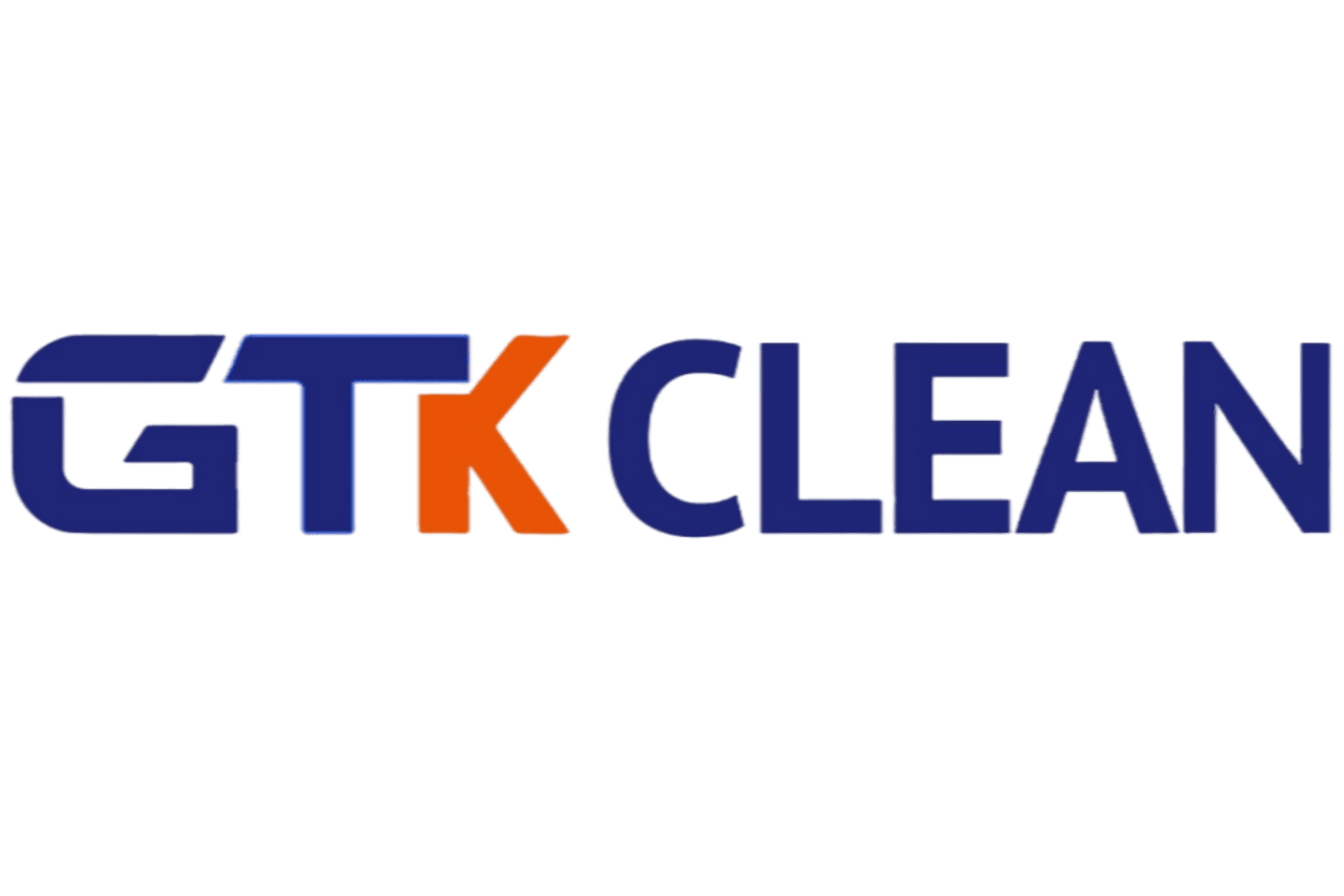


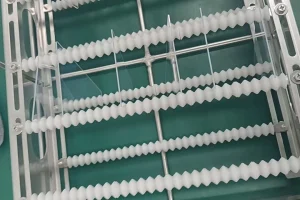 Basket design is therefore part of process validation. Circular baskets that rotate parts with blind holes expose recesses to cavitation from multiple directions. Sheet-like baskets protect flat surfaces from contact marks. The choice changes the validated state, so a validation run is only meaningful if it documents the exact basket, load pattern, and orientation.
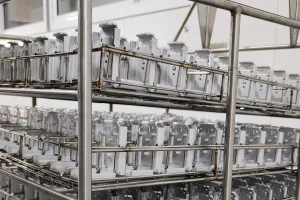 A multi-tank line separates rough cleaning, precision cleaning, fresh rinse, and drying into distinct stages. This matters because cross contamination is one of the main reasons a validated process slowly drifts out of tolerance. The part leaves the first tank clean, then picks up residue from a rinse tank that has not been changed or filtered. We design rotary basket systems and multi-tank lines so the basket moves through each stage without requiring the operator to touch the part or change parameters.
 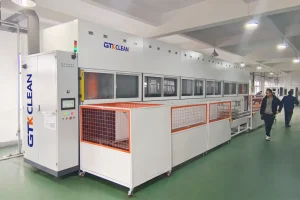 The same control logic applies to inline and conveyor systems. An inline washer with an oil-water separator can hold surface oil removal above 98 percent and keep separated oil at under 2 percent water content. That figure is taken from our fastener tunnel cleaner specification, and it matters because the separator is what keeps oil from returning to the final rinse. PLC recipe control and remote upgrades also matter after installation. If a process engineer changes a timer or temperature setpoint, the change should be recorded and repeatable. A system with barcode-based recipe switching can pull the correct cycle for each part family, which reduces the chance that a process validated for one part runs on another.
 English
  German
  Spanish
  French
  Russian
  Portuguese