Conveyor ultrasonic cleaning systems only deliver consistent output when the part, basket, and drying stage are specified together. Buyers usually start with tank width and ultrasonic power, but continuous production lines fail more often at transfer timing, rinsing, and moisture carryover than at the cleaning stage. This article explains the specification sequence I use in our projects: first fix part orientation and throughput, then match ultrasonic frequency to contamination, then size filtration and drying so the line does not slow down after the first shift. The goal is not marginally cleaner parts; it is stable cycle time and predictable cost per thousand parts.
What Makes a Conveyor Ultrasonic Cleaning System Fit a Continuous Line?
Continuous production does not simply mean a conveyor instead of a basket transfer. It means the cleaning machine must accept parts at the line's rate, hold them long enough in the active ultrasonic zone, and release them dry enough for the next process. In my reviews, the first failure point is upstream: the conveyor was sized for tank volume, but not for the dwell time created by the part's contamination and orientation. For a pass-through system, the available ultrasonic contact time is active tank length divided by conveyor speed. A 2 m active immersion zone traveling at 0.5 m/min gives only 4 minutes of cavitation. If the part needs 5 minutes to meet a particle count, the line either slows down or runs out of room. That tradeoff has to be fixed before the frame is welded. A conveyor ultrasonic cleaner typically follows the same sequence: spray pre-wash, ultrasonic immersion, rinse, air knife, hot air or vacuum drying. The key is not adding tanks; it is removing the contamination from the fluid before the next basket arrives. [caption id="attachment_400" align="alignnone" width="300"] Conveyor Metal Plate Spray Cleaners[/caption]
Continuous line design is often sold as a question of conveyor width and tank length. <Conveyor Ultrasonic Washers for Heavy Industrial Parts> covers how load-bearing conveyors and reinforced tanks handle components that would otherwise require a separate lifting fixture between stages.
Blind holes and recesses will not clean reliably in a static conveyor orientation. If the part travels in one position, the same bubble pattern repeats and the blind cavity keeps its air pocket. For these geometries we rotate the basket or use a spray path that forces fluid into the cavity before immersion.
How Do Power and Frequency Change Cleaning Results?
Ultrasonic power drives cavitation; frequency controls bubble size and where the cleaning happens. Lower frequencies create larger, more energetic cavitation bubbles suitable for heavy oil and chips on steel. Higher frequencies create smaller bubbles that reach tighter clearances but remove less mass per cycle. Neither setting is correct by itself.
Frequency
Cavitation behavior
Typical target
Main limitation
20 kHz
Large bubbles, higher energy
Castings, forgings, burnished steel
Risk of surface erosion on soft or polished metals
28 kHz
Strong cleaning with moderate impact
Stamping oil, fasteners, bearing parts
Less reach into submillimeter gaps than 40 kHz
40 kHz
Smaller bubbles, finer distribution
CNC machined parts, aluminum, precision hardware
Lower mass removal per cycle
80 kHz
Very small bubbles, gentle action
Optics, polished components, thin-wall parts
Narrow cleaning depth, must work with clean rinse water
[caption id="attachment_425" align="alignnone" width="300"] fastener[/caption] Generator matching is as important as the transducer plate. If the generator cannot stay on resonance when the load changes, cleaning drops even though the display shows normal power. Our builds use 20, 28, 40, and 80 kHz modules depending on the tank, but we rarely run a single frequency across all stages. If the part family includes blind holes below 3 mm mixed with polished aluminum, the frequency split is not something to take from a catalog. It is worth confirming transducer placement and power density before the conveyor pitch is fixed. I would rather review those two points with a drawing than have the line limited to one cleaning recipe later. Email [email protected].
Why Do Rinsing, Filtration, and Drying Decide Uptime?
Most continuous line stops are not caused by the ultrasonic tank. They show up as water spots, residue, or parts arriving at assembly still wet. The cause is usually fluid management: soil removed from parts stays in the bath and then deposits again during rinsing. Filtration is the only way to keep an ultrasonic bath from becoming a recirculating soil tank. We put circulation filtration on every line; the goal is to keep cleaning solution from carrying the same particulate into the rinse. In our pre-coating systems, the ultrapure water circuit is specified at 0.06 μS/cm or lower to prevent water spots. Oil-water separation matters when stamping oil or forming fluid is the main contaminant. Our fastener tunnel line uses a separator that removes more than 98% of surface oil, with under 2% water content in the recovered oil. That recovers process quality, not just fluid. Air knives work only if the part has a clean surface and no trapped pocket. Deep holes may need vacuum drying or a solvent stage. If the part exits the air knife with moisture in a blind hole, the line has not met its true cycle time.
The decision between water-based and solvent-based cleaning should be made at the rinsing and drying stage, not at the ultrasonic tank alone. <How to Choose Between Aqueous and Solvent Cleaning Systems> covers where multi-stage water rinsing works and where solvent drying removes a residual moisture risk that air knives cannot.
When Do Conveyor Ultrasonic Cleaning Systems Need Solvent or Vacuum Stages?
Water-based conveyor ultrasonic cleaning is the default for many metal parts because it is easier to rinse and has lower fire risk. But there are three conditions that push us toward solvent or vacuum stages: blind holes that trap water, oil-heavy stampings that emulsify poorly, and parts that must be dry in seconds before coating or assembly. In a vacuum drying stage, the chamber pressure drops so residual solvent boils off below the part's thermal limit. This is why solvent systems can achieve dry parts in a fraction of the air knife time for complex geometries. Solvent systems are not a simple upgrade. Once you choose a hydrocarbon or modified alcohol stage, you also need vapor containment, gas monitoring, distillation recovery, and probably a lower operating temperature limit. That changes the conveyor enclosure and the exhaust layout.
If the parts require high precision and oil-heavy blind holes, solvent recovery changes the total cost calculation. <Mastering Hydrocarbon Solvent Cleaning Systems for Industrial Precision> covers distillation-based recovery, vapor containment, and why sealed solvent consumption can remain below 200 L/month on a correctly specified system.
For continuous lines, the same principles apply but must be embedded into the conveyor. Solvent vapor is heavier than air, so extraction points belong below the part path. Recovery must be automatic because a line does not stop for manual distillation. The PLC interlock should tie heating and ventilation together so a fault cannot leave the solvent stage running without extraction.
Do You Need a Line Specific Quote Without the Guesswork?
Most conveyor ultrasonic cleaning proposals are built from the wrong starting point: tank dimensions and generator power. The line-level questions are more specific: how many parts per hour, what is the allowed reject level, and which stage is currently creating the bottleneck. If those are not on the table, the quote is likely to fit a catalog, not a production line. GTKCLEAN reviews the part drawing, throughput target, and current cleanliness failure before proposing a layout. Send the part number, daily volume, and a photo of the defect or wet part to [email protected]. If the line has already been quoted by another supplier, include the stage sequence. I will confirm whether the transfer and drying assumptions match the line speed. Phone +86 17768507147.
What Do Buyers Ask About Conveyor Ultrasonic Cleaning Systems?
Can the same conveyor system run different part families?
Yes, but only when the basket and fixture strategy is designed for the full range. A conveyor pitch set for one large housing may leave small parts bouncing or shielded. We normally specify interchangeable fixtures, a variable conveyor speed range, and PLC recipes tied to basket codes. The ultrasonic frequency should be chosen for the most difficult surface and the chemistry set for the main contaminant. The rinse and drying stages need enough range to cover the part that carries the most water. Without those three variables, a mixed line tends to pass one family and fail the next.
Is ultrasonic cleaning alone enough for heavy chips?
Many plants expect the ultrasonic stage to carry chips out of deep holes. Cavitation loosens and lifts small particles, but it is not a chip evacuation pump. On rough-machined parts, the line still needs a high-pressure spray or flood stage before immersion, and a rinse path that leaves the cavity. We design the pre-wash to remove the mass, then use ultrasonic cleaning for the film and fine particulate. If the chip load is high and the part geometry is tight, we add a deburring or spray stage before the conveyor enters the ultrasonic tank.
How long should the ultrasonic stage be?
It depends on the contaminant and the part geometry. Light machining oil on a flat part may clean in 2 to 3 minutes of active immersion. Stamping compound inside a blind hole may need 5 to 8 minutes plus a second rinse. The better question is how much active ultrasonic contact the conveyor actually provides. Conveyor speed and tank length set that number, and recirculation does not create the same cavitation exposure. We calculate backward from the worst part in the mix, then confirm whether the line still hits the required parts per hour. If it cannot, the answer is usually a longer active tank or a different part orientation, not more transducer power.
What maintenance keeps a conveyor line from losing cycle time?
In lines we support, most cycle-time drift comes from plugged filters, dirty rinse tanks, and worn air knife slots, not transducer failure. Transducers usually hold unless the tank has run hot without liquid or the generator is matched poorly. Weekly filter checks and daily rinse tank conductivity checks catch the problems that quietly lengthen drying time. Basket and chain wear also deserve a monthly check because a slight fixture shift can change part orientation and reduce coverage. If your current line runs hot or must cover more part families, share a 24-hour production profile and your cleanliness target. We will confirm whether a conveyor ultrasonic system can hold both. Email [email protected] or call +86 17768507147. If you're interested, check out these related articles: Industrial Cleaning System ROI: Calculating Your Investment ReturnManual Ultrasonic Cleaning Machines: When to Use ThemUltrasonic Cleaning Energy Costs Minimizing StrategiesWhat Is Ultrasonic Cavitation Effect?


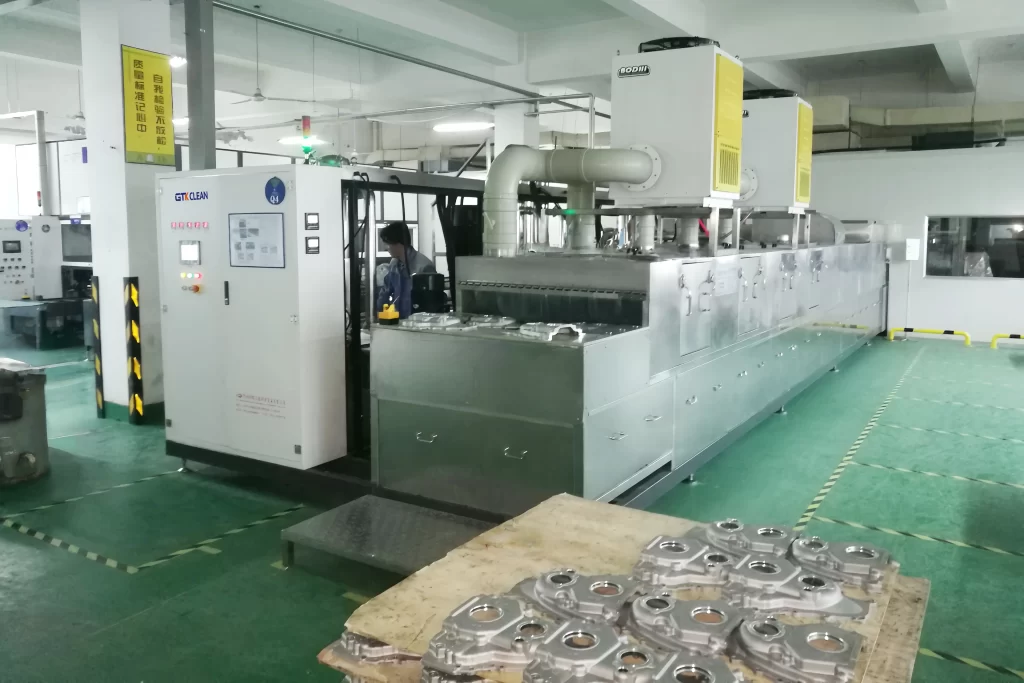
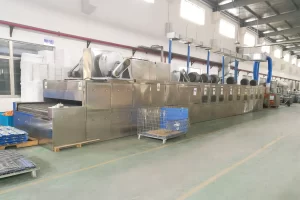 Conveyor Metal Plate Spray Cleaners[/caption]
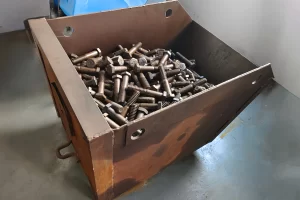 fastener[/caption] Generator matching is as important as the transducer plate. If the generator cannot stay on resonance when the load changes, cleaning drops even though the display shows normal power. Our builds use 20, 28, 40, and 80 kHz modules depending on the tank, but we rarely run a single frequency across all stages. If the part family includes blind holes below 3 mm mixed with polished aluminum, the frequency split is not something to take from a catalog. It is worth confirming transducer placement and power density before the conveyor pitch is fixed. I would rather review those two points with a drawing than have the line limited to one cleaning recipe later. Email [email protected].
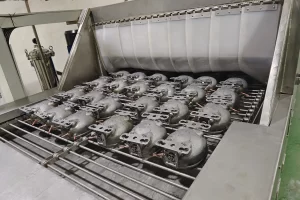 Air knives work only if the part has a clean surface and no trapped pocket. Deep holes may need vacuum drying or a solvent stage. If the part exits the air knife with moisture in a blind hole, the line has not met its true cycle time.
 English
  German
  Spanish
  French
  Russian
  Portuguese