Ultrasonic cleaning systems are built around cavitation, but the configuration only delivers when it matches the part geometry, the contaminant, and the hourly throughput. I have seen lines struggle not because the ultrasonic power was too low, but because the basket orientation was wrong, the rinse conductivity was uncontrolled, or the drying stage left water in blind holes. This article separates the common system types by production logic, shows where ultrasonic cleaning earns its cost, and names the benefits and limitations that hold up on a factory floor rather than in a brochure.
How Do Ultrasonic Cleaning Systems Remove Contaminants?
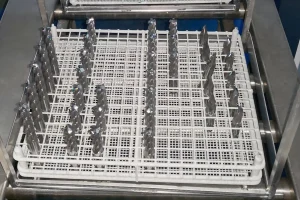
An industrial ultrasonic cleaning system converts electrical energy into mechanical vibration through transducers mounted on a stainless steel tank. The generator drives those transducers at a set frequency, usually between 20 kHz and 80 kHz for industrial work. At 20 kHz to 28 kHz, the cavitation bubbles are larger and more energetic, which suits removing stamping oil, chips, and polishing compound from machined or formed metal. At 40 kHz and above, the bubbles are smaller and less aggressive, which fits precision parts, electronics, and components with fine threads or polished surfaces. Cleaning happens when those bubbles collapse against the part surface. The collapse releases a high-speed jet that dislodges oil, particles, and films from the surface and from accessible blind holes. The effect is not a soak. If the watt density is too low or the parts basket is packed too tightly, the cavitation field cannot reach internal cavities. That is why a rotary basket often outperforms a static tray on the same tank: the rotation changes which surfaces face the transducer field during the cycle. The cleaning liquid is not the main mechanical force; it carries away the removed soil and prevents redeposition. Filtration and overflow are the two controls that keep the fluid working. Without circulation, the first load cleans, and every following load is bathed in the same dirty liquid. We specify filtration and surface skimming as part of the system, not as an accessory.
What Types of Ultrasonic Cleaning Systems Fit Different Production Volumes?
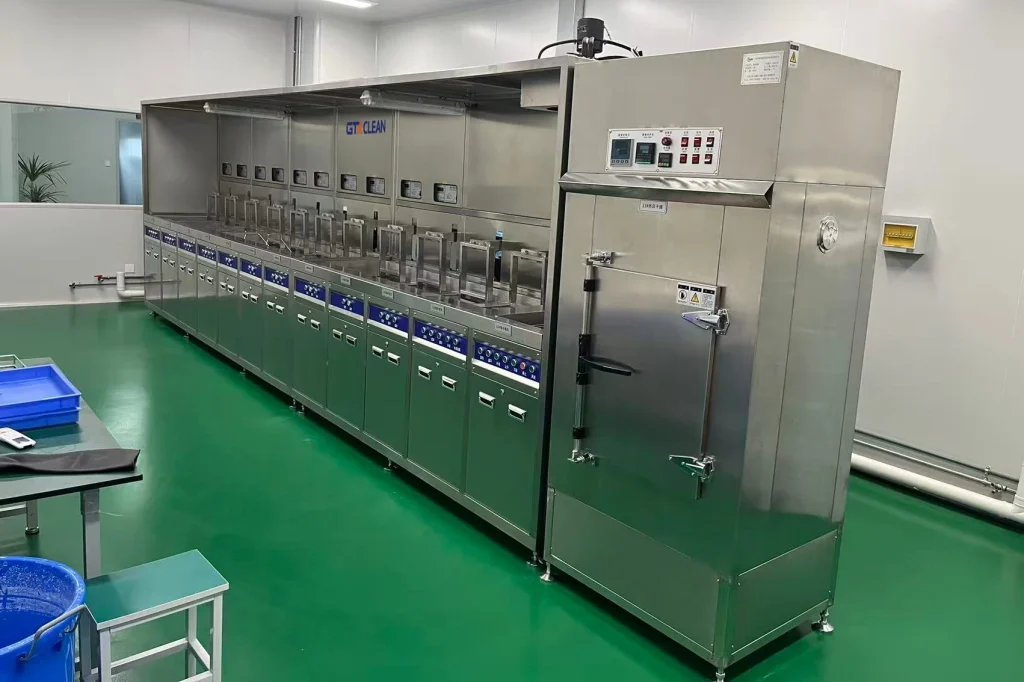
Ultrasonic cleaning systems divide by material handling rather than by cleaning theory. A benchtop cleaner, a multi tank line, and an inline tunnel all use the same cavitation mechanism. The difference is how parts enter, move, rinse, and dry, and that difference decides whether the system can hold production rhythm.
System type
Best fit
Typical load or capacity
Throughput logic
Benchtop ultrasonic cleaner
Small batches, toolroom, rework
30 to 187 L, 750 to 2400 W
Manual load and unload
Multi tank ultrasonic cleaner
Medium volume, multi-step rinsing
Manual basket transfer
Parallel tank cycles
Rotary basket ultrasonic system
Complex parts, blind holes
Up to 2000 kg per basket
Automatic rotation by stage
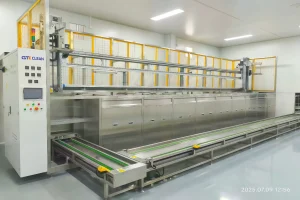
Inline tunnel ultrasonic system
High volume, continuous line integration
Conveyor speed 0.5 to 1 m per min
Single pass flow
Single station solvent vacuum cleaner
Precision parts, solvent containment
200 kg or less per batch
Closed loop batch
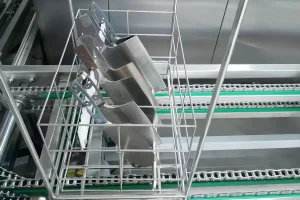
Multi tank configurations remain the workhorse when a part needs ultrasonic degreasing followed by a clean rinse. The basket moves from tank to tank, so the part does not wait for one tank to be emptied and refilled. That becomes important when rinse water contamination controls final cleanliness, as in coating or assembly lines.
Rotary basket systems address the failure I see most often in high-value parts: a clean-looking surface with contaminated blind holes. When the basket rotates, part orientation changes continuously, trapped air releases, and cavitation reaches recessed areas. For gearboxes, housing castings, and molds, load capacity is as important as ultrasonic power because a 2000 kg basket demands reinforced motors and tank structure. Manual systems still fit short runs and maintenance bays, but operator discipline becomes their weakest point. The same geometry that needs careful fixturing also has the highest risk of inconsistent loading.
Which Applications Benefit Most from Ultrasonic Cleaning Systems?
Ultrasonic cleaning earns its place where a residue failure is expensive. Pre-coating and pre-assembly lines are the clearest examples. PVD and CVD coatings expose contamination that standard final inspection does not see. A fingerprint or a water spot can become an adhesion failure after coating. For those lines, we run multistage cleaning with ultrapure water rinsing at conductivity of 0.06 μS/cm or lower, so drying does not create spots. CNC machined parts carry cutting fluid, chips, and burr fragments. Ultrasonic degreasing followed by RO water and DI water rinsing removes those soils from threads and cross-drilled holes better than spray alone. The gain is not only cleaner parts. It is a stable process before heat treating, coating, or assembly. Stamped parts present a similar case. Drawing oil sits inside deep forms and under folded edges. A rough ultrasonic stage followed by fine cleaning and pure water rinse fits high-volume stamping lines in automotive and appliance work. Medical devices and electronic components need a different frequency range. Delicate parts and polished surfaces call for 40 kHz or higher so cavitation does not erode fine features. Aerospace and precision metal components use ultrasonic cleaning before inspection to remove machining residue from cavities that manual cleaning cannot reach.
What Benefits Justify Investment in Ultrasonic Cleaning Systems?
On production lines, three benefits appear repeatedly: lower direct labor, more consistent part quality, and lower fluid consumption per thousand parts. The first is straightforward arithmetic. A multi tank automatic system can clean, rinse, and dry without an operator transferring baskets between stations. The second benefit is harder to quantify but often worth more. Manual cleaning changes with operator, shift, and fatigue; an automated system locks the recipe, temperature, and cycle time. The third benefit depends on filtration and solvent recovery. On hydrocarbon systems, distillation recovery can cut solvent consumption below 200 L per month on a single-shift line in some designs. That changes the operating cost compared with open-top manual degreasing. Water-based systems with circulation filtration extend solution life, but they still need rinse water management. A buyer who compares only machine price will miss the cost of rinse water treatment, exhaust, and solvent loss. If your program combines high volume with blind-hole parts and solvent-based degreasing, it is worth confirming the basket rotation, vacuum drying, and distillation recovery before finalizing the BOM. Send the part drawing and target cycle time to [email protected] and I will confirm whether the proposed system reaches the recessed surfaces you need.
How Do You Choose the Right Ultrasonic Cleaning System?
Start with four inputs: part material, part geometry, contaminant, and hourly throughput. The material decides chemistry. The geometry decides basket rotation or fixturing. The contaminant decides frequency and cleaning time. The throughput decides batch or inline architecture. Many selection errors begin with the machine catalog instead of these four facts. Then name the failure you cannot accept. If a blind hole must be particle-free, the system needs rotary basket or vacuum ultrasonic, not just a larger generator. If water spots are unacceptable, the rinse stage and drying method matter as much as the wash stage. If the line must feed an automatic conveyor, an inline system with a fixed transfer pitch is safer than a manual batch station placed at the end of the line. Selection reduces to proving that the system can carry the part, reach the critical surfaces, rinse without redeposition, and dry to the required condition. If you are comparing equipment for a new line, send the part drawing, the contamination, the hourly volume, and the final cleanliness specification. I will confirm the tank configuration, frequency, basket design, and drying method against your target before you commit. Contact [email protected] or +86 17768507147 with part drawings and quantities.
What Questions Do Buyers Ask About Ultrasonic Cleaning Systems?
What Frequency Works Best for Heavy Industrial Parts?
For heavy oil, chips, and stamping compound, 28 kHz is usually the better starting point. The larger cavitation bubbles release more energy at the part surface and remove heavy soil faster than 40 kHz. If the same part includes polished surfaces, fine threads, or sensitive edges, a two-stage approach works better: 28 kHz for rough cleaning, then 40 kHz for fine cleaning with a clean rinse. The frequency alone is not the full answer because watt density and tank geometry decide whether the cavitation field reaches the part. Choose the frequency based on the most sensitive surface on the part, not the easiest.
Will Ultrasonic Cleaning Damage Delicate Parts?
Damage is more often caused by part contact, wrong frequency, or loose nesting than by cavitation alone. A delicate part can be eroded if it sits against the tank face or another part at high power, or if 20 kHz is used on a thin cross-section. At 40 kHz and above, the risk drops but cleaning time may increase. The practical rule is to hold the part so it cannot strike anything, keep a liquid-compatible basket material between the part and the metal surface, and start at a lower power density on first-article parts.
How Long Should an Ultrasonic Cleaning Cycle Last?
Cycle time depends on the soil load, the cleaning temperature, and the required particle size. A light machining oil on a small part can clean in two to four minutes in a heated bath. A blind-hole part with baked-on compound may need eight to twelve minutes plus a second rinse station. Time is not the only variable. Raising the bath temperature within the detergent range, improving basket rotation, or switching to a lower frequency can shorten the cycle without raising power. Start with the shortest cycle that passes your cleanliness test, then add a reasonable safety margin.
Why Do Water Spots Appear After Ultrasonic Cleaning?
In production lines I have worked on, water spots after ultrasonic cleaning usually trace back to rinse water conductivity or incomplete drying, not the ultrasonic stage. A rinse with ultrapure water at 0.06 μS/cm or lower removes the dissolved solids that stay behind when water evaporates. If parts have deep blind holes, vacuum drying is more reliable than hot air alone because residual water evaporates at lower pressure. Send the part drawing and the current spot location to [email protected], and I will confirm whether the rinse or the drying step is the limiting factor. If you're interested, check out these related articles: Ultrasonic Cleaning Process: A Step by Step Technical GuideAutomated Tunnel CleanerSemi-Automated Ultrasonic Cleaning for Medium-Volume Production


 The cleaning liquid is not the main mechanical force; it carries away the removed soil and prevents redeposition. Filtration and overflow are the two controls that keep the fluid working. Without circulation, the first load cleans, and every following load is bathed in the same dirty liquid. We specify filtration and surface skimming as part of the system, not as an accessory.
 Multi tank configurations remain the workhorse when a part needs ultrasonic degreasing followed by a clean rinse. The basket moves from tank to tank, so the part does not wait for one tank to be emptied and refilled. That becomes important when rinse water contamination controls final cleanliness, as in coating or assembly lines.
 Selection reduces to proving that the system can carry the part, reach the critical surfaces, rinse without redeposition, and dry to the required condition. If you are comparing equipment for a new line, send the part drawing, the contamination, the hourly volume, and the final cleanliness specification. I will confirm the tank configuration, frequency, basket design, and drying method against your target before you commit. Contact [email protected] or +86 17768507147 with part drawings and quantities.
 English
  German
  Spanish
  French
  Russian
  Portuguese